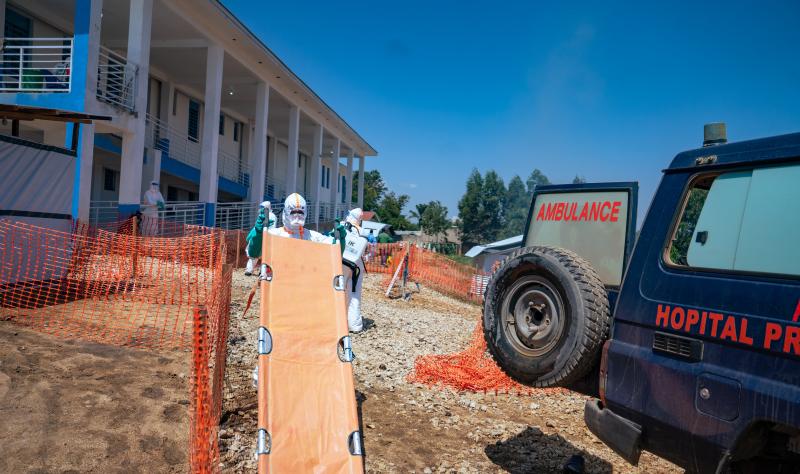
In response to the escalating Ebola outbreak in the Democratic Republic of the Congo (DRC), the World Health Organization (WHO) has initiated a groundbreaking clinical trial to evaluate two promising antiviral therapies. The first patient has now received treatment as part of this significant research effort.
This randomized platform trial aims to determine if the monoclonal antibody MBP134 and the antiviral drug remdesivir, administered individually or in combination, can improve survival rates for patients of all ages diagnosed with Bundibugyo virus disease. This specific strain of the virus is responsible for the current outbreak, and currently, there are no licensed treatments or vaccines available.
The trial, a collaborative undertaking involving the DRC’s National Institute for Biomedical Research, Oxford University, and the Institute of Tropical Medicine in Belgium, will establish four treatment arms. Participants will be assigned to receive either MBP134, remdesivir, a combination of both therapies, or standard supportive care. The trial is designed to incorporate additional treatments as they become available for evaluation.
MBP134 is a pan-Ebolavirus monoclonal antibody developed by Mapp Biopharmaceuticals. Remdesivir, a product of Gilead Sciences, is an antiviral agent widely recognized for its use in treating hospitalized COVID-19 patients. Both candidates were previously recommended for prioritization by the WHO Technical Advisory Group. However, their efficacy in treating Ebola has not yet been tested in human subjects.
Vasee Moorthy, MD, PhD, acting lead of the WHO’s R&D Blueprint group, noted at a press briefing that the trial is expected to be a lengthy process. "We shouldn’t expect that this is going to be over in weeks; it will take some months, it could go even into next year. It could be that we need a thousand patients enrolled in the trial until we get a definitive answer," Moorthy stated. He added that a quicker conclusion might be possible if the trial demonstrates very high efficacy.
WHO Director-General Tedros Adhanom Ghebreyesus, PhD, emphasized the organization’s commitment to ensuring access to these drugs for patients in the DRC, contingent upon their demonstrated safety and effectiveness in the trial. He also announced that the WHO has granted emergency use listing for the first molecular diagnostic test specifically for Bundibugyo virus.
Persistent Community Distrust Hinders Response Efforts
Dr. Tedros reported that the DRC has confirmed 1,406 cases, resulting in 438 deaths. Neighboring Uganda has recorded an additional 20 cases and two fatalities. While acknowledging progress in testing, contact tracing, and treatment capacity within the DRC, Dr. Tedros cautioned that the response continues to face substantial obstacles, including deep-seated mistrust and instances of violence.
"Just this week, an Ebola treatment center in Ituri province was attacked, resulting in the deaths of two people. The center was set on fire, and patients fled," he stated. "Such acts not only endanger patients and health workers but also impede efforts to stop transmission and save lives."
Chikwe Ihekweazu, MPH, executive director of the WHO Health Emergencies Programme, explained that the recent violence stemmed from local community resistance to health officials overseeing the burials of Ebola victims. Due to the virus’s high infectivity even after death, such burials require specialized handling by trained health workers in protective gear.
"Every time there’s an incident like this, it sets the whole response back," Ihekweazu commented, adding that WHO officials are actively engaging with community members to explain the necessity of these protocols to prevent virus spread.
Ihekweazu further highlighted that community mistrust is one of several factors complicating control efforts in the three provinces – Ituri, North Kivu, and South Kivu – which are at the epicenter of the outbreak. These regions have been severely impacted by food insecurity and ongoing conflict between the Congolese military and militia groups, leading to widespread internal displacement.
"The outbreak is happening in this context, and, unfortunately, the conflation between a very difficult humanitarian context and a very difficult infectious disease context is coming together to cause challenges in responding to this outbreak," he concluded.