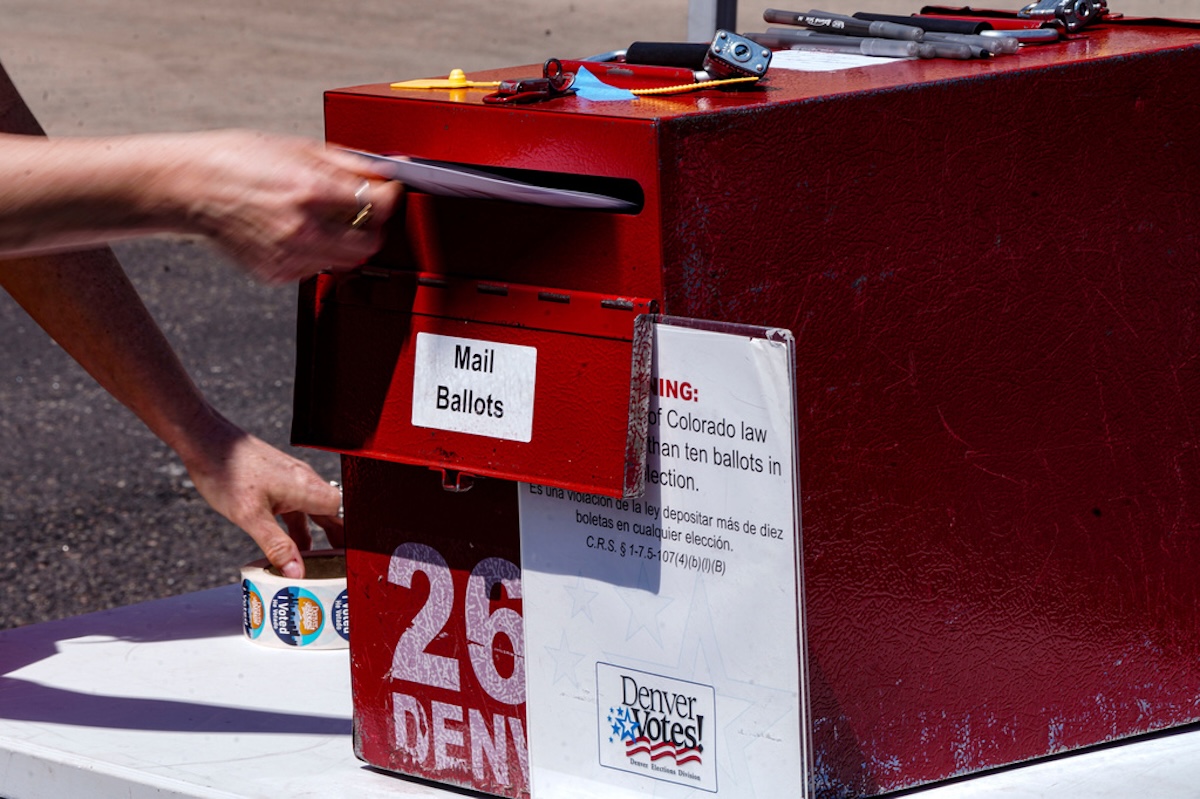
President Donald Trump and Homeland Security Secretary Markwayne Mullin recently highlighted concerns about noncitizens voting in U.S. elections. This follows Trump’s push for the SAVE America Act, which would mandate government-issued photo identification and proof of citizenship for voter registration. The legislation faces opposition in the Senate due to worries about voter disenfranchisement.
As the 2026 midterms approach, the Trump administration has been seeking voting data from states, though many have declined, and judicial challenges have blocked efforts to obtain this information.
In a release of documents accompanying Trump’s address, the Department of Homeland Security stated that “over 250,000 non-citizens are illegally registered to vote in just the four states” of California, Pennsylvania, New Jersey, and Nevada. Secretary Mullin repeated this figure in a press conference the following day.
However, voting experts urge caution regarding this number. Databases can contain errors, including mistaken identities and outdated citizenship information. Historically, initial estimates of noncitizen registrants have significantly decreased after thorough accuracy checks. Furthermore, the data provided by DHS does not indicate whether these registered noncitizens actually voted, let alone if their votes impacted election outcomes.
While allegations of noncitizen voting have been a recurring theme for Trump for over a decade, it is illegal for noncitizens to vote in federal elections. Violations are investigated and prosecuted, but evidence suggests that noncitizen voting has not been significant enough to alter election results, according to the Bipartisan Policy Center.
The Department of Homeland Security’s breakdown of the “potential” noncitizen registered voters in the four states is as follows: California (190,832), New Jersey (35,152), Nevada (15,903), and Pennsylvania (14,576). These numbers represent less than 1% of each state’s registered voters. The methodology used to arrive at the 250,000 figure has not been fully disclosed by DHS. Reports suggest the data comparisons were made using commercial data, which, according to elections expert David Becker, may lead to numerous false matches due to a lack of personally identifiable information for comparison with public voter files.
Several states have used the SAVE (Systematic Alien Verification for Entitlements) system to identify potential noncitizen voters. However, the four states highlighted by DHS reportedly had not used SAVE for this review. Officials from California, Nevada, and Pennsylvania have expressed skepticism about the accuracy of the 250,000 figure, emphasizing the rarity of noncitizen voting and requesting further evidence to support the claims.
Experts point to historical precedents where initial estimates of noncitizen registrants were greatly reduced after scrutiny. For instance, in Florida’s 2012 voter roll cleanup, an initial list of 180,000 potential noncitizens was narrowed down to a much smaller number after extensive vetting, which even erroneously included a World War II veteran born in the U.S. Similarly, Texas has also encountered inaccuracies when reviewing voter rolls for noncitizens, with state officials raising concerns about the reliability of citizenship status data.
Regarding the question of whether these individuals actually voted, neither Secretary Mullin nor his department provided details on how many of the 250,000 potential noncitizens cast ballots. State reviews consistently show that only a small fraction of registered noncitizens actually vote. For example, Georgia reported around 139 noncitizen votes out of 32 million cast since 1992. Ohio referred 597 apparent noncitizen registered voters for prosecution, of whom 138 reportedly cast ballots. Iowa’s initial estimate of potential noncitizens registered to vote was revised downwards, with 35 individuals confirmed to have cast ballots in the 2024 general election.
Reference