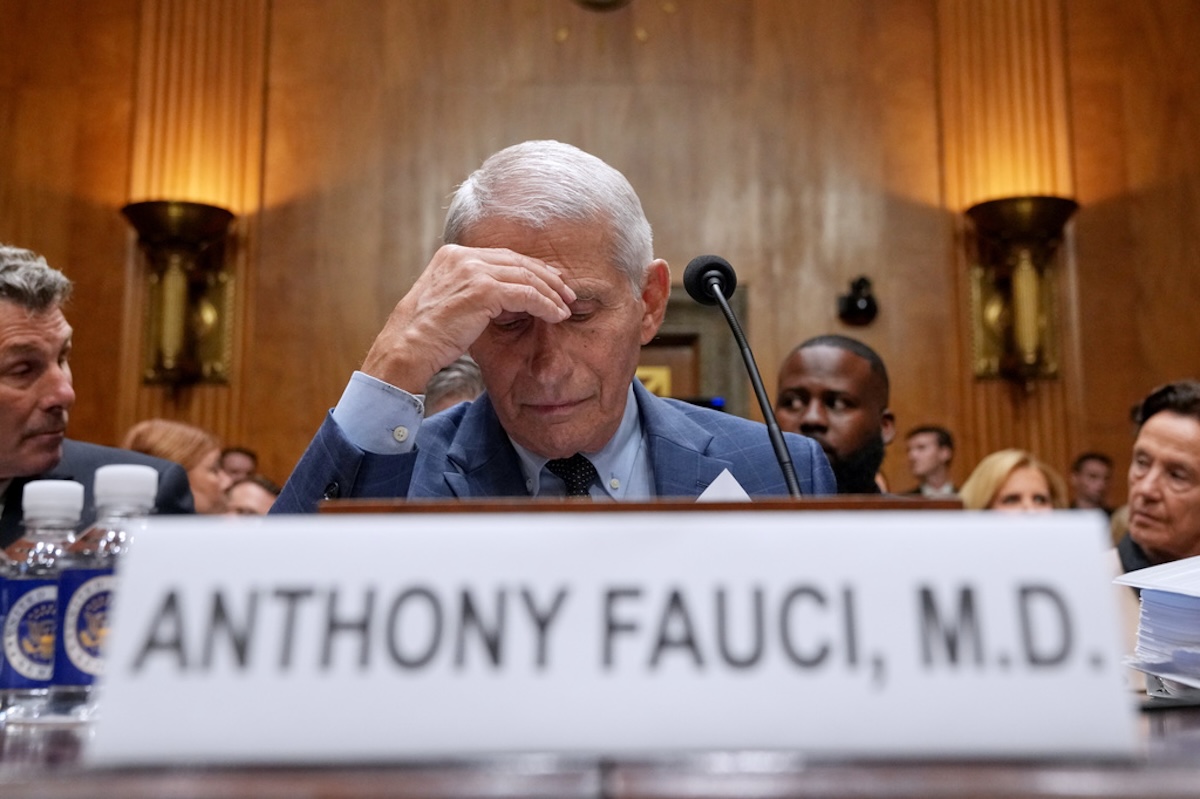
Dr. Anthony Fauci faced a challenging Senate Homeland Security Committee hearing concerning his leadership during the COVID-19 pandemic, which began in 2020. Throughout the three-hour session on July 29, Dr. Fauci repeatedly invoked his Fifth Amendment right against self-incrimination, stating, “On the advice of counsel, I respectfully decline to answer based upon my rights under the Fifth Amendment to the Constitution,” over 100 times.
In a prepared opening statement, Dr. Fauci explained his decision to invoke the Fifth Amendment, citing concerns that Committee Chairman Sen. Rand Paul, R-Ky., intended to manipulate his testimony for prosecutorial purposes. Sen. Paul reiterated his assertion that U.S. funding contributed to research in China that he claims led to the pandemic and that this information was subsequently concealed from Congress, a claim Dr. Fauci disputes.
“Frankly the American people deserve an apology,” Sen. Paul declared during the hearing.
Republican members of the committee highlighted perceived inconsistencies between Dr. Fauci’s public statements and his personal diary entries, which Sen. Paul had made public shortly before the hearing. This occurred amid ongoing scrutiny of various claims related to COVID-19, including the use of ivermectin and the nature of COVID-19 vaccines, which have been subject to fact-checking.
Dr. Fauci noted in his opening remarks that he had previously testified before Congress more than 200 times. However, he articulated that Sen. Paul’s “obsession with calling for my prosecution, his repeated slanderous comments about me, and recently his publicly releasing my unredacted personal diary aimed at embarrassing and intimidating me,” led him to believe the hearing’s sole purpose was to elicit statements that would support Sen. Paul’s public declarations of seeking Dr. Fauci’s imprisonment.
An attempt by Dr. Fauci’s lawyer, David Schertler, to address the committee was interrupted by Sen. Paul, who instructed security to remove him, stating he was not invited to testify. Following the hearing, Schertler issued a statement calling Sen. Paul’s accusations “false and disgraceful” and vowing to explore accountability measures.
President Joe Biden had previously issued a pardon to Dr. Fauci shortly before leaving office. Legal analysts suggest that while Republicans could pursue contempt charges, which Sen. Paul indicated he was considering, Dr. Fauci’s legal exposure would have been greater had he not invoked the Fifth Amendment.
Michael J. Gerhardt, a law professor at the University of North Carolina, commented that advising Dr. Fauci to invoke the Fifth Amendment was likely prudent, given Sen. Paul’s apparent objective of building a case for prosecution. Gerhardt also pointed out that invoking the Fifth Amendment in a civil proceeding, such as a congressional hearing, can lead to negative inferences drawn from the refusal to answer.
Conversely, Tracey Maclin, a law professor at the University of Florida specializing in the Fifth Amendment, suggested that the alternative to invoking the Fifth Amendment could have been worse, with a perjury trial being a more severe potential outcome.
Reasons Behind Invoking the Fifth Amendment
Many legal experts interpret President Biden’s pardon as applicable only to actions preceding its effective date of January 19, 2025. This interpretation means any statements or actions by Dr. Fauci after that date, including potential perjury during the July 29 hearing, might not be covered.
Frank O. Bowman III, an emeritus law professor at the University of Missouri, suggested that while in past environments he might have advised against invoking the Fifth Amendment, the current climate necessitates a different approach. He expressed certainty that Sen. Paul and like-minded Republicans would scrutinize any testimony for inaccuracies or inconsistencies to pursue prosecution. Bowman cited the referral of Jack Smith, the special prosecutor investigating Trump, as an example of such actions. He also noted that a Justice Department handling such referrals might be inclined to pursue charges against political opponents, referencing figures like James Comey and Jerome Powell.
While President Biden’s pardon covers federal offenses, the possibility of state-level prosecution, though less likely, remains a factor in Dr. Fauci’s legal considerations. Florida Attorney General James Uthmeier, a Republican, publicly criticized Dr. Fauci’s “lack of candor” and announced an investigation by his office.
Potential Next Steps for Sen. Paul
Sen. Paul has indicated his intention to pursue contempt charges against Dr. Fauci, which could carry penalties ranging from fines to imprisonment. However, legal experts question the Senate’s authority to penalize an individual exercising a constitutional right.
Bowman suggested that Sen. Paul’s prior public statements, such as his 2024 remark that Dr. Fauci “should go to prison,” could complicate any prosecution. He questioned how a prosecutor could argue against a witness’s well-founded fear of prosecution when invoking the Fifth Amendment.
Bowman also highlighted a practical concern for Republicans: pursuing contempt charges could establish a precedent that could be used against them by Democrats in future congressional investigations.
Recent contempt convictions, such as those of former Trump aides Peter Navarro and Steve Bannon for refusing to testify before the Jan. 6 committee, involved a complete refusal to appear rather than invoking the Fifth Amendment. Bradley Moss, an attorney specializing in government-related cases, noted that Navarro and Bannon could have potentially avoided prosecution by following Dr. Fauci’s approach. He suggested that granting Dr. Fauci immunity would be a way to compel his testimony, but doubted this would occur, given the perceived focus on headlines rather than factual discovery.