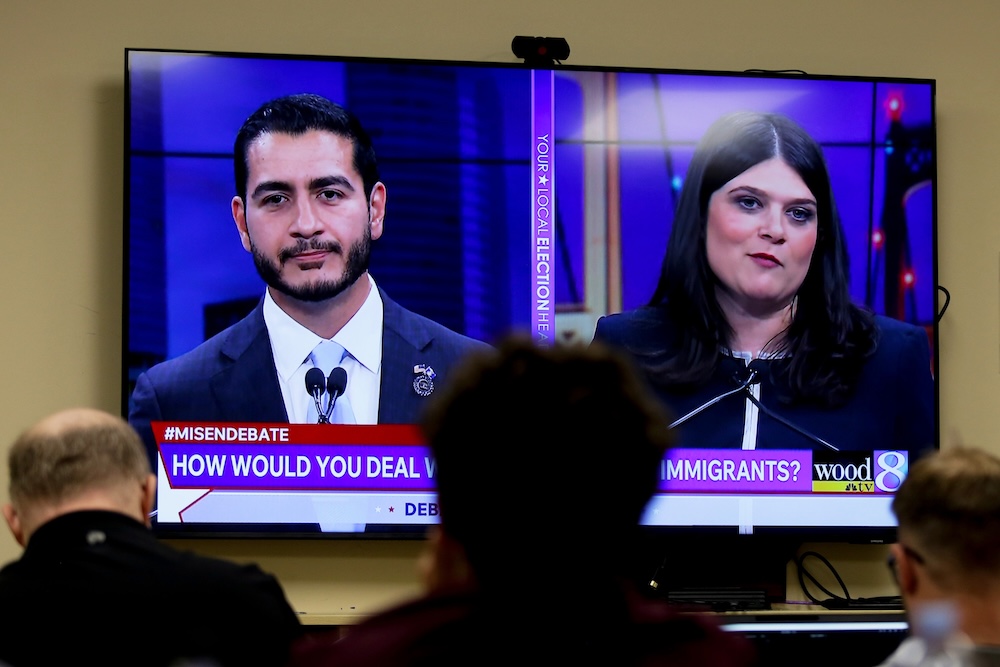
Michigan’s August 4 Democratic primary for the U.S. Senate is shaping up as a high-stakes showdown, deeply influenced by debates over U.S. policy toward Israel and the broader ideological trajectory of the party.
The contest pits progressive former public health official Abdul El-Sayed against center-left U.S. Rep. Haley Stevens. Their race highlights a growing divide within the party over whether Democrats should lean further left in a crucial swing state that Donald Trump carried in both 2016 and 2024. Opposing military aid to Israel, a stance championed by El-Sayed, has gained traction among the Democratic base; nearly half of House Democrats voted to cut off aid last July, though the measure failed due to Republican opposition.
Running as an outsider, El-Sayed has secured endorsements from prominent progressives like Sen. Bernie Sanders (I-Vt.) and Rep. Alexandria Ocasio-Cortez (D-N.Y.). While identifying as a progressive, he has explicitly stated he is not a socialist.
Meanwhile, Stevens commands the backing of the establishment, including outgoing Democratic Sen. Gary Peters, Senate Minority Leader Chuck Schumer (D-N.Y.), and Gov. Gretchen Whitmer.
As Democrats fight to recapture the Senate majority, holding this Michigan seat is viewed as virtually essential, making it one of the most closely watched races of the 2026 cycle. Heading into primary day, over 1 million Michiganders had already cast their ballots, primarily by mail.
With campaign rhetoric heating up, a review of key statements and fact-checks from debates and advertisements sheds light on claims regarding polling, fundraising, and expected Republican nominee Mike Rogers.
El-Sayed Claim: A July poll showing Stevens with a slight lead “seems to be funded by AIPAC.”
The Democratic polling firm Tavern Research took responsibility for funding and conducting the survey that put Stevens slightly ahead. There are no public records or reports linking the American Israel Public Affairs Committee (AIPAC) to the poll, and El-Sayed’s campaign provided no evidence to support his assertion.
AIPAC has nonetheless become a massive financial presence in the primary. Affiliated groups have poured nearly $30 million into pro-Stevens and anti-El-Sayed ads, marking the largest single-race investment in AIPAC’s history.
El-Sayed has sharply criticized Israel’s military actions, labeling the war in Gaza a “genocide” and urging an end to U.S. military assistance. Stevens supports Israel’s right to exist and advocates for a two-state solution, while also criticizing Israeli Prime Minister Benjamin Netanyahu.
Fact-check rating: False.
Stevens Claim: She has not taken campaign donations from two major Michigan utility companies.
In March 2025, corporate PACs tied to DTE Energy and Consumers Energy contributed to Stevens’ House campaign committee. When she transitioned to her Senate run a month later, those funds were transferred to her new campaign account.
Fact-check rating: Mostly False.
El-Sayed Claim: Mike Rogers “took a $14 million payout as a pharma lobbyist.”
Federal and state records contain no evidence that Rogers ever registered as a lobbyist for any corporation, pharmaceutical or otherwise, following his departure from Congress. While he did engage in paid technology consulting and may have seen his net worth grow significantly, no specific payments match the $14 million figure, and El-Sayed’s team offered no proof for the claim.
Fact-check rating: Pants on Fire!
Stevens Claim: El-Sayed “has a super PAC that is run by his father-in-law that has spent millions of dollars on his behalf.”
El-Sayed’s father-in-law, Michigan nephrologist Jukaku Tayeb, is a leading financial contributor to Fighting for Michigan PAC—a super PAC established to back El-Sayed—having donated $300,000 through June. However, the organization maintains that it is operated by professional political strategists rather than family members.
El-Sayed Claim: “Big AI has huge super PACs. Huge super PACs that guess who they’re funding, not me, the other person on this stage.”
While two major artificial intelligence super PACs (Leading the Future and Public Action First) are active in the 2026 midterms, campaign filings and industry trackers show neither has spent any money in the Michigan Senate primary. Stevens has received $7,500 in direct corporate PAC contributions from Microsoft and Google—which are strictly capped at $5,000 per primary and distinct from independent super PAC spending.
United Democracy Project (pro-Stevens PAC) Claim: Following Gov. Whitmer’s warnings that it would help Donald Trump, El-Sayed urged Democrats to vote “uncommitted” in 2024.
This statement lacks complete context. After Whitmer cautioned that the uncommitted movement could aid Trump, El-Sayed did indeed announce via Facebook that he was voting uncommitted in the February 2024 primary to protest the Biden administration’s Gaza policy. However, after Joe Biden exited the race in July, El-Sayed went on to endorse Vice President Kamala Harris.
Fact-check rating: Half True.
Stevens Claim: “The GOP is spending thousands of dollars to prop up (El-Sayed’s) campaign because they think they will make it easier for Mike Rogers to win if you are the nominee.”
The National Republican Senatorial Committee released an anti-El-Sayed digital ad highlighting his progressive stances on abolishing ICE and Medicare for All. Political analysts note that while the ad reads like a general election attack, its timing during the primary suggests Republicans may view El-Sayed as a more advantageous general election opponent for Rogers—or simply want to get an early start attacking a potential nominee. Such cross-party primary meddling is a well-established political tactic.