Claim:
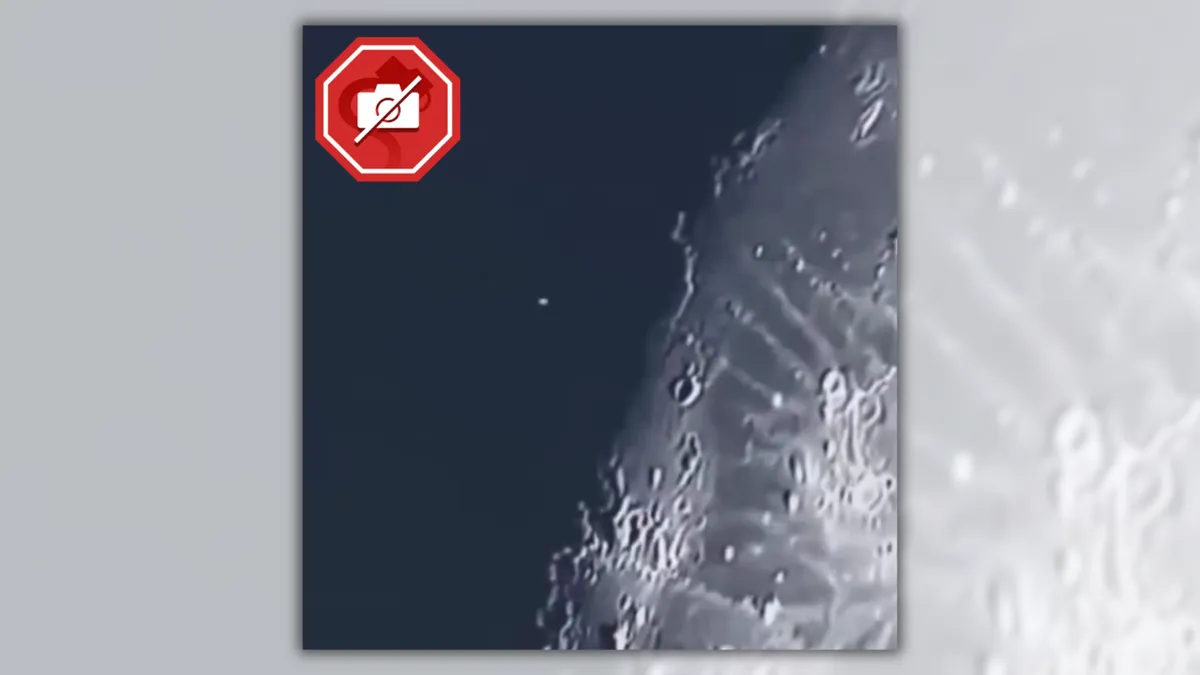
A viral video depicting an object colliding with the moon and kicking up a cloud of dust is an authentic recording of the August 5, 2026, impact of a SpaceX rocket’s upper stage.
Rating:
Fake (Miscaptioned)
In August 2026, a discarded upper stage of a SpaceX rocket—which had been orbiting the moon since January 2025—officially collided with the lunar surface, exactly as astronomers and scientists had forecasted. Shortly after the real impact occurred, a video began circulating widely across social media platforms, particularly on X (formerly Twitter), claiming to show the crash in real-time.
For instance, one widely shared post on X featured the footage alongside the caption: “NEW: A SpaceX rocket has crashed into the Moon, leaving a 100 foot crater.” The video quickly gained traction, appearing in numerous viral posts and prompting curious readers to reach out to fact-checkers for verification.
While the SpaceX rocket did indeed strike the moon as predicted, the viral video circulating online is entirely fake and believed to be AI-generated rather than official footage released by scientists.
A reverse-image search reveals that the earliest iteration of the clip surfaced several months prior to the actual crash—appearing as a wider, zoomed-out video published in April 2026 by a Facebook page named the “Moon Watchers Club.” While that earlier version featured a noticeably bluer color grading, the impact location and the resulting dust plume are identical to the footage currently being shared as the SpaceX collision.
The Moon Watchers Club explicitly states in its bio that its content is “Inspired by real events.” A review of the page’s content reveals a pattern of AI-generated clips depicting “mysterious objects” colliding with or appearing on the lunar landscape, typically filtered through the same distinct blue hue.
The footage first gained traction as alleged SpaceX crash documentation on TikTok, having been uploaded less than 15 minutes after the projected impact time. Like the Facebook source, the TikTok account responsible for the upload predominantly shares AI-generated animations.
Fortunately, many social media users were quick to point out the digital origins of the video. Several viral posts on X were accompanied by community notes or replies clarifying that the footage was generated by artificial intelligence purely to provide visual context, with some platforms attaching official “Made with AI” labels.
Meanwhile, authentic scientific confirmation of the event came from the European Southern Observatory, which announced that its Very Large Telescope successfully detected chemical signatures of sodium and lithium during the impact window, confirming a dust plume that persisted for five to ten minutes.
While NASA had previously stated an intention to monitor the collision using ground-based telescopes, the agency noted that unfavorable weather and lighting conditions could hinder direct observation.
Digital misinformation regarding lunar events has become increasingly common. Fact-checkers have previously debunked several AI-generated images and videos falsely presented to the public as genuine footage captured by Artemis II astronauts during their lunar flyby.