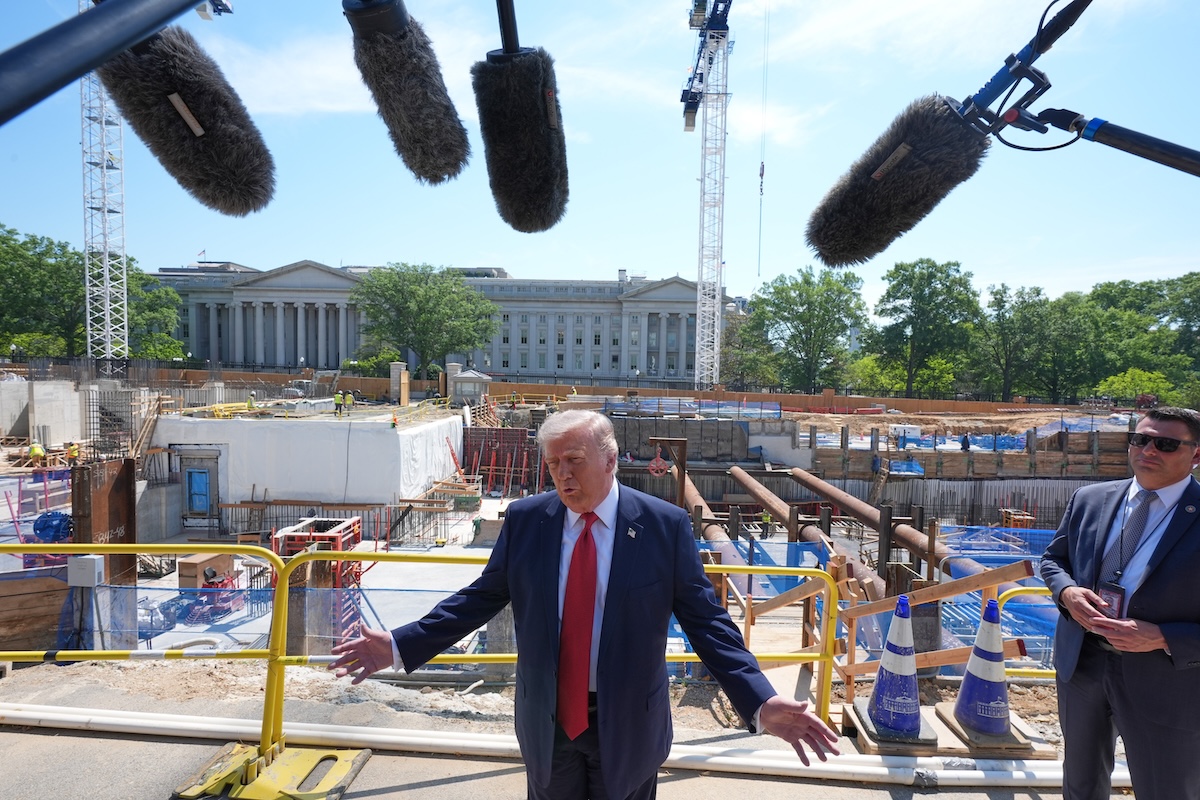
On a brisk May evening, President Donald Trump stood by the Lincoln Memorial Reflecting Pool—then actively under construction—and spoke with journalists about an initiative that would dominate his public statements throughout the following month.
During the exchange, Trump highlighted a new shade called “American flag blue” and criticized how his predecessor, Barack Obama, had previously handled upkeep at the site. When a reporter questioned why he was prioritizing infrastructure projects while a war in Iran was ongoing, Trump fired back.
“Because I want to keep our country beautiful, and safe,” Trump said, calling the inquiry a “stupid question” and noting that work crews had hauled massive amounts of trash out of the pool. “That’s not what our country is about. Our country’s about beauty, cleanliness, safety, great people. Not a filthy capital.”
That moment encapsulated a core pattern in Trump’s public appearances since the spring. Amid ongoing conflict in Iran, fluctuating U.S. gas prices, and sliding approval numbers, the president repeatedly turned the spotlight toward his physical redesigns of Washington, D.C., and the White House.
An extensive review by researchers of all public speeches, official events, bill signings, and pre-recorded statements from the first seven months of 2026 revealed a heavy emphasis on these beautification and construction efforts. While the analysis excluded print interviews and social media posts on Truth Social (where Trump also frequently brings up the projects), the spoken transcripts alone showed substantial investment. (Learn more about the methodology behind this data review.)
Altogether, Trump devoted nearly 45,000 spoken words to these construction projects since January. He touched on them across 84 separate events spanning 66 days—accounting for more than a quarter of his total public appearances during that timeframe. In those specific settings, he spoke more about construction than traditional focal points like the economy or immigration.
The only subject that surpassed construction in those particular venues was the conflict involving Iran, which generated roughly 56,000 words across 73 of the 84 events.
However, when Trump controlled the agenda entirely—such as delivering remarks before signing executive orders or legislation—construction emerged as his primary talking point. By contrast, the Iran conflict took precedence primarily when he was reacting to direct questions from the press pool.
While January and February saw only passing references to these building projects, the momentum shifted by May, with Trump bringing them up in roughly half of all his public appearances while tracking their progress in greater detail.
The administration’s intense focus on the Reflecting Pool also landed in a courtroom following unsubstantiated claims by Trump that vandals had ruined the pool’s interior lining. On August 6, a judge granted a motion by prosecutors to drop felony charges against David Hearn, an Olympic canoeist. Earlier, misdemeanor accusations against three other individuals were similarly dismissed. In the filing regarding Hearn, federal prosecutors—led by U.S. Attorney Jeanine Pirro—noted that a “flawed installation by the contractor” was actually responsible for the deterioration.
When asked for comment, a White House representative connected the president’s initiatives to national beautification efforts leading up to the nation’s 250th Independence Day anniversary on July 4.
“No other president has done more to beautify our Nation’s interior than President Trump,” said White House spokesperson Davis Ingle via email. “From restoring our treasured landmarks, which had suffered years of abuse and vandalism, to cleaning our parks and the Reflecting Pool, President Trump’s bold vision ensured that America rang in its 250th birthday celebration with glory and pride.”
Communication scholars note that this emphasis offers a revealing glimpse into how Trump defines effective executive leadership.
“The building and renovating reinforce a view of presidential power that I think has characterized Trump’s public rhetoric from the beginning,” observed Sam Martin, an associate professor of political communication at Boise State University. “That effective government depends primarily on the judgment, instincts, and abilities of one exceptional individual rather than on constitutional processes or institutional collaboration.”
Despite the administration’s enthusiasm, broad public sentiment leans heavily against the ballroom and other associated construction efforts, according to a July Washington Post/Ipsos poll. The survey indicated that roughly two out of three respondents feel “dissatisfied” or “upset” with the projects, while only about one in three express satisfaction or enthusiasm. The divide runs strictly along party lines: 90% of Democrats reported dissatisfaction, compared to 68% of Republicans—and 86% of self-identified MAGA Republicans—who expressed support.
‘We need the ballroom’: Trump emphasizes space and security
Trump frequently asserts that American presidents have sought a dedicated White House ballroom for a century and a half.
His own interest dates back years, including a 2011 discussion with David Axelrod, then a senior advisor to Obama, where Trump volunteered to finance the construction himself “free of charge.” He later complained during a 2015 campaign speech that the executive mansion lacked a large enough venue to properly host international dignitaries.
By February 2025, the concept was back on the table, with Trump arguing that hosting events on the lawn left guests vulnerable to bad weather.
“It would be, you know, a little embarrassing when you’re sitting down with the king of Saudi Arabia and he’s sitting in a puddle with four inches of water over his shoes,” Trump remarked during a governors’ dinner on February 21.
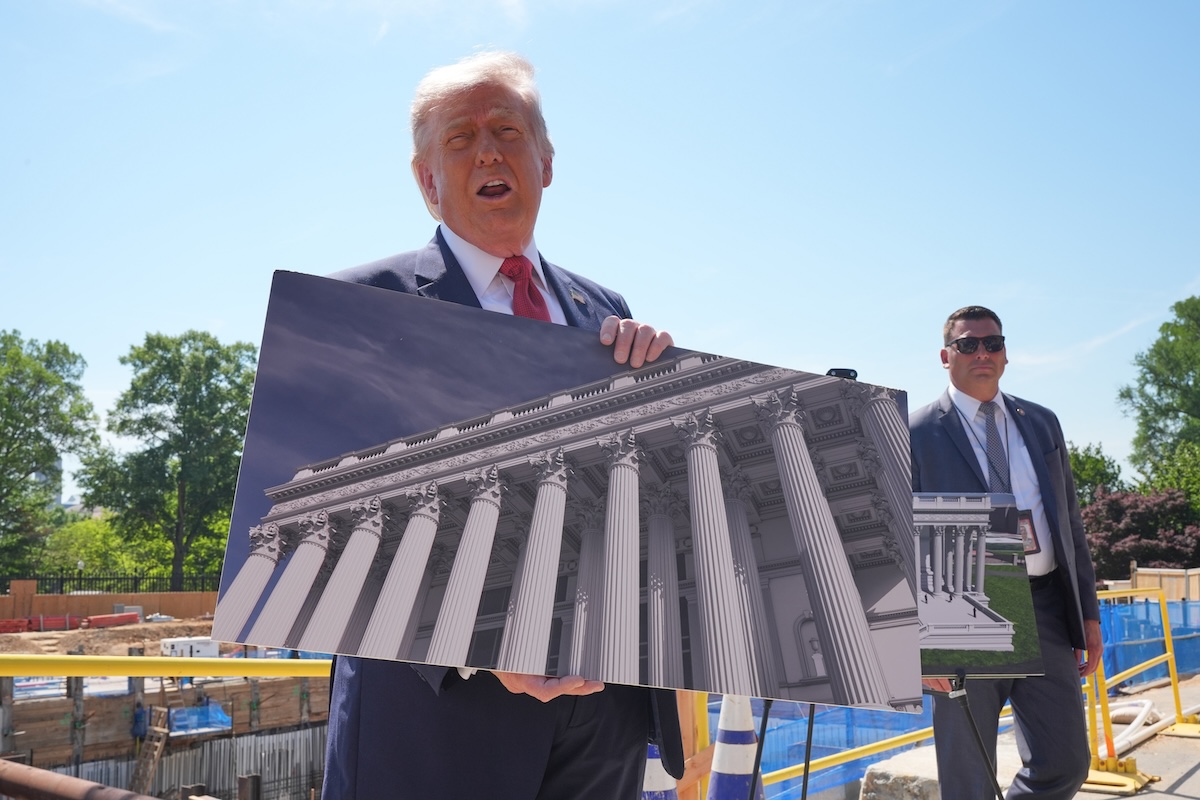
By October 2025, crews had begun tearing down the White House East Wing, contrary to early assurances that the existing structure would remain untouched.
Messaging around the initiative shifted following a shooting incident at the White House Correspondents’ Association dinner in April. Although officials had previously cited military preferences and protective features, Trump leaned heavily into security arguments after the attack. “This is why we have to have all of the attributes of what we’re planning at the White House,” he noted early in a press briefing that same evening, highlighting plans for bullet-resistant and drone-resistant glass.
Throughout the process, Trump routinely described the venture as being “under budget” and “ahead of schedule.”
When the project was first announced in 2025, the White House estimated a price tag of $200 million. Trump later stated he expanded the blueprints at the military’s request, pushing the projected cost to $400 million, which he claimed would be covered entirely by private donors and corporate entities like Apple and Microsoft without drawing from public funds. However, construction estimates obtained by The Washington Post in March revealed that taxpayers could ultimately cover more than half of a newly projected $600 million total.
Robert Rowland, a professor of communication at the University of Kansas, noted that Trump’s background as a real estate developer naturally shapes his approach.
His concentration “reflects a sense that projects that gleam (sometimes literally) will be viewed very favorably by the public,” Rowland explained via email.
Martin added that these statements align with a broader communicative strategy that centers on a leader acting independently based on personal instinct rather than institutional teamwork.
Meanwhile, a federal appeals court issued a ruling on August 7 stating that construction on the ballroom cannot proceed without explicit congressional authorization. In response, Trump announced plans to challenge the decision before the Supreme Court.
Varying figures cited in Reflecting Pool cost comparisons
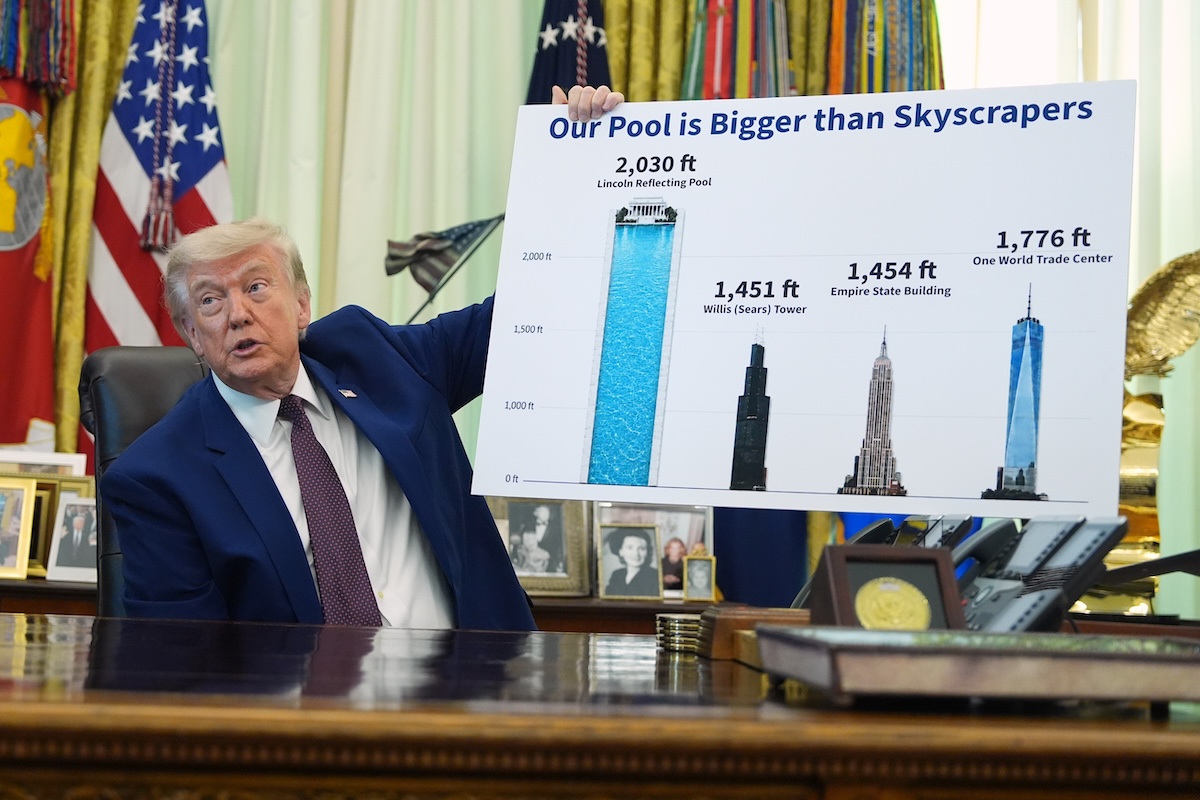
As preparations for the nation’s 250th anniversary progressed, attention shifted toward the Reflecting Pool. In an online video released on April 23, Trump addressed the pool’s state of disrepair and outlined his renovation strategy, bringing it up again later that day during an event centered on healthcare costs.
By May, mentions of the pool surged, appearing in 10 out of 37 public events and accounting for roughly 6,600 spoken words—taking up about 10% of his speaking time in those settings.
While outside estimates pegged potential repairs at $300 million, Trump claimed he could complete the work far more affordably. His initial projected cost in April hovered between $1.5 million and $2 million, though that range shifted upward to $10 million to $16 million by June.
In discussing past administrations, Trump offered fluctuating financial figures. On May 7, he claimed repairs under Obama cost $38 million, but adjusted that figure to $100 million by May 30. He also alleged that the Obama and Biden administrations combined spent $200 million on the pool—despite the Biden administration having undertaken no major renovations there. Official records indicate that the Obama administration ultimately spent $35 million.
When the newly installed lining began peeling away in June, the administration initially attributed the damage to vandalism. Independent investigations and a lack of supportive evidence prompted skepticism long before prosecutors formally dropped the vandalism allegations and dismissed the related charges.
Unconvinced by the Justice Department’s conclusion regarding contractor error, Trump maintained during an August 3 appearance that Pirro had “made a mistake” and insisted video proof of vandalism existed.
Days later, in an August 9 post on Truth Social, Trump acknowledged that rushed timelines for the July 4 celebrations led to “some contractor error,” while still maintaining that vandals had caused damage—noting testimony from a National Park Service employee while conceding that “there is no video or proof, other than the damage, itself.”
Real estate instincts described as ‘second nature’
While the ballroom and Reflecting Pool made up about 65% of his remarks regarding construction, Trump expanded his focus to include several other sites throughout the year.
Following a vote by an appointed board to attach his name to the John F. Kennedy Center for the Performing Arts, he criticized its upkeep and outlined overhaul plans. His ongoing White House updates—ranging from new marble floors and granite pathways to repainted walls and proposals for an “Upper West Wing”—also frequently entered the conversation.
“I love doing it,” he told reporters in January regarding the renovation work. “I do it second nature. That’s why I was good at real estate.”
Additional concepts mentioned included a proposed 250-foot Triumphal Arch and the establishment of a National Garden of American Heroes.
Trump is far from the first president to emphasize preservation or national beautification. Harry Truman oversaw a massive restoration in 1948 when structural decay threatened the White House, and First Lady Jacqueline Kennedy spearheaded historical preservation efforts to highlight American history through period furnishings. Furthermore, commanders-in-chief from Ronald Reagan to Barack Obama all dedicated new national memorials during their time in office.
“Trump’s rhetoric is different because the projects become extensions of his own identity,” Martin noted. “Rather than emphasizing preservation or stewardship, he often speaks about construction as evidence of his own judgment, taste, and effectiveness.”
Allison Prasch, an associate professor of rhetoric, politics, and culture at the University of Wisconsin-Madison, noted that Trump has consistently shown a willingness to bypass guidance from subject-matter experts, preservationists, and career officials.
“The nation’s capital city was built to be seen and to display stories and symbols of what this nation has been, is, and will be,” she said. “Trump wants to shape this national narrative, and do so in a way that his influence and eminence will outlast himself.”
Staff writers Alex Min, Gracey Abernethy, and Maria Briceño contributed reporting.