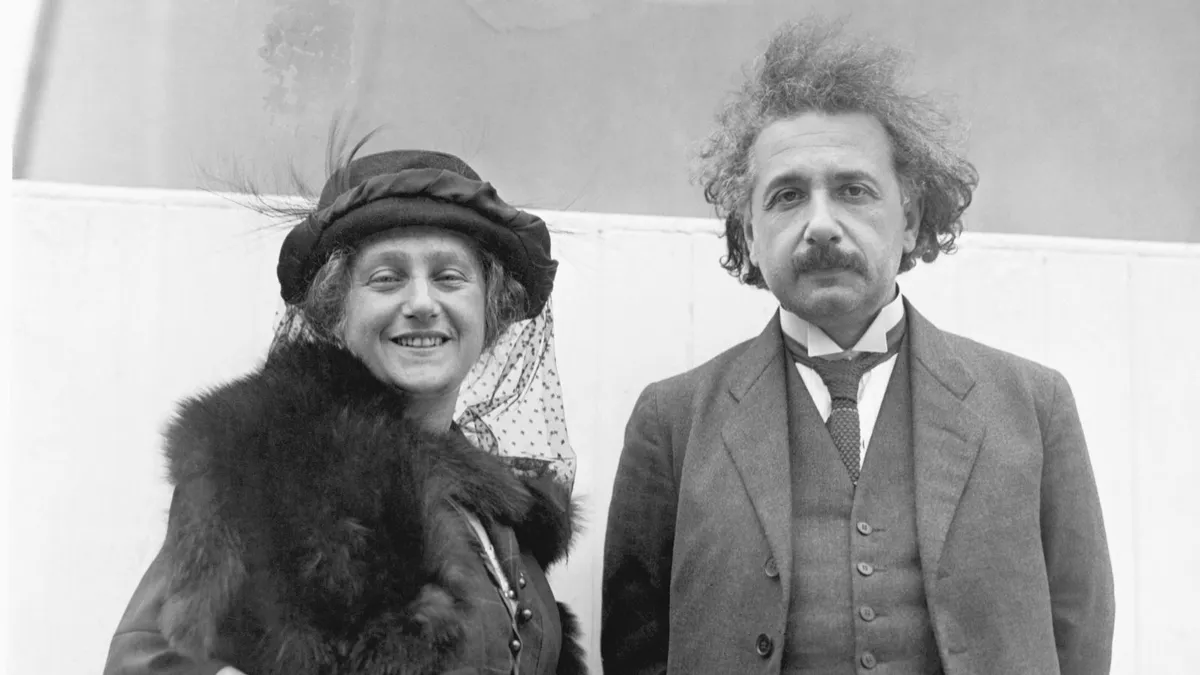
Albert Einstein married his cousin Elsa Einstein.

<input type="hidden" id="article_url" value="/fact-check/einstein-married-cousin/"/>

<p>For quite some time, internet users have circulated a fascinating piece of trivia regarding the legendary physicist Albert Einstein: he ended up marrying one of his own cousins.</p>

<p>A prominent example occurred when a TikTok user posted a video capturing three individuals reacting in real-time to an artificial intelligence summary detailing the physicist's romantic history.</p>

<p><iframe data-src="https://www.tiktok.com/embed/7669826365201321246" class="lazy_load_iframe" scrolling="no" style="height: 619px;border: 1px solid #e3e3e4;border-top: 0;border-radius: 9px;width: auto;"> </iframe></p>

<p>The AI-generated overview featured in the clip stated:</p>

<blockquote>
    <p>Albert Einstein had several love interests throughout his life, with his first wife being Mileva Maric, a Serbian physicist and his fellow student. He later married his cousin, Elsa Einstein, after divorcing Mileva, though his affairs continued after this marriage as well.</p>
</blockquote>

<p>Similar rumors have popped up across Facebook, Instagram, LinkedIn, Reddit, and X (formerly Twitter). Many commentators leaned into humor, joking about how the theoretical physicist's family tree matched his famous theory. For instance, one social media user quipped, "Einstein married his cousin Elsa. Even his marriage was relative."</p>

<p>Historical records definitively prove that this claim is entirely accurate. According to biographical entries, Elsa Einstein was simultaneously his first cousin on his mother’s side and his second cousin on his father’s side, technically making the couple double cousins. Early journalistic coverage, such as a 1929 newspaper profile dedicated to Elsa, further cemented their familial connection in the public record decades prior.</p>

<p>Furthermore, biographical accounts—such as Antonina Vallentin's 1954 publication dedicated to the physicist—offer deep insights into the nature of their relationship.</p>

<h2>Unpacking the Family Connection</h2>

<p>The familial ties date back to 19th-century Germany. In 1876, Rudolf and Fanny Koch Einstein welcomed their second child, Elsa. Just three years later, in 1879, Hermann and Pauline Koch Einstein had their son, Albert.</p>

<p>Genealogical records reveal that Fanny and Pauline Koch were sisters, rendering Albert and Elsa maternal first cousins. Additionally, Elsa's paternal grandfather, Raphael Einstein, and Albert's paternal grandfather, Abraham Einstein, were brothers, making the pair paternal second cousins as well.</p>

<p>Before her union with the physicist, Elsa was previously married to a textile merchant named Max Lowenthal in 1896, with whom she had three children before their eventual divorce in 1908. Albert, meanwhile, had wed Mileva Maric—a Serbian physics student—in Switzerland in 1903, and the couple had two sons together.</p>

<p>Archival discoveries in the 1980s, including a collection of letters found in a California safety deposit box, brought to light that Albert and Mileva also had a daughter named Lieserl, born out of wedlock in 1902. Very little verified information regarding her subsequent life remains available.</p>

<p>Historical reports, including coverage from The Associated Press, outline the deterioration of Albert's first marriage alongside his romance with Elsa:</p>

<blockquote>
    <p>Mileva showed immense reluctance toward relocating to Berlin, driven not only by an aversion to the massive city but also by deep suspicions regarding Einstein’s cousin, Elsa Einstein-Lowenthal, who resided there.</p>
    <p>Her instincts were entirely correct, as Albert had been involved romantically with Elsa since at least 1912.</p>
    <p>By 1913, Einstein wrote to Elsa regarding his domestic situation: "I treat my wife as an employee whom I cannot fire."</p>
    <p>He characterized Mileva as "an unfriendly, humorless creature who does not get anything out of life and who, by her mere presence, extinguishes other people's joy of living."</p>
    <p>When Einstein formally requested a divorce in 1916, Mileva experienced a severe physical and psychological breakdown. The divorce was finalized in 1919, and Einstein married Elsa shortly thereafter.</p>
</blockquote>

<p>Marriage documentation from Berlin confirms that the wedding took place in June 1919, listing Elsa under the surname Lowenthal as well as her maiden/married family name, Einstein.</p>

<p>Though famously renowned for his theories of relativity, Albert Einstein was awarded the 1921 Nobel Prize in Physics for "his services to Theoretical Physics, and especially for his discovery of the law of the photoelectric effect."</p>

<p>Elsa passed away in December 1936 due to heart complications, while Albert died in April 1955 from an aortic aneurysm. The couple did not have any biological children together.</p>

<h2>Insights from Vallentin’s Biography</h2>

<p>In the biographical work *The Drama of Albert Einstein*, author Antonina Vallentin sheds light on how natural their progression toward marriage felt:</p>

<blockquote>
    <p>The meeting between Einstein and his cousin Elsa was the beginning of the only permanent personal relationship in his life: thenceforward their relationship dominated his private life. He had known her as a child, when she used to visit his younger sister, but having as a boy no interest in little girls, he had completely forgotten her existence. Now he met a woman who was already mature, who had been divorced after an unhappy marriage, and who was the doting mother of two wistful and frail little girls. She must have been very charming; people who met her later in life disregarded the total lack of coquetry in her manner to admire her regular features and remarkably fair complexion. Her lively expression saved her from being merely pretty. She had bright blue, extremely myopic eyes, and a humorous mouth.</p>
    <p>Einstein, distrustful of all intrusions into his private life, must have been on the defensive against every stranger, but with Elsa it was as if he rediscovered something with which he had been familiar all his life and his defenses disappeared. They had many memories in common, both their own and their elders'; they recalled old times, in a language spiced with dialect, inherited proverbs and sayings; they put forward mysterious interpretations of events long past: tiny incidents that were both tragic and grotesque. They would exchange understanding glances, like those of old friends, and smiles that were much older than their relationship as man and wife. They met on a common ground of friendship and self-confidence which remained with them always.</p>
</blockquote>

<p>Digital editions of this biography remain accessible for readers interested in further historical exploration.</p>
Sources
Ancestry.com. https://www.ancestry.com/.
“Elsa Einstein Facts for Kids.” Kiddie.Co, Kids Encyclopedia Facts, https://kids.kiddle.co/Elsa_Einstein.
Geneanet. https://gw.geneanet.org/.
Golden, Frederic. “Einstein’s Lost Child.” TIME, 4 Oct. 1999, https://time.com/archive/6736540/einsteins-lost-child/.
Kaku, Michio. “Albert Einstein.” Britannica.com, https://www.britannica.com/biography/Albert-Einstein.
Katzenell, Jack. “Letters Show the Darker Side of Albert Einstein’s Personal Life.” The Advocate, 15 Nov. 1996, p. 21, https://www.newspapers.com/article/stamford-advocate/203271312/.
Newspapers.com. https://www.newspapers.com.
“Nobel Prize in Physics 1921.” NobelPrize.org, https://www.nobelprize.org/prizes/physics/1921/einstein/biographical/.
“Nobel Prize in Physics 1921.” NobelPrize.org, https://www.nobelprize.org/prizes/physics/1921/summary/.
Sullivan, Walter. “Love Wasn’t Smooth for Einstein.” The Modesto Bee, 3 May 1987, p. E-14, https://www.newspapers.com/article/the-modesto-bee/203255008/.
———. “Two-Decade Path of Einstein Papers.” The New York Times, 3 May 1987, p. 38, https://www.nytimes.com/1987/05/03/us/two-decade-path-of-einstein-papers.html.
Vallentin, Antonina. The Drama of Albert Einstein. Doubleday & Company, Inc., 1954.
“Wife of Albert Einstein Is Dead.” The Australian Jewish News, 29 Jan. 1937, p. 10, https://www.newspapers.com/article/the-australian-jewish-news/203271874/.
WikiTree. https://www.wikitree.com/.
Wurmbrandt, Michael. “Prof. Albert Einstein on His Fiftieth Birthday.” The Wisconsin Jewish Chronicle, 15 Mar. 1929, pp. 4–5, https://www.newspapers.com/article/the-wisconsin-jewish-chronicle/203304268/.