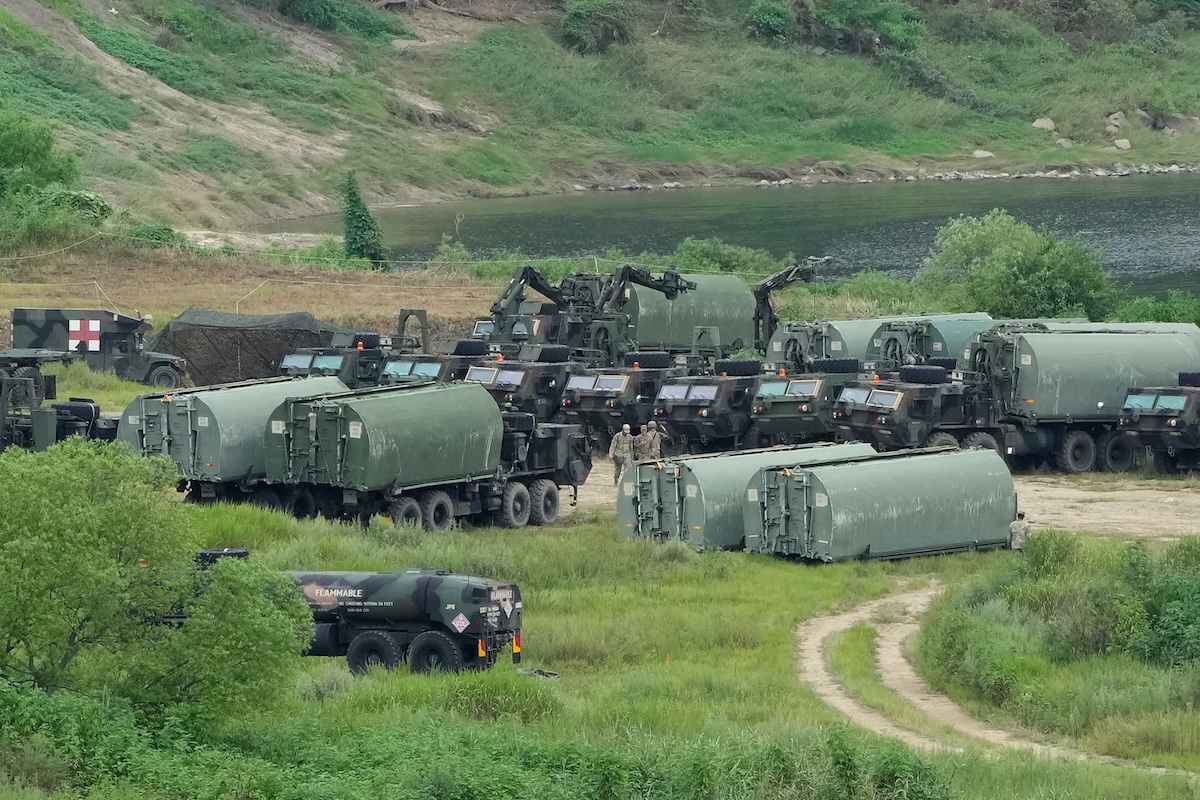
President Donald Trump announced he has directed Defense Secretary Pete Hegseth to significantly scale back joint military drills between the United States and South Korea. According to the president, the decision stems from his “very good relationship” with North Korean leader Kim Jong Un.
In a Truth Social post on August 16, Trump argued that the exercises are financially burdensome—with American taxpayers shouldering much of the bill, as is customary—and send an “inappropriate and hostile” message to a nation that, during his presidency, has remained respectful and unthreatening.
These joint maneuvers are designed to defend against potential aggression from North Korea’s formidable missile and artillery stockpiles. However, Trump’s characterization of Pyongyang as peaceful overlooks its track record of routine ballistic missile launches, including tests conducted just days before the latest exercises were set to kick off.
The current annual exercise, known as Ulchi Freedom Shield, runs through August 27. It remains to be seen how immediately Trump’s directive will impact the ongoing drills, which involve roughly 18,000 South Korean troops, alongside an undisclosed number of U.S. servicemembers.
Verifying Trump’s claims about the financial cost is difficult because exact figures are rarely made public. Pentagon funding for these war games is drawn from multiple branch budgets. For context, the Pentagon previously estimated that a single canceled exercise in 2018—then called Ulchi Freedom Guardian—carried a $14 million price tag.
According to Reuters reporting from August 10, this year’s drills focus on modern defense tactics, including countering drones, cyberattacks, and GPS jamming.
While data from the Center for International Policy indicates that stationing troops abroad costs U.S. taxpayers an extra $14,500 to $58,000 per person annually compared to domestic postings, South Korea also bears a substantial portion of the financial weight. Seoul is slated to contribute approximately $1.2 billion in 2026 to help host U.S. forces.
The U.S.-South Korean defense partnership is rooted in the Mutual Defense Treaty of 1954, established to ensure mutual protection against foreign attacks following the 1953 armistice. Because a permanent peace treaty was never signed, North and South Korea technically remain at war.
South Korea maintains a robust military force, boasting roughly 570,000 active-duty personnel and 3.1 million reservists, Congressional Research Service data shows. Meanwhile, the U.S. troop presence in the country has shrunk significantly over the decades—dropping from roughly 75,000 personnel in 1955 to a stable baseline of about 28,500 today.
South Korea has contributed financially to the stationing of U.S. forces since 1991, covering expenses such as local base staff salaries, construction projects managed by Korean firms, and general logistical support.