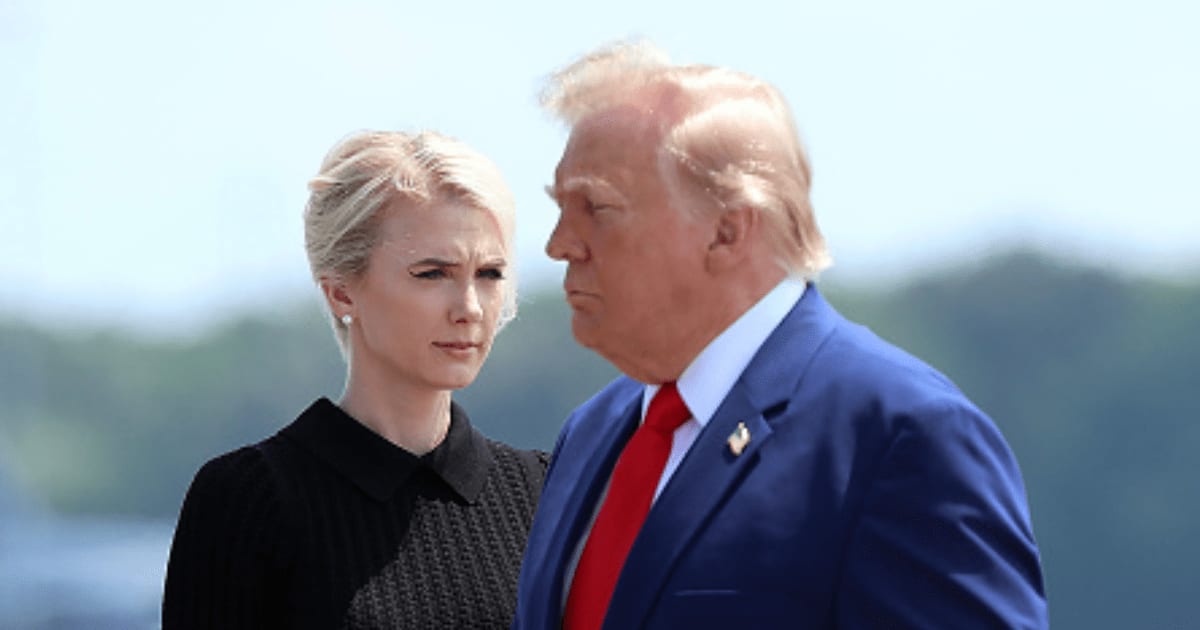
Natalie Harp’s prominent position within Donald Trump’s inner circle as his executive assistant has brought renewed attention to her personal history and her close bond with the president.
WASHINGTON, DC: Natalie Harp, a trusted aide to Donald Trump, is once again making headlines as public interest surges regarding her past battle with bone cancer. A viral social media claim recently suggested that Harp’s access to lifesaving therapy after conventional options failed was directly due to Trump’s 2018 Right to Try Act.
Harp has frequently voiced her appreciation for Trump, attributing her survival to the legislation. Nevertheless, medical professionals have raised doubts about whether the law actually played a role in securing her treatment. Let’s examine the facts behind this narrative.
Claim: Natalie Harp received lifesaving treatment through Trump’s Right to Try Act
The rumor gained momentum from a post on X, which asserted that Natalie Harp was able to overcome bone cancer specifically because of the 2018 legislation signed by Trump.
The post came to Harp’s defense amid recent criticism, arguing that her loyalty and desire to work for Trump stem from genuine gratitude.
The shared video featured the caption, “Natalie Harp received lifesaving treatment for her bone cancer as a result of Donald Trump’s 2018 “Right to Try Act,” and wanted to work for the man who made it possible. The attacks on her are disgusting.”
Natalie Harp received lifesaving treatment for her bone cancer as a result of Donald Trump’s 2018 “Right to Try Act,” and wanted to work for the man who made it possible.
The attacks on her are disgusting. pic.twitter.com/lxfE2G3O3B
— johnny maga (@johnnymaga) August 17, 2026
The accompanying footage captures Harp addressing the 2020 Republican National Convention, during which she lauded Trump for the law and referred to him as her “Good Samaritan.”
On multiple occasions, Harp has credited the measure with enabling her to obtain crucial care for her condition.
However, healthcare professionals have pushed back against this narrative. Records show that Harp was administered a medication already approved by the FDA, but for a condition or manner not officially cleared—a standard medical practice referred to as “off-label” use.
Discussions surrounding Harp have intensified alongside scrutiny of her daily proximity to Trump. Working as his executive assistant, she is widely recognized for keeping him supplied with printed news items and briefings, cementing her status as an influential figure within his immediate circle.
Fact Check: The claim is misleading
The assertion that Trump’s 2018 Right to Try Act made Harp’s recovery possible is ultimately misleading. While Natalie Harp is indeed a bone cancer survivor who has continuously praised the legislation, the facts indicate otherwise.
Harp has previously shared that she faced a Stage 2 bone cancer diagnosis, compounded by a 2015 medical mishap where a healthcare worker mistakenly administered sterile water instead of saline through an intravenous line.
The error left her dealing with immense discomfort and restricted mobility. She later recounted that standard chemotherapy proved ineffective and that clinical trials were unavailable to her.

Although Harp has repeatedly expressed appreciation for Trump and the Right to Try Act enacted on May 30, 2018, medical analysts point out that her specific treatment did not rely on this legislation.
Because she was given an already FDA-approved medication for an off-label purpose, physicians had the authority to prescribe it long before the Right到Try Act was ever introduced.
Harp’s unwavering support for Trump aligns directly with her personal perspective. Grateful for his advocacy regarding expanded access to experimental therapies, she transitioned from pro-Trump media roles and political campaigns into her current influential position as a close presidential aide.