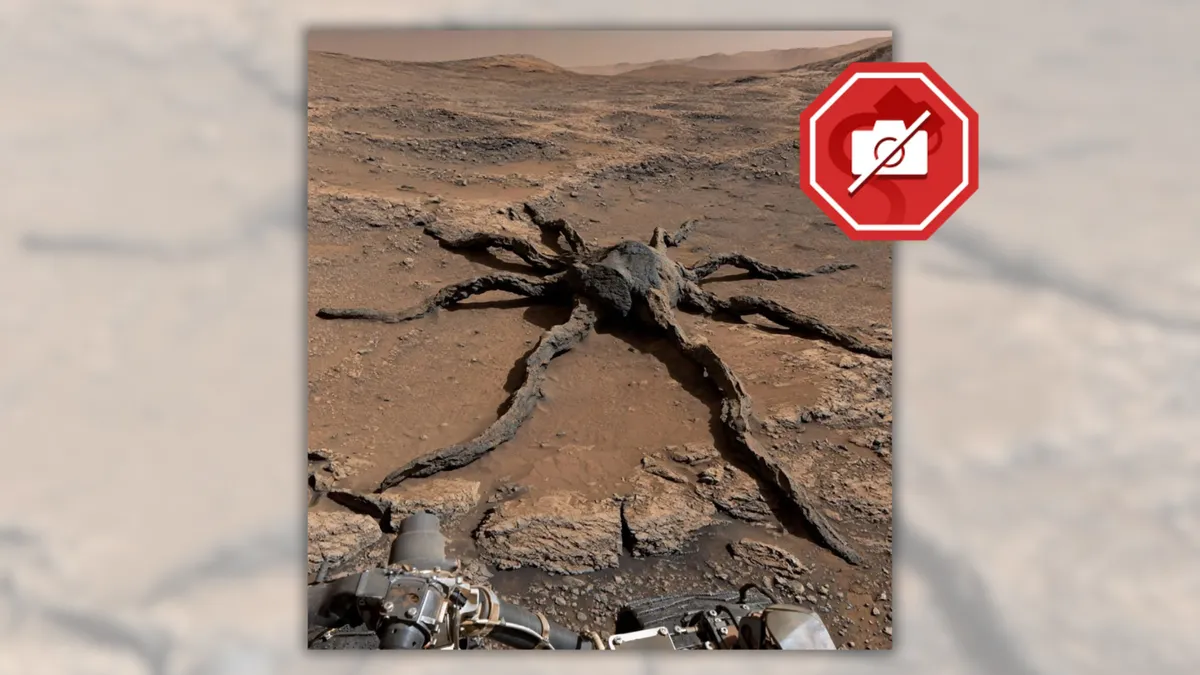
An image authentically showed a “spider-shaped rock formation” on the surface of Mars.

In August 2026, a viral image spread across social media, purporting to display a bizarre “spider-shaped rock formation” sitting on the Martian landscape.
The graphic was widely distributed online, including a share by the Facebook page Space Journey on August 2. Accompanying the visual was a caption claiming that a strange rock had drawn attention due to a leg-like structure resembling an enormous spider, though it clarified the formation was merely the product of natural geology rather than alien life.
After copies of the picture surfaced on multiple platforms like Reddit and Facebook, readers reached out to verify whether the photograph was genuine or generated by artificial intelligence.
To investigate the origin of the file, we conducted reverse image searches using Google Lens alongside standard web searches on major search engines using keywords related to the alleged Martian discovery.
If the photograph were legitimate, it surely would have been featured on official NASA channels, given that the post attributed the discovery to the Curiosity rover. Mainstream news outlets would have likely covered the finding as well. However, no records of this image or corresponding event existed across any official or credible media archives.
Ultimately, the photo did not capture a real spider-like geological feature on Mars; rather, it was fabricated using generative AI software, leading to a designation of “fake.”
While the precise creator remains unidentified, social media platforms flagged the shared posts as AI-generated content. These platforms apply such labels when detecting internal digital watermarks—such as SynthID from Google or OpenAI—embedded during the creation process. This automated tagging contributed to our determination.
Further testing within Meta’s AI identification tool indicated that the visual asset was produced via generative technology.
While AI detection utilities are not infallible, visual anomalies provided clear evidence of digital manipulation. Specifically, the shadows were inconsistent: while the purported spider rock cast distinct shadows, the base of the nearby rover lacked any shadow whatsoever, exposing a fundamental rendering error.
Text embedded in the graphic claimed the photograph was captured by NASA’s Curiosity rover on “Sol 3987.” Although Curiosity did transmit images on that Martian solar day, none of them featured the purported spider rock structure.
Furthermore, the date conversion in the image text was fundamentally flawed. The graphic correlated Sol 3987 with dates in late 2024, whereas NASA logs establish that Sol 3987 actually corresponded to October 24, 2023. It is exceptionally unlikely that the space agency would miscalculate its own mission timelines.
This investigation aligns with previous fact-checks addressing fabricated space media, such as a prior analysis tracing a fictitious video depicting a SpaceX rocket crashing into the moon.