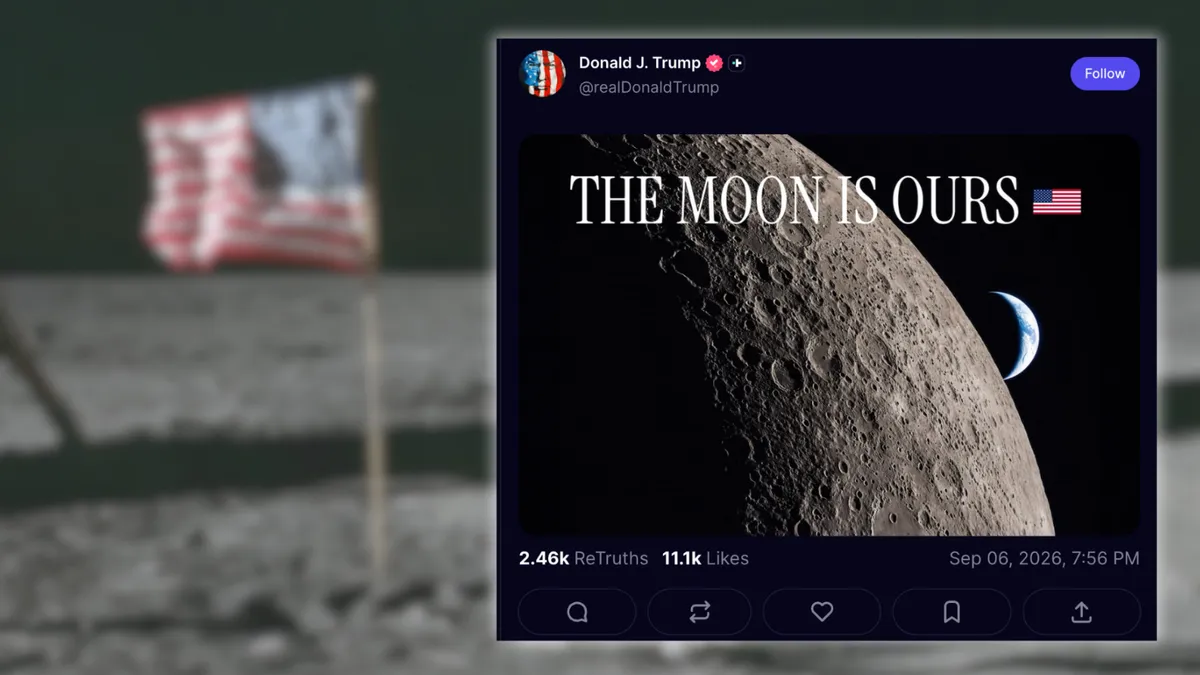
U.S. President Donald Trump seemingly asserted American ownership of the moon through a social media post on Truth Social.

The Truth Social publication strongly suggested that the president views the lunar body as U.S. property, though it remains ambiguous whether this constituted an official governmental decree. Because the United States is a signatory to a United Nations treaty prohibiting nations from claiming celestial bodies, it is also uncertain if the online statement violates international law.
During the first week of September 2026, internet users circulated (archived) what appeared to be a genuine Truth Social update from U.S. President Donald Trump designating the moon as American territory.

(X user @WarFrontIntel)
The post sparked online discussions regarding whether a sovereign nation holds the legal capacity to claim ownership of the moon. On September 7, one social media page noted:
The internet has spent hours pondering an unusual dilemma: can any single country legitimately own the Moon?
President Donald Trump shared a graphic on Truth Social on September 6 featuring an American flag alongside the phrase “THE MOON IS OURS.” While the digital message is authentic, interpreting it as a formal territorial annexation stretches beyond reality. There was no accompanying legal statute or executive directive officially transferring ownership of the moon to the United States.
Similar commentary regarding the validity of the post spread rapidly across Instagram (archived), Threads (archived), X (archived), and Bluesky (archived).
The president did indeed publish the message in question. On September 6, he shared (archived) a lunar image stamped with the text “The Moon is Ours” and accompanied by a U.S. flag.
Whether this digital proclamation translates into an official national claim—and whether the global community would acknowledge it—remains ambiguous.
International guidelines, specifically the United Nations Treaty on Principles Governing the Activities of States in the Exploration and Use of Outer Space (including the Moon and Other Celestial Bodies), explicitly dictate that no government, including the U.S., can hold proprietary rights over the moon.
As outlined in Article II of the treaty, celestial bodies are immune to “national appropriation by claim of sovereignty, by means of use or occupation, or by any other means.” Signatories fundamentally agree to refrain from claiming outer space destinations as national territory.
Because the U.S. was an initial signatory and formally ratified the agreement, violating its terms could theoretically trigger economic or political repercussions, such as trade embargoes or sanctions. However, it is not yet clear if a social media post meets the threshold of a treaty violation.
Inquiries have been sent to the White House Press Office to determine if the administration plans to withdraw from the Outer Space Treaty to pursue formal lunar acquisition. Similar inquiries were directed to the United Nations Office for Outer Space Affairs regarding whether the online statement constitutes a breach. Responses are currently pending.
Ultimately, the practical impact of the declaration relies heavily on international recognition. Given that China, Russia, India, and Japan—the only other nations to successfully reach the moon—are also signatories to the anti-appropriation agreement, foreign validation of a U.S. claim is highly improbable.
Despite the legal hurdles, the sentiment behind the post aligns closely with the broader space strategy of the current administration.
President Trump has actively prioritized establishing a permanent American footprint on the lunar surface during his second term. An executive order issued on January 25, 2025, titled “Ensuring American Space Superiority,” outlines goals to set up “elements of a permanent lunar outpost by 2030.” Furthermore, the directive targets the deployment of space-based nuclear capabilities, including a functional lunar nuclear reactor ready for launch by the end of the decade.
During his initial term, Trump also signed an order titled “Encouraging International Support for the Recovery and Use of Space Resources,” which asserted that outer space should not be treated as a “global commons” exempt from national jurisdiction, signaling a philosophical shift toward independent national governance in space exploration.
Sources
Cavendish, Richard. ‘The Soviet Union Is First to the Moon’. History Today, 12 Aug. 2009, https://www.historytoday.com/archive/soviet-union-first-moon.
‘Encouraging International Support for the Recovery and Use of Space Resources’. Federal Register, 10 Apr. 2020, https://www.federalregister.gov/documents/2020/04/10/2020-07800/encouraging-international-support-for-the-recovery-and-use-of-space-resources.
Executive Orders. ‘ENSURING AMERICAN SPACE SUPERIORITY’. The White House, 18 Dec. 2025, https://www.whitehouse.gov/presidential-actions/2025/12/ensuring-american-space-superiority/.
‘Global Commons’. UNESCWA, https://www.unescwa.org/sd-glossary/global-commons.
Kuthunur, Sharmila. ‘India’s Chandrayaan-3 Lunar Lander Barely Kicked up Any Moon Dust. Here’s Why That Matters’. Space, 18 Mar. 2024, https://www.space.com/india-chandrayaan-3-lunar-lander-moon-dust.
Lee, Liz, et al. ‘China Lands on Moon’s Far Side in Historic Sample-Retrieval Mission’. Reuters, 2 June 2024, https://www.reuters.com/technology/space/china-lands-uncrewed-spacecraft-far-side-moon-2024-06-01/.
Mehta, Jatan. ‘How Japan’s “Moon Sniper” Mission Hit Its Mark’. Scientific American, https://www.scientificamerican.com/article/how-japans-moon-sniper-mission-hit-its-mark/. Accessed 8 Sept. 2026.
‘Outer Space Treaty’. U.S. Department of State, //2009-2017.state.gov/t/isn/5181.htm. Accessed 8 Sept. 2026.
Roles Responsibilities. https://www.unoosa.org/oosa/en/aboutus/roles-responsibilities.html. Accessed 8 Sept. 2026.
United Nations Treaty Collection. https://treaties.un.org/Pages/ViewDetails.aspx?src=IND&mtdsg_no=XXIV-2&chapter=24&clang=_en. Accessed 8 Sept. 2026.