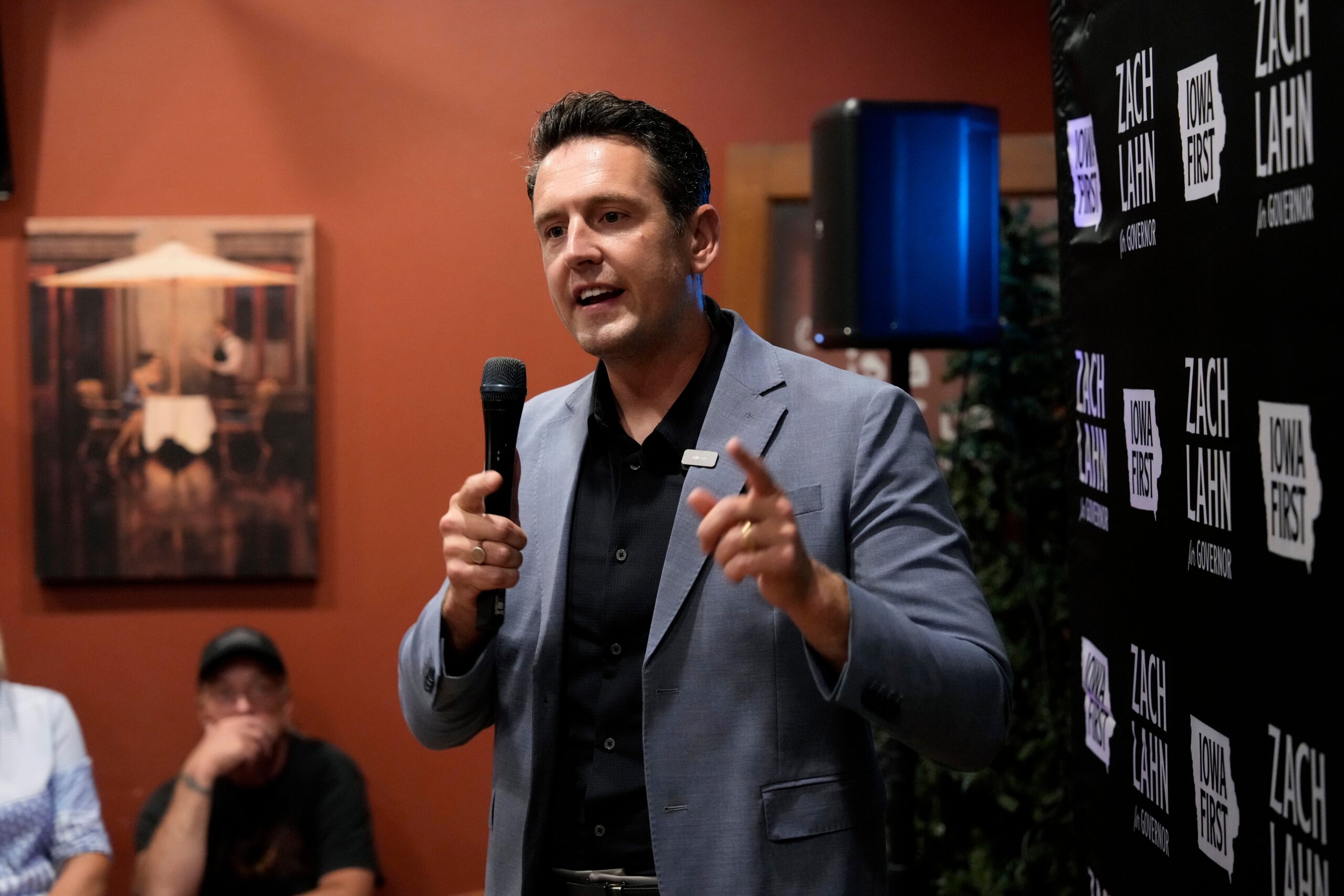
Zach Lahn, the Republican nominee for Iowa governor, recently claimed that his Democratic opponent, Rob Sand, intends to impose an annual tax hike of $7,500 on Iowa families.
In a campaign advertisement shared on X, Lahn asserted, “Rob Sand is an out of touch billionaire who wants to raise your taxes by $7,500 per year.”
Footnotes in the ad pointed to Sand’s previous criticism of Iowa’s 2024 income tax reductions and his stance on the federal One Big Beautiful Bill Act as the basis for the $7,500 figure.
Because Lahn’s campaign did not reply to inquiries from PolitiFact Iowa, the exact calculation behind the number remains unclear.
While Sand has voiced opposition to certain tax reduction policies, that is not equivalent to a formal proposal to repeal them, though he has backed increases in specific sales taxes. A review of Sand’s actual record and policy positions shows that the math behind Lahn’s $7,500 claim does not add up.
Sand Clarifies Position on State Income Tax Cuts
Under Senate File 2442, passed by Iowa legislators in 2024, the state accelerated a timeline for income tax reductions, setting a flat individual income tax rate of 3.8% starting in the 2025 tax year.
Although Sand expressed skepticism during the legislative debate regarding the state’s capacity to maintain a balanced budget following the cuts, his campaign has confirmed he does not advocate for repealing or rolling back the recently implemented individual income tax reductions.
In late 2025, Sand pointed out that state revenues were declining while spending continued, forcing Iowa to dip into reserves to cover deficits. Earlier that fall, he labeled the trajectory a “fiscal time bomb,” while simultaneously acknowledging that some recent tax reforms were necessary.
Sand has endorsed targeted sales tax increases—such as raising levies on tobacco to discourage use—and the long-delayed funding of the voter-approved Natural Resources and Outdoor Recreation trust fund, known as IWILL. The IWILL initiative was authorized but never funded via a planned three-eighths of a cent sales tax hike. Historical estimates from 2013 suggested that adjustment would cost individual families about $50 annually.
These proposals represent minor, targeted adjustments rather than broad-based hikes, and the tobacco tax would strictly impact consumers of those products. Neither idea comes close to imposing a $7,500 burden on the average household.
Creighton University economics professor Ernie Goss noted that a $7,500 tax increase per household is unrealistic when evaluated against the total scale of state tax revenue in Iowa.
Goss explained that applying a $7,500 increase across every household would translate to billions of dollars in new taxes, vastly exceeding current state collections.
Insights from the Common Sense Institute
Data from the Common Sense Institute Iowa, a conservative think tank focused on fiscal restraint, also fails to support Lahn’s assertions regarding the impact of recent tax laws.
The institute projected that Senate File 2442 would yield roughly $410 in savings for a typical Iowa household earning $75,000 in 2025, separate from the impact of earlier tax policies.
Ben Murrey, the organization’s director of policy and research, noted that the institute’s study focused exclusively on the 2024 adjustments rather than a cumulative tally of all recent income tax modifications. Nonetheless, Murrey stated that prior tax cuts could not reasonably account for the vast difference between their findings and Lahn’s figures.
The think tank also reviewed property tax adjustments under House File 718, enacted in 2023, estimating a cumulative statewide reduction of about $952 per household over a six-year span—not an annual savings amount.
Federal Tax Policy Considerations
The One Big Beautiful Bill Act preserved the individual tax cuts originally instituted by President Donald Trump in 2017, preventing an automatic tax increase for most Americans. According to the nonpartisan Tax Foundation, these extensions resulted in average tax savings of roughly $3,100 for Iowans in 2026.
While Sand’s campaign expressed overall disapproval of the federal legislation—pointing to potential negative consequences for Medicaid funding and rural health facilities—his representatives emphasized that a state governor has no legal power to alter federal tax statutes.
Fact-Check Conclusion
Lahn’s assertion that Sand intends to implement a $7,500 annual tax increase is unsubstantiated.
Although Sand has critiqued specific state and federal tax cuts and voiced support for select targeted levies, his campaign confirmed he does not plan to reverse state income tax reductions. Furthermore, as governor, he would lack the jurisdiction to alter federal tax policy.
Combined, the state and federal tax measures cited in Lahn’s campaign materials account for roughly $3,500 in average household savings—far below the $7,500 figure claimed.
Consequently, Lahn’s statement is rated False.