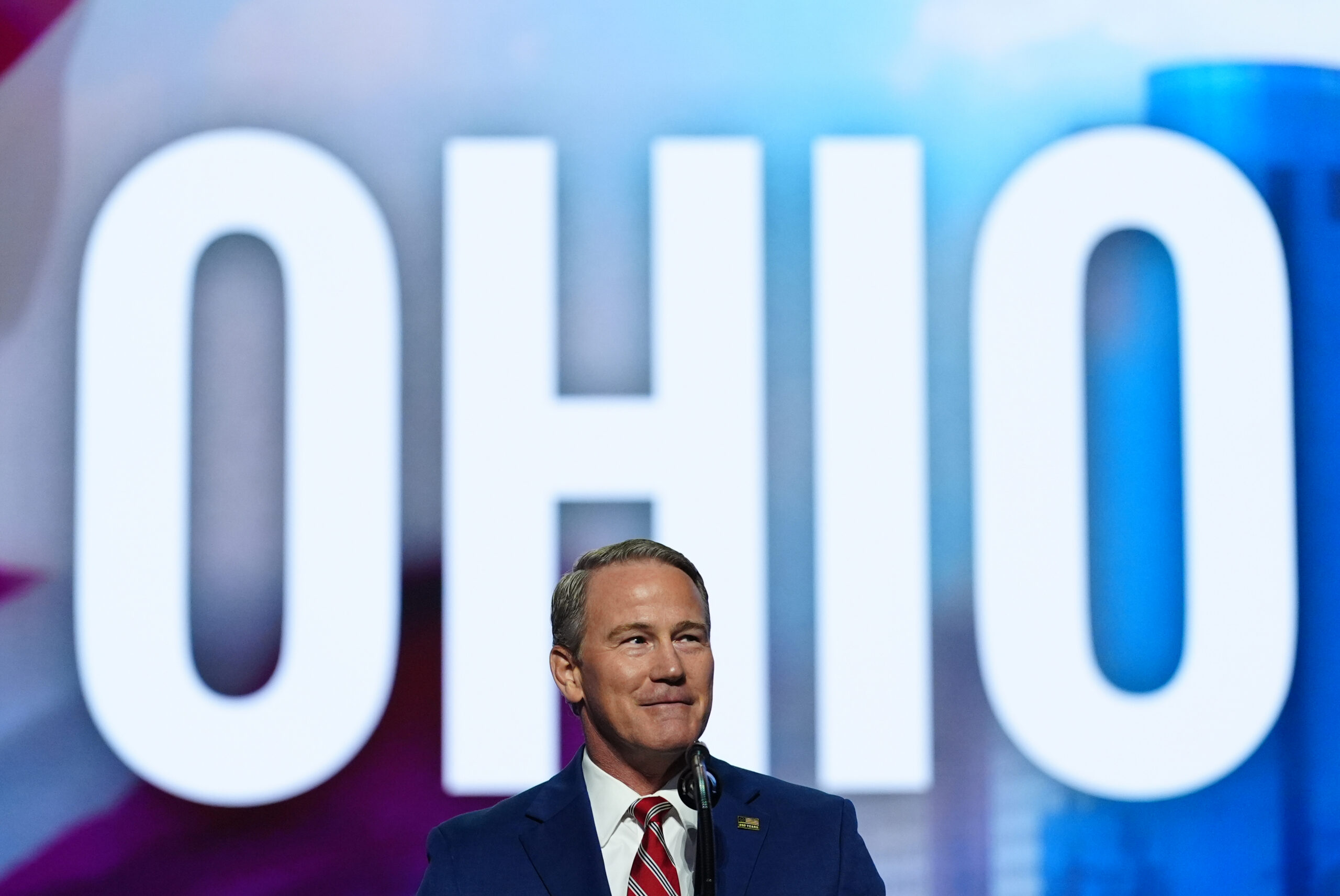
As Ohio prepares to launch a massive artificial intelligence data center, political friction has intensified over the billions of dollars in tax breaks the state used to lure the tech sector.
Entering the race to challenge Republican U.S. Senator Jon Husted, Democratic candidate Sherrod Brown released an advertisement asserting that Husted “led the push to bring data centers to Ohio and gave billions of tax dollars to make it happen.”
The Brown campaign has amplified this narrative across multiple digital ads and social media platforms.
The campaign spot features an unidentified resident criticizing Google’s facility in central Ohio’s Lancaster area.
“No one asked for that data center to be built here. And no one here is getting a damn thing from it, except higher electric bills,” the resident claims. “Jon Husted is the reason this is here.”
Husted built a long career in Ohio state politics spanning from 2001 until early 2025, culminating in his appointment by Republican Governor Mike DeWine to fill the U.S. Senate seat previously held by Vice President JD Vance. Serving as DeWine’s lieutenant governor, Husted actively championed data center growth, an industry that subsequently harvested billions in tax concessions.
Under Ohio regulations, the Ohio Tax Credit Authority handles exemptions for qualifying tech infrastructure. The panel weighs recommendations from the Department of Development and the state tax commissioner before finalizing any tax relief deals.
However, David Niven, a political science professor at the University of Cincinnati, noted that the tax authority functions essentially as an extension of the executive administration, adding that governors and lieutenant governors routinely take credit for the corporate tax perks cleared by the board.
Husted’s Record on Tech Recruitment and Tax Subsidies
According to a 2025 analysis by the Ohio Chamber of Commerce, data centers operating in the state pulled in roughly $2.5 billion in state and local tax breaks between 2017 and 2024. These exemptions were greenlit by the tax authority under the administrations of both former Governor John Kasich and Governor DeWine.
Husted’s most influential positioning on the issue occurred during his tenure as lieutenant governor from 2019 to 2025.
“Many, if not most Ohio lawmakers actively supported” the expansion of the data center industry locally, “and Jon Husted was certainly among them,” observed Robert Alexander, a political science professor at Bowling Green State University. “His position as lieutenant governor put him in key position to advocate on behalf of data centers and he did so enthusiastically.”
Back in 2019, Husted publicly defended the tax incentives tied to a $600 million Google facility in New Albany. That package included a 15-year state sales-tax waiver valued at approximately $43.5 million alongside local property-tax relief. Husted contended that the long-term economic gains would outweigh the upfront breaks, warning that forcing Google to pay standard sales taxes might have driven the company toward out-of-state investments.
By June 2023, Husted stood alongside DeWine and the private economic development group JobsOhio to unveil Amazon Web Services’ monumental $7.8 billion investment for a central Ohio data center. At the time, Husted framed the move as a vital stride toward cementing Ohio as the Midwest’s premier tech capital.
Several months later, in September 2023, the DeWine-Husted administration highlighted an Aligned Data Centers venture in Erie County, which secured a 15-year, 75% tax exemption while pledging to generate 18 permanent jobs.
The push continued into 2025, when Husted and DeWine celebrated a $10 billion expansion pledge from Amazon. Husted remarked that artificial intelligence and data centers were vital for American economic dominance, driving technological innovation and providing the computational muscle necessary for international competitiveness.
Historical Ties to Early Tax Exemption Frameworks
During his stint as Ohio House Speaker from 2005 to 2009, Husted held the power to appoint members to the Ohio Tax Authority. Inquiries sent to Husted’s reelection team and the Ohio Department of Development regarding his past appointments yielded no specific records.
Niven pointed out that while Husted backed the state’s tax credit mechanisms as speaker, the composition of the tax authority naturally shifted between his legislative leadership years and the later data center surge. Nevertheless, he noted that Husted’s broader involvement in executive appointments during the DeWine administration gave him clear leverage over regulatory boards.
The foundation for these perks was laid when the Ohio General Assembly passed legislation in 2011 establishing sales and use tax exemptions for eligible data center machinery, kicking off the state’s targeted incentive program.
Under Governor Kasich, the state introduced a complete 100% sales-tax waiver for qualifying facilities. Between 2014 and 2018, the Kasich administration locked in statewide exemption pacts with industry giants Amazon, Meta, and Google. Recent state calculations peg the value of those three initial agreements at roughly $600 million apiece, totaling about $1.8 billion.
Shifting Stances and Modern Pushback
As public pushback against the rapid spread and utility strain of data centers has mounted, Husted has adjusted his rhetoric, suggesting that fresh developments should forego tax exemptions while ultimately remaining a matter of local control.
This past July, Husted introduced the Ratepayer Protection Act to push states into forcing high-energy consumers—chiefly data centers—to shoulder the financial burden of the electricity generation and grid upgrades required to power them. Although a companion measure cleared the House, Husted’s attempt to secure unanimous Senate consent on September 17 fell short.
Controversies over transparency have also surfaced across Ohio. In Brown County, local leaders in the village of Mount Orab utilized non-disclosure agreements during negotiations for a proposed data center, sparking public outcry over suppressed information. The friction inspired legislative countermeasures like House Bill 695, which aims to ban local officials from using NDAs in such contexts, though the bill has yet to clear the legislature.
Fact-Check Summary
Sherrod Brown’s campaign advertisement claimed that Jon Husted “led the push to bring data centers to Ohio and gave billions of tax dollars to make it happen.”
As lieutenant governor, Husted actively promoted data center development throughout the state and aggressively defended the tax incentives utilized to attract major tech corporations. While the Ohio Tax Credit Authority technically possesses the power to issue these exemptions, political analysts emphasize that the board operates closely as an arm of the executive administration.
Consequently, Brown’s assertion is fundamentally accurate, though it benefits from the broader context surrounding executive influence and historical legislative policies.