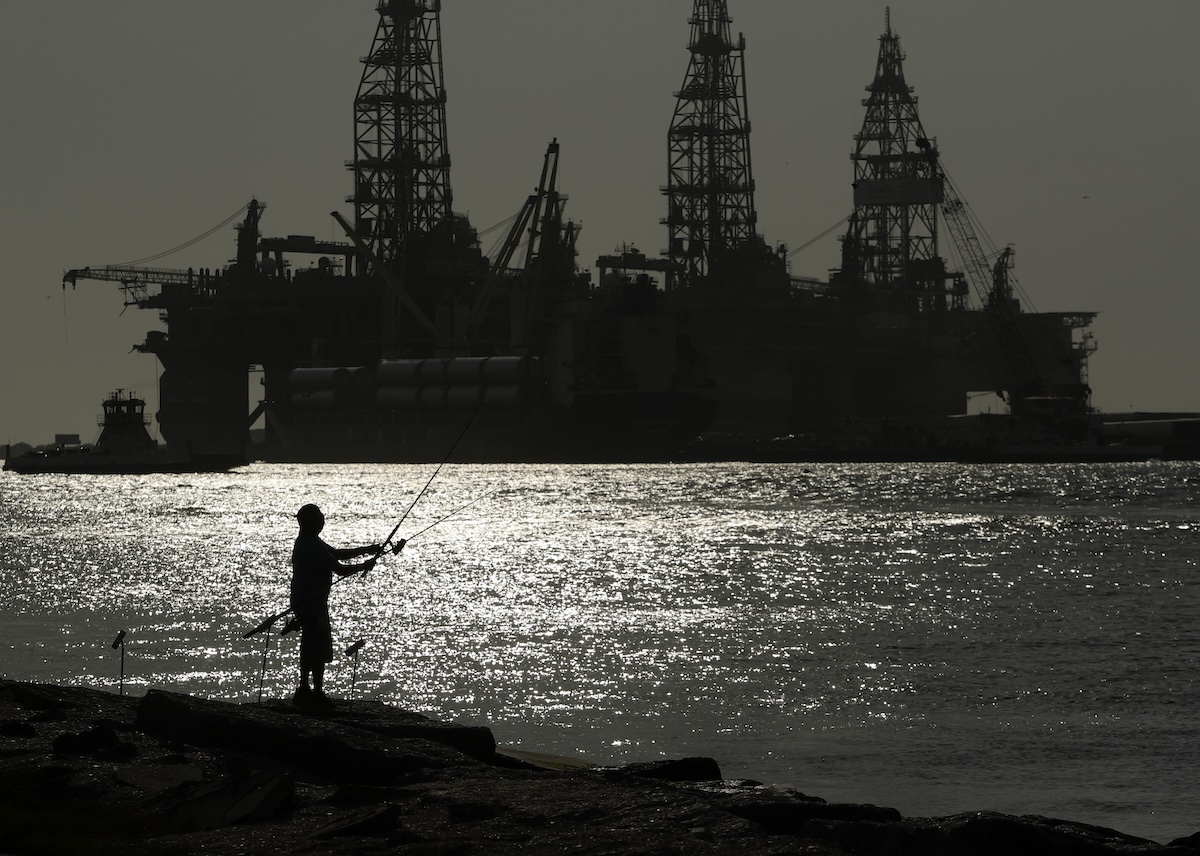
Offshore drilling has emerged as the latest flashpoint in Florida’s gubernatorial race.
In a recent campaign advertisement, Republican U.S. Rep. and gubernatorial nominee Byron Donalds alleges that his Democratic opponent, David Jolly, pushed for expanded offshore drilling in Florida waters shortly after the devastating 2010 Deepwater Horizon disaster in the Gulf of Mexico.
“While Florida was still cleaning up, lobbyist David Jolly was already cashing in,” the ad’s narrator states. “Just months after the spill, Jolly was in Washington, pressuring Congress to expand drilling off the Florida coast, over $5 million in billings.”
Before launching his political career as a Republican in 2014, Jolly worked as a lobbyist. Today, he maintains that he has always opposed drilling near Florida’s coastline, pointing to his legislative record as a former congressman trying to keep the practice away from the state. (Jolly later transitioned to an independent before registering as a Democrat in 2025 to run for governor.)
The central question remains: Did he actually lobby for drilling back then?
Donalds’ campaign insists he did, citing a 2014 PolitiFact Florida fact-check from Jolly’s initial House campaign. At the time, Jolly claimed he “never” lobbied for offshore oil drilling—a claim rated Mostly False.
Conversely, Jolly’s team highlights a separate fact-check from his unsuccessful 2016 Senate bid against former Gov. Charlie Crist. Crist claimed Jolly “used money and power to try to … drill off our beaches,” a statement also rated Mostly False.
The nuance lies in the details: As a lobbyist, Jolly was present at a meeting where offshore drilling legislation was discussed, which industry experts classify as technical lobbying. However, Donalds’ ad is misleading because it attributes his firm’s entire multi-million dollar revenue stream exclusively to drilling while completely omitting Jolly’s subsequent legislative efforts in Congress to shield Florida from offshore extraction.
Back in 2014, records showed a lobbyist disclosure form directly contradicted Jolly’s denial of ever lobbying for the issue. Jolly later clarified that while he attended a 2011 meeting touching on the topic, he did not actively advocate for the bill. Similarly, Crist’s 2016 assertions exaggerated the extent of Jolly’s lobbying footprint while ignoring his protective measures in Congress.
In response to Donalds’ spot, Jolly’s campaign reiterated that he consistently fought against drilling near Florida during his time in public office.
Meanwhile, Donalds’ team points out that in 2011, Jolly authored a blog post supporting a stalled bill—pushed by his client Free Enterprise Nation—that would have accelerated federal offshore oil and gas leasing.
Want more in-depth Florida election coverage? Sign up for the Florida midterms newsletter.
The Background: What Happened in 2011?
From 2011 through late 2013, Jolly operated his own lobbying practice, Three Bridges Advisors.
A federal disclosure form reveals the firm performed work during the first quarter of 2011 for Free Enterprise Nation, a now-defunct, pro-business, anti-regulation advocacy organization.
The group had endorsed H.R. 909, a piece of legislation designed to lift federal restrictions and promote offshore oil and gas exploration in the Atlantic, Pacific, and eastern Gulf of Mexico. Ultimately, the bill died in committee.
Jolly previously explained to PolitiFact that he included H.R. 909 on his disclosure paperwork simply because he attended a meeting where the client discussed it, maintaining that he “did not lobby on its behalf.” He added that he routinely practiced “overcompliance” in his filings and generally supported drilling outside of Florida’s protected 230-mile moratorium zone.
During Jolly’s lobbying era, offshore drilling near Florida was largely prohibited by the 2006 Gulf of Mexico Energy Security Act, which blocked drilling within 230 miles of Tampa Bay and 125 miles of the Panhandle until its expiration in 2022. Furthermore, Florida voters heavily approved a constitutional amendment in 2018 permanently banning drilling in state-controlled waters.
Compliance and lobbying experts noted in 2014 that while it’s difficult to verify conversations behind closed doors, professionals frequently over-report topics on disclosure forms out of caution to avoid legal penalties.
Kenneth Gross, an attorney specializing in political law compliance, confirmed that over-reporting lobbying activities is a common industry practice. While an April 2011 blog post written by Jolly highlighted the client’s support for H.R. 909, the organization’s founder and former CEO Jim MacDougald stated in 2014 that Jolly was never hired to advocate for that specific bill and primarily represented them on other matters.
Federal guidelines mandate that lobbyists disclose any legislative topic discussed on behalf of a client, which encompasses research, strategic planning, and direct communication with officials.
Omissions in the Donalds Advertisement
The primary flaw in Donalds’ commercial is its exaggeration of Jolly’s lobbying scope and its total omission of his congressional record fighting against drilling near Florida.
The ad claims Jolly brought in over “$5 million” specifically to pressure Congress into opening up Florida’s coast. However, public financial disclosures reveal that the $5 million figure represents Three Bridges Advisors’ *total* revenue across all clients and policy areas—not income derived strictly from oil and gas interests.
In fact, Three Bridges Advisors reported pulling in $30,000 from Free Enterprise Nation in 2011, with no subsequent filings indicating additional payments from that client.
Furthermore, as a Republican lawmaker in 2014, Jolly actively opposed seismic testing and oil exploration off the Atlantic coast out of fear it could trigger a spill in the Gulf. He signed a bipartisan letter to President Barack Obama opposing the testing—a project that was ultimately scrapped.
In 2015, Jolly co-sponsored bipartisan legislation aiming to extend the eastern Gulf drilling moratorium through 2027. He also successfully introduced an amendment countering a Senate initiative that could have expanded drilling near Florida’s Gulf shores.
While Jolly generally supported domestic energy production, he drew a firm line at Florida. In a 2015 op-ed, he argued that Florida’s economy should not gamble with its coastline. He reiterated in 2016 that he favored drilling in the western and central Gulf while strengthening protections in the east.
Today, Jolly’s gubernatorial campaign says his stance has evolved alongside energy technology. “We should eventually move away from offshore drilling altogether,” Jolly stated via email, noting that while the transition must be practical, it should remain a long-term national goal.
The Verdict
Donalds’ ad asserts that following the Deepwater Horizon catastrophe, Jolly headed to Washington and raked in “over $5 million in billings” to lobby Congress for expanded drilling off Florida.
The record shows that while working as a lobbyist in 2011, Jolly participated in a meeting with a client whose supported legislation could have expanded offshore leasing, and he duly reported the bill on his disclosure forms. Although he contends he did not actively lobby for the provision during the meeting, transparency experts note that attending such discussions technically constitutes lobbying.
However, the ad falsely equates his firm’s total cumulative earnings across all clients and issues with oil and gas lobbying revenue. It also completely ignores Jolly’s established legislative record blocking drilling off Florida’s coast and his current opposition to the practice.
Because the claim contains a kernel of truth but leaves out vital context that alters the narrative, it is rated Mostly False.
RELATED: $1,000 hurricane tax? Fact-checking claims about Jolly’s proposal for Florida homeowners insurance