
A recent political advertisement targeting Josh Turek, the Democratic candidate for the U.S. Senate in Iowa, accuses him of dismissing border security and advocating for “amnesty” for undocumented immigrants.
The commercial features a narrator stating, “Liberal politician Josh Turek supports amnesty for illegals,” alongside footage of Turek remarking, “We need an easier pathway to citizenship.”
Released by the Senate Leadership Fund super PAC, the ad incorporates visuals of individuals crossing a river and dismantling wire barriers to support its narrative that Turek favors weak immigration policies. It broadcast nationally on September 26 during the football game between the University of Iowa and the University of Michigan.
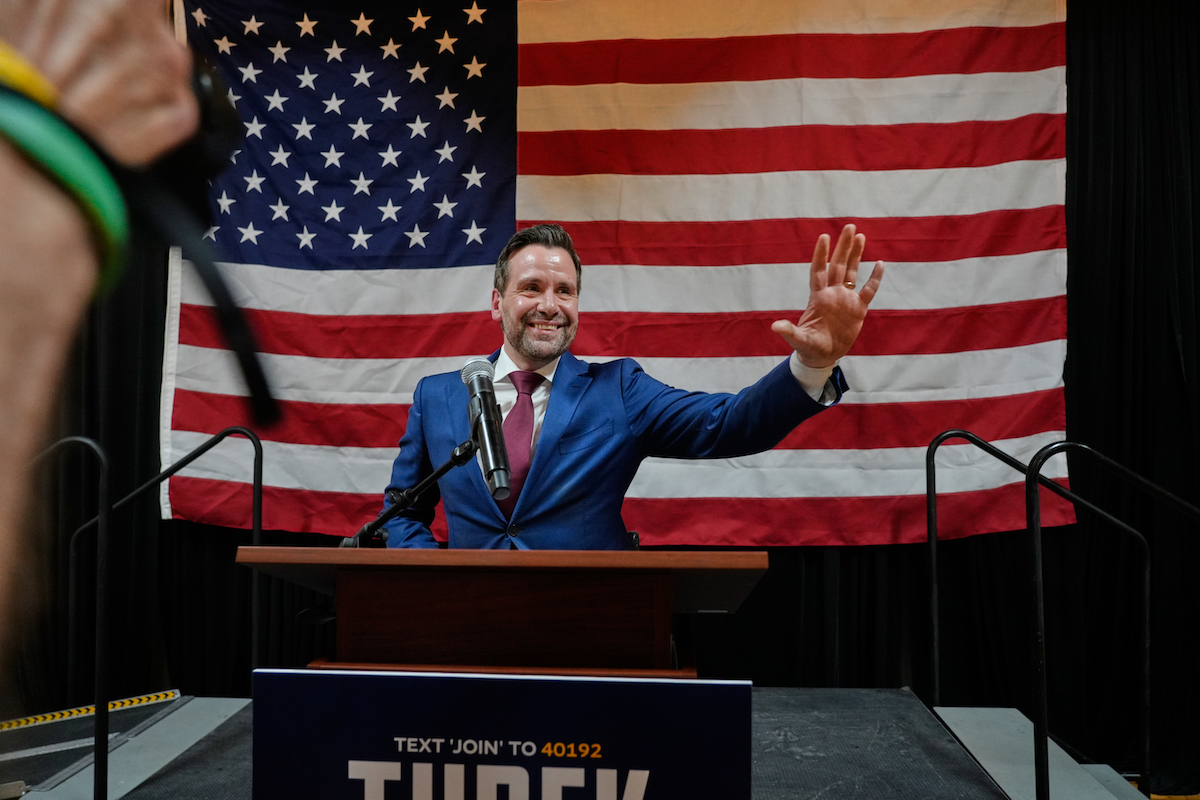
Turek, a state representative and two-time Paralympic gold-medalist wheelchair basketball player, is locked in a high-stakes contest against Republican U.S. Rep. Ashley Hinson, a former journalist. The two are competing to occupy the Senate seat being vacated by retiring Republican Senator Joni Ernst. Conservative critics have repeatedly characterized Turek as an advocate for expansive protections for individuals residing in the country unlawfully.
However, the campaign ad paints an oversimplified picture of Turek’s platform, relying heavily on a fluid definition of “amnesty”—a term that lacks a formal legal designation within federal immigration statutes.
While Turek has voiced opposition to Donald Trump’s hardline immigration measures, he maintains that he backs rigorous border enforcement. He has also argued that the legal immigration process should be more accessible, frequently mentioning his wife, who emigrated from the Dominican Republic. Even so, he stops short of backing blanket citizenship for all undocumented residents, instead suggesting that certain individuals should be allowed to remain under strict, qualifying conditions.
The specific quote featured in the commercial is pulled from a May primary debate, where Turek expressed support for the Dignity Act. This bipartisan congressional bill proposes granting restricted legal status to qualifying undocumented immigrants who meet specific criteria, though it does not establish a guaranteed route to citizenship.
As a super PAC, the Senate Leadership Fund faces no financial caps on the funds it can raise and deploy to influence federal elections. When questioned about the basis for their claim that Turek supports amnesty, a spokesperson for the group, Chris Gustafson, directed inquiries to those debate remarks and the specifics of the Dignity Act.
Below is a closer look at the claims made in the campaign’s messaging.
Defining ‘amnesty’ and evaluating the Dignity Act
In its broadest sense, amnesty can refer to any policy that forgives or waivings penalties for breaking immigration laws. In a narrower context, critics often use it to describe mass legalizations or the granting of citizenship to undocumented populations.
Ilya Somin, a law professor at George Mason University, notes that the term functions primarily as a political talking point rather than a legal standard, frequently weaponized by opponents to criticize any softening of immigration penalties.
What remains evident is that the Dignity Act endorsed by Turek does not fit the narrower definition of blanket citizenship.
“If your definition of amnesty is complete forgiveness with no strings attached, this legislation doesn’t fit that description,” Somin remarked regarding the act.
Authored by Republican Rep. María Elvira Salazar of Florida and Democratic Rep. Veronica Escobar of Texas, the Dignity Act boasts 38 bipartisan cosponsors split evenly across both parties. The latest iteration was introduced in July 2025 and has yet to advance through committee review.
Under the proposed bill, immigrants who entered the U.S. unlawfully prior to 2021 could apply for a specialized “dignity status” provided they maintain employment or enrollment in school, pass comprehensive background checks, and pay a $7,000 penalty alongside both back taxes and ongoing tax obligations. Individuals with felony records would be strictly disqualified.
Acquiring this status would not grant permanent residency; participants would be required to renew their standing every seven years and would remain ineligible for federal benefits or direct U.S. citizenship.
Additionally, the framework would allow individuals brought to the United States as minors—commonly known as “Dreamers” — to secure legal status and eventually pursue permanent residency. From there, they could navigate the traditional pathways to naturalized citizenship available to all permanent residents.
The legislation also bundles numerous enforcement enhancements, such as mandatory E-Verify usage for employers, increased funding for physical border barriers and surveillance technology, and harsher sentences for unauthorized border crossings.
Steve Camarota, research director at the Center for Immigration Studies—a think tank advocating for restrictive immigration policies—argues that despite these provisions, the bill constitutes amnesty because it ultimately waives penalties for unlawful entry.
“You pay a fine, you comply with rules, you wait a certain duration—that is still a form of amnesty,” he stated. “And that is precisely what this bill establishes.”
Even among the bill’s architects, opinions are divided on whether it qualifies as amnesty. The Senate Leadership Fund highlighted a statement from Republican Rep. John Duarte of California, who conceded, “If you want to call it an amnesty, I’m comfortable with the word.”
Conversely, other Republican cosponsors firmly reject that characterization. During an April radio interview, Iowa Republican Rep. Zach Nunn asserted, “This is not an amnesty bill.” Similar pushback has come from Republican Reps. Mike Lawler of New York and Gabe Evans of Colorado.
Reviewing Turek’s legislative record and public remarks
Turek previously defied his party leadership in 2024 by aligning with Republicans to support tighter immigration constraints. He was one of a trio of Iowa House Democrats who voted in favor of state-level legislation criminalizing unauthorized presence in Iowa and empowering local authorities to enforce immigration laws.
Furthermore, while Turek suggested during his primary debate that he would be open to “permanent residency or citizenship” pathways for certain qualifying undocumented individuals, that stance goes beyond the actual text of the Dignity Act.
In response to inquiries, Turek’s campaign emphasized that he does not support a general pathway to citizenship for undocumented residents. Campaign spokesperson Hannah Goss dismissed the super PAC’s claims as “categorically false,” pointing to his willingness to break with Democrats on enforcement votes and reiterating his support for streamlining the legal immigration process for those entering lawfully.
Our assessment
A political commercial from the Senate Leadership Fund alleges that Turek “supports amnesty” for individuals residing in the country unlawfully.
Turek has expressed openness to letting certain undocumented immigrants access a restricted legal status contingent upon paying fines, though such provisions explicitly exclude citizenship. Proponents of strict border enforcement view this compromise as a form of amnesty because it softens legal penalties.
At the same time, Turek has occasionally mentioned supporting a broader “pathway to citizenship” without clarifying whether those remarks apply to individuals currently in the country without authorization.
While interpretations of amnesty vary, the specifics of the Dignity Act are crucial: the bill does not grant citizenship and sets a high threshold for obtaining limited legal standing.
Because the commercial captures elements of Turek’s stated positions while omitting critical nuances and context, the claim is rated Half True.