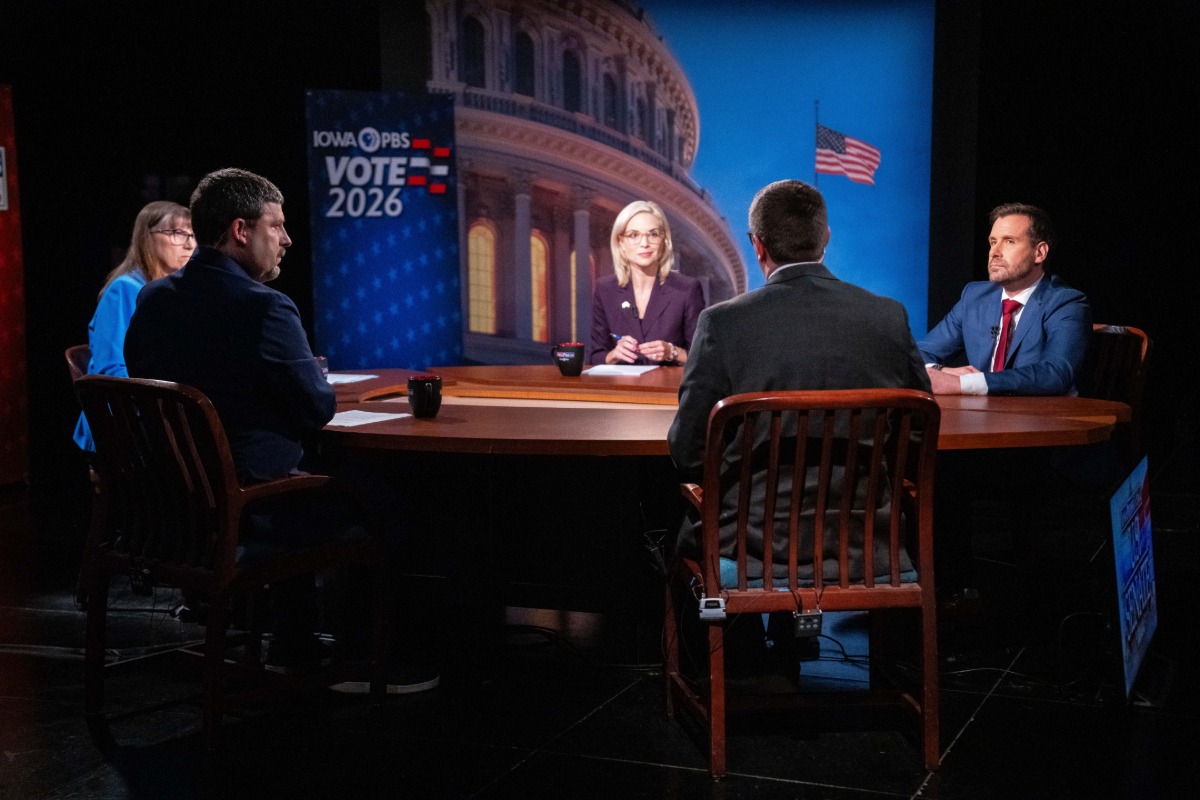
Republican Ashley Hinson and Democrat Josh Turek, the candidates vying for Iowa’s open U.S. Senate seat, faced off in their inaugural debate on Oct. 7, locking horns over immigration, healthcare, and the financial disclosures behind their campaigns.
The high-stakes race to succeed retiring GOP Senator Joni Ernst features Hinson, a three-term congresswoman and former television news anchor, against Turek, a state lawmaker representing Council Bluffs who is also a two-time Paralympic gold medalist in wheelchair basketball.
Throughout the evening, Turek sought to link Hinson to the ongoing conflict involving Iran, escalating gas prices, agricultural tariffs, and soaring medical expenses. In turn, Hinson targeted Turek’s attendance record in the Iowa House, cautioning that his policies would lead to relaxed immigration enforcement and higher taxes.
The Johnston studios of Iowa PBS, located just outside Des Moines, served as the venue for the debate.
Following the event, statements from both candidates were subjected to fact-checking.
Turek: “Ashley Hinson has voted in favor of (the Iran war) seven times.”
This statement is largely accurate.
Hinson has cast votes opposing six separate resolutions that sought to utilize Congress’ authority under the War Powers Resolution to mandate an end to the Iran conflict. Her most recent dissenting vote occurred on Sept. 15, when a coalition of seven Republicans joined Democrats to pass the measure through the House, though it ultimately stalled in the Senate.
The seventh vote cited by the Turek campaign took place on June 30, when Hinson voted against a resolution introduced by Democratic Representative Rashida Tlaib of Michigan aimed at pulling U.S. troops out of hostilities in Lebanon. While observers pointed out at the time that no American forces were actively engaged in combat in Lebanon, the localized fighting between Israel and Hezbollah remains tied to the broader Iran situation and has complicated potential peace efforts. However, that specific vote was not a direct referendum on ending the Iran war itself.
During the debate, Hinson stated her desire for a swift and successful conclusion to the military engagement, though she emphasized her opposition to congressional restrictions on President Donald Trump’s command of the armed forces.

Hinson: Turek “has said publicly that he supports the Dignity Act, which would allow for basic amnesty.”
A nearly identical assertion previously received a Half True rating.
The term “amnesty” lacks a strict legal definition, leaving it open to interpretation—some view it as any reduction in penalties for immigration violations, while others define it strictly as conferring citizenship upon a large, undocumented population.
Turek has expressed backing for the Dignity Act, a bipartisan legislative framework that would permit certain undocumented individuals to remain in the U.S. provided they maintain employment or educational enrollment, clear background checks, and pay a $7,000 fine alongside owed back taxes. Participants granted this specialized status would not receive a pathway to permanent residency or citizenship. The bill does, however, contain a separate mechanism for individuals brought to the country as minors, commonly known as Dreamers, to pursue permanent legal status.
Critics of the legislation from a restrictionist perspective argue that waiving penalties for qualifying individuals amounts to amnesty, even though the bill sets high hurdles and excludes most undocumented immigrants from obtaining citizenship.
In his debate remarks, Turek emphasized his support for robust border security and the deportation of undocumented individuals convicted of violent offenses. He criticized the enforcement strategies of the Trump administration while advocating for streamlined legal immigration channels.
Turek targets Hinson wealth gain and Hinson denies owning stock
Turek revisited a frequent line of attack concerning Hinson’s personal financial growth during the debate.
“In just six years of being up in D.C., Ashley Hinson is up to 15 times more wealthy, still owns up to $5 million of private stock,” Turek stated.
Hinson pushed back against the accusation, asserting that she and her spouse liquidated their individual stock holdings immediately upon her initial election to Congress in 2021.
Both statements require additional context.
Congressional financial disclosure rules permit lawmakers to report asset values in broad brackets rather than exact figures. Hinson’s 2025 disclosure lists total assets between $2.3 million and $8.8 million with zero reported liabilities. By comparison, her filing for the 2020 tax year—submitted when she first entered office—reported assets ranging from $726,000 to $2.4 million, alongside debts totaling $65,000 to $150,000.
Turek’s “15 times” multiplier is calculated by comparing the lowest estimated value from her 2020 filing against the highest estimated value in her most recent report. When evaluating the averages across both periods, Hinson’s net worth has indeed grown substantially, though the increase reflects a factor of four rather than 15.
The primary driver of this financial expansion is a single asset: her husband’s equity stake in Highstreet Insurance Partners, a private equity-backed consolidator of local insurance agencies, which is valued between $1 million and $5 million on her latest disclosure.
Hinson’s husband, Matt Arenholz, whom she married in 2008, held a partial ownership interest in an independent agency known as Transportation Insurance & Consultants Inc., which was acquired by Highstreet in 2021. That initial local stake was valued between $250,000 and $500,000 on the 2020 disclosure. Following the buyout, Arenholz received equity in the parent company, accounting for the multi-million-dollar valuation cited by Turek.
This differs significantly from purchasing equities on the public stock market. On that specific point, Hinson’s assertion holds true: her filings show no direct individual stock holdings beyond mutual funds and exchange-traded funds.
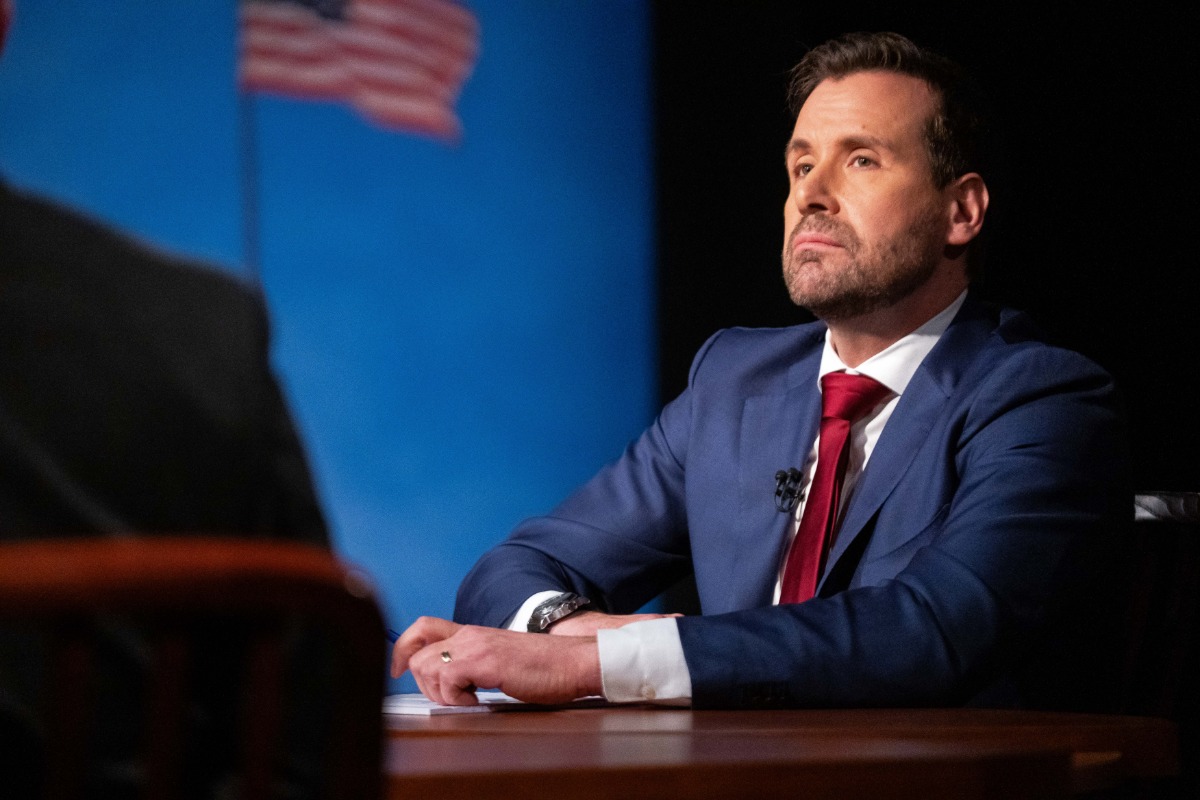
Hinson and Turek spar over Medicaid effects of One Big Beautiful Bill Act
Turek criticized Hinson for supporting the One Big Beautiful Bill Act, the prominent 2025 tax and spending legislation championed by Trump, claiming her vote caused “110,000 Iowans to lose their healthcare.”
In response, Hinson countered that Turek advocates for repealing the entire measure, arguing that doing so would immediately restore Medicaid coverage to undocumented immigrants.
A look at the underlying facts reveals the details behind both assertions.
The legislation implemented stricter Medicaid eligibility criteria, including the addition of work mandates, while disqualifying certain lawfully present immigrant populations, such as refugees and asylum seekers, from program benefits.
Additionally, congressional Republicans declined to renew temporary federal subsidies that assisted consumers with Affordable Care Act marketplace premiums—a key priority for Democrats.
Projections from the Congressional Budget Office indicated that the law’s structural modifications will lead to 10 million additional uninsured individuals by 2034, with the expiration of marketplace subsidies contributing another 4.2 million over the same timeframe.
Focusing strictly on the direct statutory changes, health policy research from KFF estimated that approximately 80,000 Iowans would lose coverage by 2034. The 110,000 figure cited by critics incorporates the separate expiration of the ACA subsidies.
While Turek has voiced opposition to these healthcare alterations and called for their reversal, he clarified during the debate that he favors the bill’s provisions eliminating taxes on tips, overtime wages, and Social Security benefits, while objecting to tax reductions aimed at high earners.
Regarding undocumented immigrants, the legislation did not alter their Medicaid eligibility status, as they were already largely barred from federally funded benefits—a dynamic that would remain unchanged if the law were repealed.
Certain states utilize local revenues to provide health coverage for undocumented residents. While an early House iteration of the federal bill sought to penalize those states by reducing federal Medicaid matching funds, that provision was removed prior to final passage.
When questioned about how the legislation stripped benefits from undocumented individuals, Hinson’s campaign directed inquiries to an analysis by the Economic Policy Innovation Center. The conservative think tank argued that restrictions on taxes states can levy against Medicaid providers indirectly constrain state budgets, potentially forcing states like California to scale back their locally funded healthcare initiatives.
While federal programs do cover emergency medical services provided to otherwise ineligible individuals, the law adjusted reimbursement levels without enacting broad programmatic shifts in eligibility.