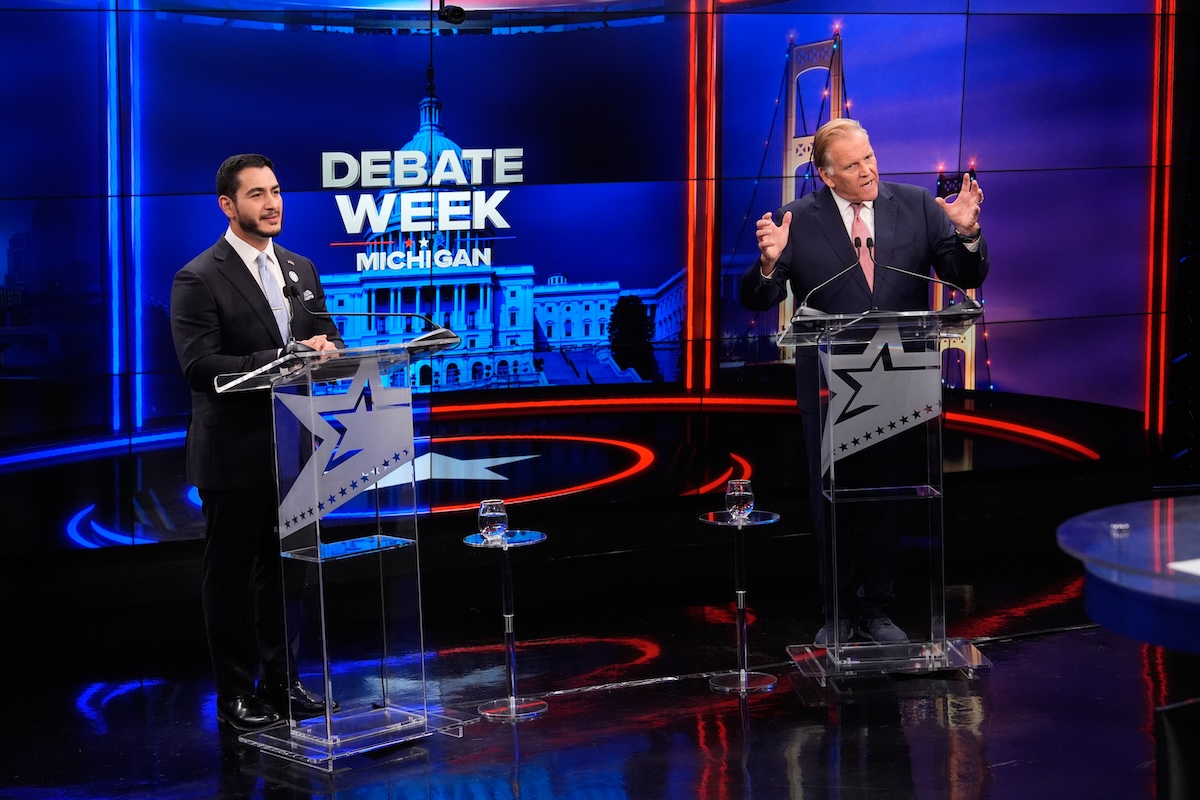
The first debate between Michigan Senate candidates Abdul El-Sayed, the Democratic nominee, and Mike Rogers, his Republican opponent and former U.S. representative, quickly devolved into a flurry of personal jabs on October 8. True to the tone of their contentious race, the hour-long showdown on Grand Rapids’ WOOD-TV featured sharp rhetoric and overlapping cross-talk right from the start.
The friction peaked when Rogers, defending his past support for federal surveillance, hinted that El-Sayed might have a family member linked to a terror watch list. After El-Sayed challenged him to speak up, Rogers instead pivoted to an accusation connecting El-Sayed’s mother to al-Qaida.
For viewers just tuning into the contest, keeping up with the rapid-fire accusations was no easy task. Here is a closer look at the factual accuracy behind some of the most prominent personal claims made by both candidates.
Fact-Checking Mike Rogers
Rogers claim: “What your mom was working at — I was going after that organization that was indicted for funneling money to al-Qaida.”
While El-Sayed’s mother did work for an organization later labeled a terror supporter, records show no indication that she was personally involved in any illegal activities.
Fatfen Fathy Elkomy, El-Sayed’s mother, was employed by the Islamic American Relief Agency between 1999 and 2004, according to reporting by the Michigan publication The Midwesterner. The U.S. Treasury Department officially designated the group as a supporter of terrorism—citing financial ties to figures like Osama bin Laden—later in 2004. El-Sayed’s parents divorced when he was young, and both subsequently remarried.
Rogers claim: El-Sayed “has taken money from groups associated in support (of) the Muslim Brotherhood. He has taken money from individuals on his campaign who openly support Hamas, Hezbollah, al-Qaida.”
This statement relies on selective linkages between El-Sayed and specific donors or advocacy groups.
When asked for evidence, the Rogers campaign pointed to various reports highlighting controversial ties among certain supporters. For instance, El-Sayed’s father-in-law, Tayeb Jukaku, has contributed heavily to a super PAC supporting El-Sayed and is affiliated with the Islamic Society of North America—a group that faced unproven 2007 allegations regarding Hamas ties, though a federal judge later ruled prosecutors violated the organization’s rights.
Additionally, Fox News reported that El-Sayed received donations from individuals tied to the Council on American-Islamic Relations (CAIR), an organization frequently targeted by conservative lawmakers over alleged extremist connections—though CAIR maintains those accusations are politically motivated. Other conservative outlets have highlighted donations from figures linked to the Muslim Brotherhood or individuals who have publicly praised militant groups.
In response, El-Sayed dismissed the attacks as Islamophobic and an attempt to divert attention from substantive issues like the cost of living.
Rogers claim: “He’s not really a doctor. He says he’s a physician. As a matter of fact, if somebody came into his office and he tried to treat that patient, he’d go to jail.”
Rogers is correct that El-Sayed does not practice medicine, but he does hold legitimate doctoral degrees.
El-Sayed earned a medical degree from Columbia University alongside a doctorate in public health from Oxford University. However, the title of “physician” is a point of contention. While El-Sayed has used the title professionally, public records show he never completed a medical residency or held a medical license in Michigan or New York, opting instead for a career in public health after graduating.
Under Michigan law and standard colloquial usage, a physician typically denotes a licensed practitioner who treats patients. Conversely, the American Medical Association defines a physician simply as someone holding an M.D. or equivalent degree, without explicitly requiring an active license.
Rogers claim: El-Sayed “can’t condemn a terrorist act that happened on our soil in the state of Michigan.”
This claim has been previously evaluated and rated as Mostly False.
Following a March attack on a Michigan synagogue, El-Sayed released a video statement explicitly declaring, “I condemn what he did,” and adding there was “never a justification for attacking innocent people or houses of worship.”
Controversy arose because he also noted in the same video that “hurt people hurt people,” referencing the attacker’s background, which critics interpreted as an attempt to rationalize the violence. El-Sayed has since apologized for his phrasing.
Fact-Checking Abdul El-Sayed
El-Sayed claim: “What (Rogers) has been serious about is making sure that he can monetize his time in public office — $14 million, two yachts, a McMansion in Florida.”
Public financial disclosures indicate that Rogers experienced a substantial increase in wealth after leaving Congress in 2015, making a $14 million growth plausible. Financial estimates placed his net worth between $800,000 and $1.7 million in 2015, compared to an estimated $10.1 million to $16.9 million by 2025.
County records confirm that Rogers and his wife own a 4,751-square-foot Florida residence featuring five bedrooms and 3.5 bathrooms, which has been intermittently listed for sale. Property improvements also include a newly added pier and boat lift.
While the El-Sayed campaign produced registration documents for two Maryland-registered boats purchased by Rogers in 2015 and 2017, independent verification of ownership was not confirmed. During the debate, Rogers denied ever owning a yacht in Florida.
El-Sayed claim: Rogers “called himself Big Pharma’s ‘champion’,” and took “a million dollars alone from Big Pharma.”
Rogers did use the term “champion,” though in a specific historical context.
During his time in the House, Rogers supported legislation aimed at expanding chronic care for pain management, a policy backed by opioid manufacturers who also contributed to his campaign. In a 2016 lobbying investigation, Rogers recalled the industry’s perspective, stating, “I think they said, ‘This guy is a champion, he’s doing something we believe in and we want to support guys like that,’” while denying that donations influenced his votes.
In addition to opioid interests, Federal Election Commission records show Rogers accepted substantial PAC donations from major pharmaceutical firms like Abbott and Merck while in office. The $1 million figure cited by El-Sayed stems from an analysis by the Michigan Independent using OpenSecrets data, which encompasses contributions from both industry PACs, company employees, and leadership PACs.
El-Sayed claim: Rogers “personally invested in the company, in the company that controls the real estate for the Saline data center.”
The El-Sayed campaign based this assertion on Rogers’ financial disclosures showing holdings of “between $100,001 and $250,000 worth of Blackstone Real Estate Income Trust.”
While Blackstone and Related Digital partnered on a $16 billion data center project in Saline Township, Michigan, financial reporting indicates Rogers invested in a distinct trust managed by Blackstone rather than the firm directly. Reports from Bloomberg and Blackstone’s 2026 earnings statements attribute the data center equity to a different fund, Blackstone Real Estate Partners, rather than the specific trust held by Rogers.
El-Sayed claim: Rogers has “cheerled” the Iran war “since the beginning. Called it a ‘win, win, win.’”
Rogers’ stance on the conflict has evolved over time.
Following U.S. airstrikes in Iran ordered in February, Rogers voiced strong support, describing the operation as leaving Iran “toothless” and calling it an unprecedented opportunity for Middle Eastern peace. By May, he characterized the objective of neutralizing Iran’s nuclear capabilities and aggression as a “win, win, win,” while expressing a desire for a swift conclusion.
By late September, however, Rogers adopted a more definitive anti-war position, stating firmly in a social media video that the conflict needed to end immediately.