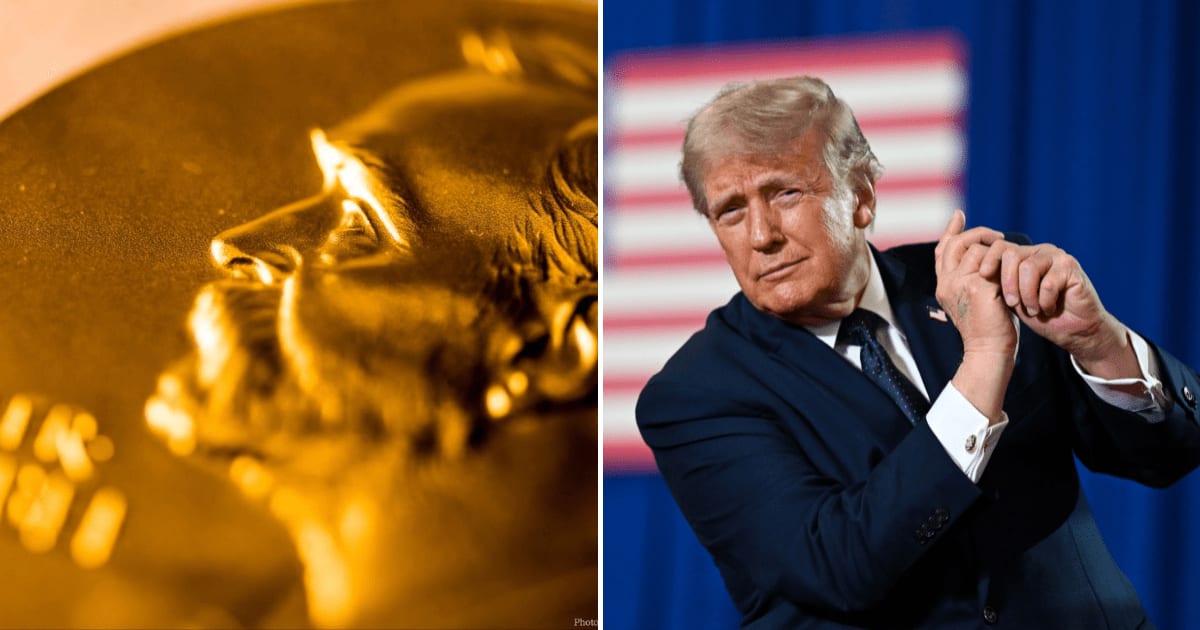
I am one of the five members of the Norwegian Nobel Committee—appointed by a parliament most of the world couldn’t locate on a map—tasked with deciding once a year who embodies global virtue. I often ponder this while riding the tram. We convene in a building on Henrik Ibsens gate, a street named after an author famous for writing about people realizing they are frauds. Only I seem to find the irony in that.
Inside our meeting room, portraits of past laureates look down from the walls: Mandela, the Dalai Lama, and numerous earnest men in glasses. There is also one portrait we never talk about—Henry Kissinger, 1973, awarded while bombs were still falling. Two committee members resigned in protest back then, and satirist Tom Lehrer famously declared that political satire was dead. Yet, we keep Kissinger on the wall. Every family has that one uncle.
It’s October in Oslo, which means the sun clocks out by four in the afternoon like a weary civil servant, leaving behind that distinct Norwegian drizzle that doesn’t quite fall so much as hang in the air to judge you. I always arrive with wet shoes. There is always coffee, because this is Norway, where we consume more caffeine per capita than almost anyone else on Earth. Someone’s spouse usually sends kanelboller (cinnamon buns), and the five of us sit there—damp, caffeinated, and sugared up—determining the moral hierarchy of the human race.
People imagine a grand cathedral, but I assure you, it’s nothing more than a book club with a very specific mandate.
We had 287 nominations this year: 208 individuals and 79 organizations. Anyone can submit a name—a professor, a lawmaker, a past winner. Because the criteria are so broad, the “nominee” list is essentially just a giant suggestion box. Every autumn, some random politician nominates their golden retriever, and the media runs headlines declaring the pet “shortlisted.” There is no public shortlist. There is just us, the coffee, the rain, the wall of portraits, and a stubborn Norwegian tenacity that predates the prize itself.
We read thick, tedious reports compiled by the institute’s advisers and then we debate. Our chairman once told the BBC that our final meetings feature “high temperature.” For a Norwegian, “high temperature” means someone raised an eyebrow slightly and then apologized for it. We don’t do shouting matches; we rely on long, loaded silences. Someone says “well,” and everyone instantly understands the unspoken verdict. That is our equivalent of a fiery argument. You have to be born here to catch the violence in a single “well.”
Now, let’s talk about this year. I won’t say his name, but you know who I mean. A certain prominent head of state wanted this prize the way a toddler covets a toy in a storefront window—loudly, publicly, and entirely convinced that simply wanting it was proof he deserved it. He claimed he had resolved eight different conflicts, a tally that seemed to grow every time he mentioned it.
He had other world leaders call our office on his behalf. Israel’s prime minister posted online demanding we give it to him. The leaders of Cambodia and Pakistan announced they had nominated him, as if public relations campaigns influenced our tally. He had people circling the globe collecting endorsements for us the way citizens circulate petitions about a barking dog.
And here is the detail that never fails to make me smile into my coffee: the nomination deadline is January 31st. He took office on January 20th. So, despite all the phone calls, social media posts, and aggressive lobbying, the only official nominations submitted in time for this year’s prize were filed during his first eleven days in office—long before he had, by his own count, solved a single war. He spent the entire year campaigning for an award whose application window slammed shut while he was still unpacking his bags.
We didn’t even have to reject him. The calendar did it for us. Norwegians are exceptional at watching things unfold from a distance. We endure very long winters, after all.
People assume we sit around analyzing his every action, but we don’t. We aren’t grading his homework, and we certainly don’t hand out medals simply because someone shouts about a ceasefire. “He made peace” is not a phrase that automatically triggers a gold medal, no matter how desperately he believes every positive outcome should bear his name.
The final will of a dead Swede dictates that the prize goes to whoever did the most to advance fraternity among nations. That same Swede made his fortune inventing dynamite and selling weaponry, only to spend his final years horrified by his obituary, which branded him a “merchant of death.” He bought his way into historical redemption as a patron of peace. In essence, the entire Nobel Peace Prize is just one guilty arms dealer’s public relations campaign. I find that wonderfully grounding. It keeps us humble—though, by my estimation, it rarely keeps anyone else humble.
So, who did we actually choose this year?
An eighty-five-year-old woman. A judge.
Born in Durban under apartheid, the granddaughter of a Tamil indentured laborer and the daughter of a bus driver from a poor Indian quarter, she became the first non-white woman to run a law practice in her province. She defended Mandela’s allies when doing so was perilous, served on the Rwanda tribunal and the International Court at The Hague, and—at eighty-five years old—is currently presiding as a judge evaluating whether atrocities constitute genocide.
When we announced her name to the world, our chairman noted that the rule of law “underpins the system we have set up to ensure peace” and that “peace requires justice.”
She wasn’t even in Oslo when the announcement was made. She was in Nuremberg—specifically in Courtroom 600, the historic room where the Nazis were tried. You couldn’t script a more poetic setting if you tried.
She didn’t call us. She didn’t post on social media. No prime minister demanded the honor on her behalf. She possessed the one qualification our loud-mouthed contender could never manufacture: she was entirely focused on the work, not the medal. The medal invariably finds people like her, just as it flees from those who chase it. It’s an unwritten rule born from a century of trial and error.
The backlash from across the Atlantic was instantaneous. A spokesperson claimed we “place politics over peace.” Ja. Perhaps we do. We are just five damp pensioners sitting in a rainy city; of course it’s political. It has always been political. It was political when we awarded it to a sitting American president nine months into his first term for unfulfilled promises, a decision we’ve quietly regretted for a decade and a half. That mistake gave us all the more reason this year to favor a woman with fifty years of tangible verdicts over a man with a string of wars behind him and a missed deadline.
Here is what he will never grasp—the truth I’d share with him on the tram if he ever rode one: We are the one accolade he cannot buy, lobby for, or bully into his possession through friendly dictators. Not because we are flawlessly incorruptible—we are just as vain, flawed, and human as the portraits staring down from our walls—but because the entire purpose of this small, cold nation’s book club is that the prize goes to someone who isn’t performing their desire for it. The moment you demand it, you prove you fundamentally misunderstand what it represents. And that entitlement is the ultimate disqualification.
He ran the most expensive lobbying campaign in the history of the prize, and that campaign was precisely why he lost. He wasn’t losing to Navi Pillay as an individual; he was losing to a principle.
It’s pitch black outside now—true four-o’clock winter darkness. The cinnamon buns are gone. Kristin uttered her definitive “well” an hour ago, and we all headed home.
Right now, I’m riding the tram with my damp shoes, while somewhere across the ocean, a very powerful man is telling a television camera that the prize is rigged, that we are corrupt, and that he’s guaranteed to win it next year. And honestly? He might. We are only five ordinary people, and we’ve been wrong before—after all, Kissinger is still on the wall.
Just not this year.
This year, an elderly woman in Nuremberg—sitting in the exact room where the law once confronted men who believed loud demands were enough to claim power—received a phone call she never solicited.
That is the job. We don’t reward the person who declares they ended a war. We reward the person who spends half a century defining what justice actually means. He will never understand the difference. But then again, that’s rather the point of him.
Takk for i dag. Time to change trams.