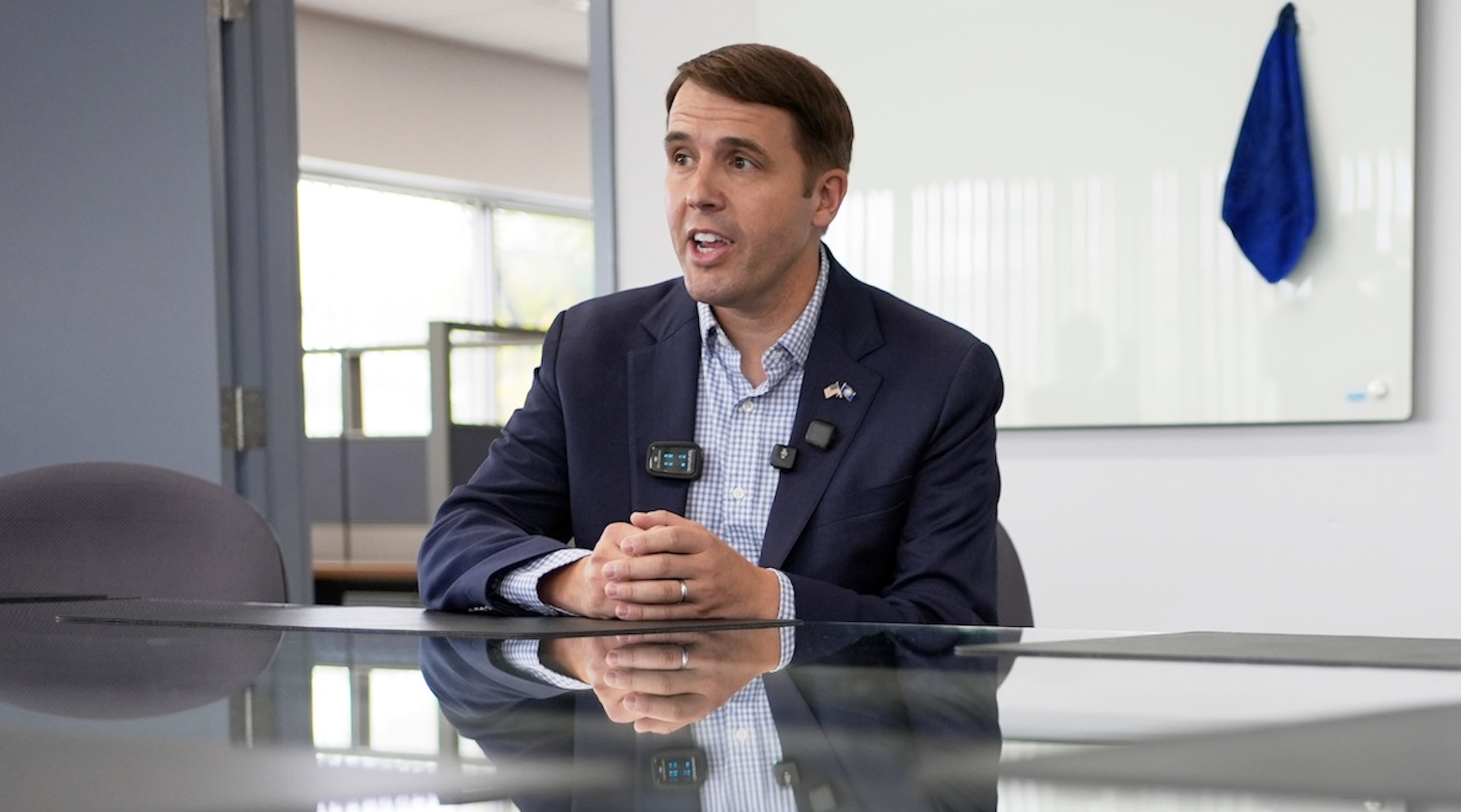
A campaign advertisement targeting Democratic U.S. Senate candidate Chris Pappas has revived a line of attack originally used six years ago when the New Hampshire congressman was seeking his second term.
Released by the Senate Leadership Fund—a super PAC backing Republican candidate John E. Sununu—the ad references a clash from an Oct. 21, 2020, debate co-hosted by PolitiFact partner WMUR-TV.
During that debate, Matt Mowers, Pappas’ Republican opponent at the time, confronted New Hampshire’s first openly LGBTQ+ member of Congress over his relationship with Vann Bentley, a former Amazon lobbyist. Mowers argued that the relationship could have improperly influenced several legislative votes cast by Pappas on matters concerning Amazon.
“You’ve been dating a corporate lobbyist, who actually was lobbying on behalf of Amazon at a time when you then went on to cast 10 separate votes on Amazon’s behalf, on bills they lobbied you on,” Mowers stated during the event.
Pappas pushed back immediately, telling him, “That’s not true, Matt.”
The Senate Leadership Fund’s current ad, which began airing Oct. 1, recycles this footage. A narrator summarizes the claim by stating: “Pappas lied about dating an Amazon lobbyist, then voted on bills Amazon lobbied on.”
However, that assertion is misleading. Following the 2020 debate, Mowers acknowledged that he had no proof Pappas broke any laws, acted unethically, or violated House regulations.
Did Pappas ‘lie’ about dating an Amazon lobbyist?
Representatives for Pappas state that he and Bentley began a romantic relationship in the spring of 2019, pointing to a Instagram post featuring the couple on Nov. 27, 2019.
The debate transcript shows a sharp back-and-forth rather than a straightforward, flat denial of the relationship:
Mowers: “With all due respect, you’ve been dating a corporate lobbyist, who actually was lobbying on behalf of Amazon at a time when you then went on to cast 10 separate votes on Amazon’s behalf. On bills they lobbied you on.”
Pappas: “That’s not true Matt. Matt, that’s not true.”
Mowers: “Yes it is, Congressman. It absolutely is.”
After Pappas countered by accusing Mowers of accepting campaign contributions from pharmaceutical companies, Mowers returned to the topic of Bentley.
Mowers: “You’re dating a corporate lobbyist, which by the way, you know, the fact of the matter is, he never disclosed it. You never disclosed it to the people of New Hampshire.”
Pappas: “That’s not true. Matt, come on.”
Mowers: “And in fact there’s actually rules and regulations. You have to disclose that, especially gifts from lobbyists, to the House ethics committee. Something you’ve never done. So this is an opportunity for you to come out and speak the truth.”
Pappas: “Matt, that’s just not true. … This is an outrageous charge.”
A review of internet archives and the Nexis news database indicates zero public reports regarding the relationship prior to the day after the 2020 debate, when the New Hampshire Union-Leader reported that Pappas’ campaign confirmed he was dating a former lobbyist.
Did Pappas vote on Amazon-related bills while Bentley was lobbying for the company?
There was indeed an overlap between Bentley’s tenure lobbying for Amazon and Pappas’ legislative votes on matters the company favored. While the Senate Leadership Fund portrays the relationship as the sole driver of these votes, this perspective leaves out critical context regarding the legislation itself.
The timeline of their relationship and professional lives shows that Bentley joined Amazon as a legal policy intern in September 2014 and became a policy counsel by May 2015. Pappas was sworn in for his inaugural term on Jan. 3, 2019, and the pair began dating that spring. Bentley departed Amazon in November 2019, and the couple married in 2023.
The Senate Leadership Fund points to seven specific bills Pappas supported while Bentley was registered as an Amazon lobbyist. Depending on the legislation, Amazon sought provisions like federal contracts or eased technology regulations, or supported broader social policies such as higher minimum wages and anti-discrimination protections. Public records confirm Amazon lobbied on each measure:
- Feb. 14, 2019: Pappas voted for a government-funding omnibus bill designed to prevent a shutdown. It passed 300-128, backed by 213 Democrats and 87 Republicans.
- May 17, 2019: Pappas voted for the Equality Act, which outlaws discrimination based on sex, sexual orientation, and gender identity. It passed 236-173 with support from 228 Democrats and 8 Republicans.
- June 19, 2019: Pappas voted in favor of the Labor and Health and Human Services appropriations bill. It passed 226-203 entirely along Democratic lines.
- July 10, 2019: Pappas voted for the Fairness for High-Skilled Immigrants Act, which adjusted employment-based visa caps. It passed 365-65, with 224 Democrats and 140 Republicans voting yes.
- July 12, 2019: Pappas voted for the 2020 National Defense Authorization Act. It passed 220-197 with unified Democratic backing and no Republican votes.
- July 17, 2019: Pappas voted for a three-year intelligence reauthorization bill. It passed 397-31 with broad bipartisan support (226 Democrats, 171 Republicans).
- July 18, 2019: Pappas voted for legislation increasing the federal minimum wage. It passed 321-199 with 228 Democrats and 3 Republicans in favor.
Federal quarterly lobbying disclosure filings from 2019 list Bentley as a lobbyist for Amazon, explicitly noting his work on several of the measures cited by the super PAC, including the defense and intelligence bills, the minimum wage increase, and the Equality Act.
However, attributing Pappas’ votes solely to Amazon’s lobbying ignores crucial context surrounding these measures.
Four of the targeted bills were massive, far-reaching packages that went well beyond Amazon’s corporate interests. Two served as primary federal funding vehicles—one of which was critical for averting a government shutdown—while the others renewed national defense and intelligence operations. Each contained hundreds or thousands of provisions entirely unrelated to Amazon’s lobbying agenda.
Furthermore, Pappas voted alongside the majority of his fellow House Democrats on every single one of these bills.
On at least three measures, Pappas’ votes aligned with long-standing positions or past campaign commitments. His support for the Equality Act predated his relationship with Bentley; he explicitly championed the bill during a 2018 WMUR debate. He similarly backed a minimum wage increase during a 2018 NHPR debate and had previously voiced support for encouraging immigration and expanding visa frameworks.
In two instances, Pappas actually voted against Amazon’s corporate preferences. The defense bill omitted a sought-after $10 billion Pentagon cloud services contract that Amazon had pursued, while the intelligence bill featured provisions demanding reports on facial recognition technology regulation—a market where Amazon held a significant stake.
Stanley Brand, a veteran congressional ethics attorney and distinguished fellow in law and government at Penn State Dickinson Law, noted that federal rules do not explicitly bar lawmakers from voting on legislation unless they hold a direct financial stake in the outcome. Brand affirmed that Pappas’ circumstances in 2019 would not have legally mandated a recusal.
Given the tenuous connection to any personal financial gain for Pappas, Brand observed, “I wouldn’t advise anyone to recuse, which effectively leaves his constituents without a voice on the bill being considered.”
Our ruling
The Senate Leadership Fund asserted that Pappas “lied about dating an Amazon lobbyist, then voted on bills Amazon lobbied on.”
While his relationship with Bentley may not have been broadly publicized prior to the 2020 debate, investigators found no evidence that Pappas actively lied about its existence.
Pappas did cast seven votes on legislation tracked by Amazon and Bentley. However, every vote mirrored the broader Democratic caucus, three aligned with positions he held prior to the relationship, and two directly contradicted Amazon’s corporate interests.
The statement contains a grain of truth but strips away necessary context that significantly alters the narrative. We rate the claim Mostly False.