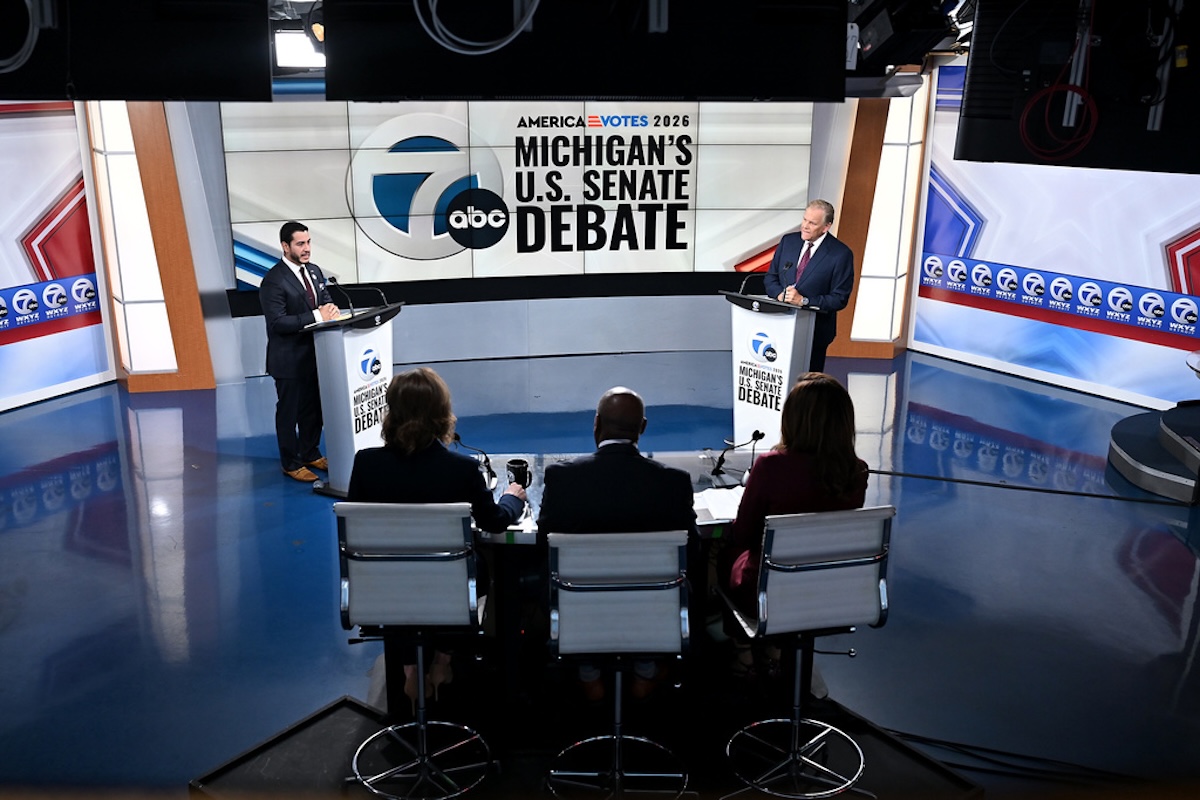
During their final showdown in Michigan’s U.S. Senate race, Democrat Abdul El-Sayed and Republican Mike Rogers went head-to-head, portraying each other as outside the mainstream while proposing contrasting strategies to tackle inflation and rising costs.
El-Sayed repeatedly attempted to tie Rogers to Donald Trump’s less popular policies, such as tariffs and the conflict in Iran, dismissing his opponent’s talking points as predictable “MAGA bingo.”
In response, Rogers launched attacks on El-Sayed’s credibility, claiming he misrepresented his status as a physician and misled the public about his citizenship. (While El-Sayed holds a doctorate in medicine, he lacks a practicing medical license.) Rogers also accused his opponent of having ties to extremist ideologies and warned that his signature “Medicare for All” agenda would significantly increase the tax burden on residents.
Despite the personal jabs, the candidates placed a stronger emphasis on actual policy than they did during their previous encounter. Below is an examination of the claims made during the October 21 debate moderated by WXYZ-TV in Detroit.
Explore the ongoing live analysis of the El-Sayed and Rogers matchup.
Hot Mics and Credibility Claims
El-Sayed: “Mike Rogers was just caught on a hot mic talking about how he wanted to make sure that there were retired cops who could intimidate voters in the city of Detroit.”
This claim stems from a leaked audio recording of Rogers addressing a regional Republican gathering back in April. Although the remarks were initially reported by local media in May, the audio itself emerged just days before the October debate. In the recording, Rogers expressed baseless concerns about ballots appearing to swing the 2024 Senate race—which he ultimately lost to Democrat Elissa Slotkin—and suggested deploying off-duty or retired law enforcement officers as poll watchers to push back against alleged 2024 intimidation of conservative monitors.
“Let’s put retired or off-duty police officers as our poll watchers in Detroit,” Rogers said in the clip. “Go ahead, try to intimidate them.”
Following the audio’s release, Rogers clarified in interviews that his intention was never to suppress voter turnout, but rather to ensure an election process that is accessible yet secure.
Rogers: El-Sayed “lied about being an Egyptian dual citizen.”
While El-Sayed previously documented himself as holding dual citizenship, his campaign later walked it back, calling it an error.
Investigative reporting earlier in the year revealed that an academic profile published around 2014 listed his citizenship as both American and Egyptian. Once questioned by journalists, the campaign removed the reference and stated that El-Sayed was never actually a dual citizen, explaining that he had simply been told as a child that his grandfather had secured Egyptian citizenship eligibility on his behalf.
Economic Debates: Trade Agreements and Energy Costs
El-Sayed: Rogers supported NAFTA, said it would be good for U.S. workers.
Rogers pushed back against accusations that he backed the North American Free Trade Agreement, noting that it was enacted before his tenure in Congress began in 2001. However, archival footage from a 2000 congressional debate shows Rogers predicting that NAFTA would benefit the American workforce over time, despite acknowledging potential initial hurdles.
During his years in the House of Representatives, Rogers consistently voted in favor of several other international trade pacts aimed at reducing export barriers. In his current Senate bids, however, he has shifted his stance, criticizing unfavorable trade deals that harmed the domestic auto industry and throwing his support behind many of Trump’s tariffs—though he has recently advocated for de-escalating trade disputes with Canada. (NAFTA itself was replaced by the U.S.-Mexico-Canada Agreement in 2020.)
Rogers: El-Sayed “has a carbon tax that he wants to put on that would give you the highest utility rates, over $2,000 in new costs.”
This figure relies on economic projections tied to broader climate platforms rather than an explicit carbon tax proposed by El-Sayed. While an archived platform from El-Sayed’s 2018 gubernatorial bid featured a “corporate polluter fee” designed to penalize carbon emissions and redistribute the revenue to taxpayers, his current Senate campaign emphasizes shifting toward renewable energy sources like wind, solar, and battery storage without explicitly pushing for a carbon tax.
The $2,000 utility rate estimate originates from an independent think tank’s analysis of Michigan’s broader state-level climate initiatives, which suggested that heavily transitioning the power grid toward renewable infrastructure could drive up residential electricity expenses over the next decade.
El-Sayed: Rogers made $14 million advising corporations he was regulating during his time in Congress
This statement requires additional context. After stepping down from Congress in 2015—where he led the House Intelligence Committee and held a seat on the Energy and Commerce Subcommittee—Rogers engaged in lucrative consulting work for technology and cybersecurity enterprises, including firms that fell under his legislative purview. Financial disclosures show a substantial increase in his net worth, with nonproperty assets climbing significantly over the years. However, this growth is tied to his broader career and general market gains rather than a direct $14 million payout solely for advisory services.
Social Security and Healthcare Reform
El-Sayed: Rogers is “on record” saying he wanted to privatize Social Security and “wanted to raise the retirement age to 67.”
Rogers’ past positions on these entitlement programs are nuanced. While he expressed openness to altering the retirement age during a brief presidential exploration, his spokespeople have maintained that he does not currently advocate for raising it. Regarding privatization, critics point to his past congressional voting record and historical comments showing openness to personal investment accounts, though Rogers’ campaign has maintained his dedication to safeguarding Social Security.
Rogers: Medicare for All would be “$7 trillion a year in new expenses, about $20,000 per family, in new taxes.”
Estimating the financial impact of a national single-payer healthcare system remains complex. While El-Sayed has conceded that taxes would likely rise under such a plan, he argues those increases would offset existing out-of-pocket expenses like premiums and copays, pointing to research suggesting overall national health expenditures could actually drop.
Rogers’ $20,000 household tax figure is derived from past budgetary models analyzing how mandatory public premiums might replace standard health insurance costs, though alternative funding methods—such as corporate taxes or payroll levies—are frequently debated by policy experts.
Rogers: El-Sayed’s Medicare for All plan “takes away your private health insurance. Five million Michiganders will lose their healthcare.”
While traditional single-payer frameworks, such as the model proposed by U.S. Senator Bernie Sanders, would outlaw private insurance that mirrors government coverage, El-Sayed has taken a slightly different approach. He has stated that his vision could accommodate supplementary private coverage alongside a public system, differing from stricter legislative models that would fully eliminate duplicate private plans.
RELATED: Explore all Michigan-focused evaluations
RELATED: View our complete coverage of the 2026 midterm elections