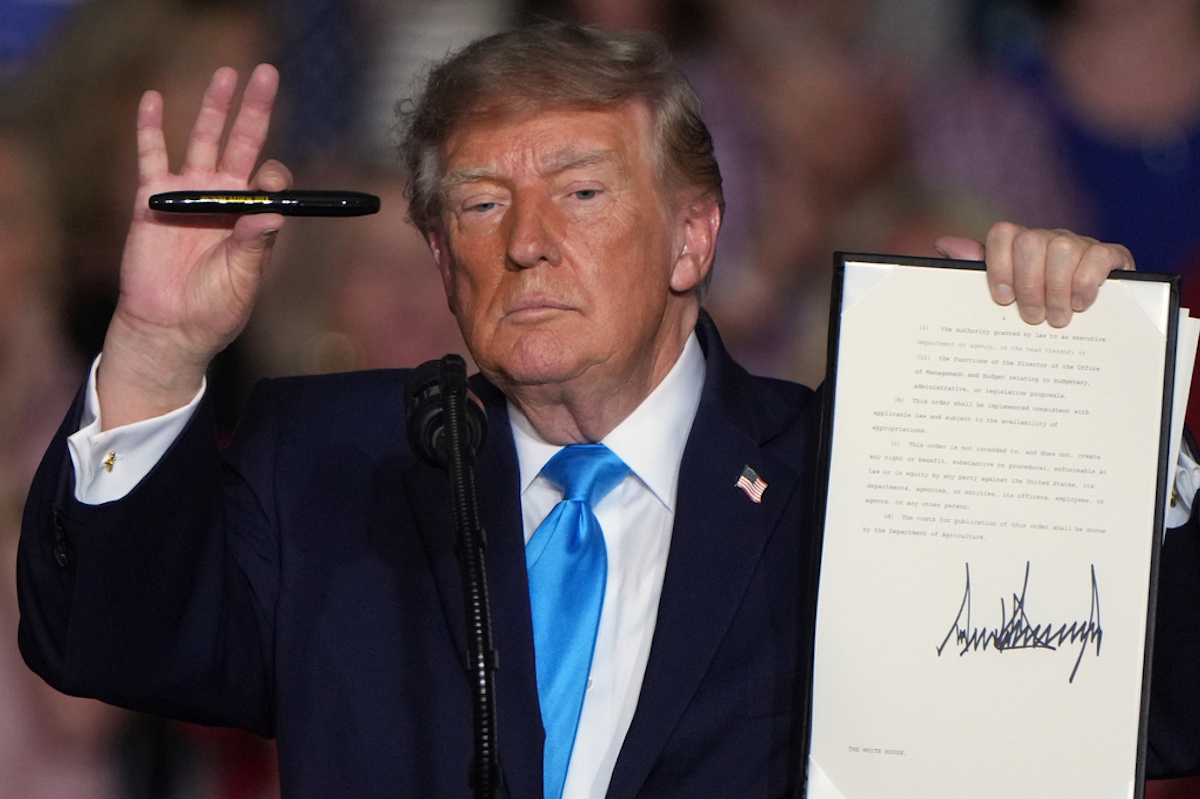
President Donald Trump is traveling across the nation in full campaign mode, resembling a political version of Santa Claus as he dangles a series of promised perks for voters—ranging from manufacturing hubs and military facilities to direct $5,000 cash payouts.
There is, however, a catch: voters must keep Republicans in charge of Congress for the remainder of his second term.
During stops in conservative states, including competitive regions that will decide the balance of power in Washington, Trump has dangled federal healthcare settlement funds for veterans and a potential Space Academy. He also suggested hurricane recovery funds for North Carolina would be tied to a Republican victory, though he later clarified he was joking.
At an October 19 rally in Kansas, he stated that voters wanting cheaper diesel fuel must support the GOP candidates for governor and the U.S. Senate.
“You have to do it,” Trump told the crowd. “And some more goodies. You know, I always heard that when you’re president, you have a little bit of an advantage and I sort of see why now, actually.”
This uniquely transactional approach sets Trump apart from conventional presidential politics.
“Presidents routinely promise that if their party retains control of Congress, they will enact programs that benefit a particular constituency or interest group. That’s normal politics,” noted John Pitney, an American politics professor at Claremont McKenna College. “Trump is different. He suggested — and sometimes said outright — that he will personally grant benefits only if he gets an election result he wants.”
Here is a look at the specific incentives Trump has dangled before the November 3 midterms.
THE MAGA-METER: Tracking the progress of Trump’s second-term commitments
An ethanol waiver in Kansas
Speaking at the Kansas event, Trump championed U.S. Senator Roger Marshall, who is facing a challenge from Democrat Adam Hamilton, and linked the race directly to fuel prices.
To help curb high costs at gas stations, the Environmental Protection Agency granted a temporary emergency fuel waiver in March permitting nationwide sales of 15% ethanol blends starting in May. Known as E15, this fuel is slightly less expensive than standard gasoline, though its summer sale is normally restricted due to smog concerns during hot weather.
“I also gave Kansas a waiver to sell E15 all year round. And with Roger Marshall in the Senate, we will make year-round E15 permanent,” Trump stated. “But if Adam Hamilton is in, I’m not doing it. That’s it. I’m only doing it for him.”
Pitney remarked that such rhetoric, while perhaps not illegal, “bears some resemblance to bribery or even extortion.”
He added, “Other presidents have tried to model themselves on Washington or Lincoln. Trump is the first to model himself on Tony Soprano.”
The E15 waiver was neither restricted exclusively to Kansas nor unique to the current administration, as summertime waivers have been widely utilized, including throughout the Biden administration.
While the waiver offers a minor reduction in posted pump prices, Yale energy and environmental economist Kenneth Gillingham noted that “it comes at a cost of lowering fuel economy, so the savings generally cancel out or come close to canceling out.”
A space academy in Ohio
During several stops in Ohio to support U.S. Senator Jon Husted’s reelection and Vivek Ramaswamy’s gubernatorial campaign, Trump hinted that a brand-new Space Academy might be established in the state. The administration hopes to break ground on the training institution by 2027, with a permanent facility finalized by 2031.
“And every other state wants it. So many states want it,” Trump said on October 3. “And I have no doubt that as the birthplace of aviation and the home of the Wright brothers, if we win the midterms, Ohio will be very, very strongly considered.”
In August, Trump signed a proclamation creating a commission tasked with delivering a December report on establishing the academy and selecting a site. Texas, Florida, and Ohio are among the states anticipated to submit formal proposals by November 16.
$100 million taxpayer investment in Kentucky manufacturing facility
At an October 17 rally in Kentucky, Trump announced another initiative that he asserted depended on Republican Andy Barr defeating Democrat Charles Booker in the Senate race.
Trump claimed the Department of Defense would pour $100 million into Antheia’s pharmaceutical manufacturing plant located in Winchester, Kentucky.
“But you have to win, Andy, otherwise forget it,” Trump declared.
The following day, Antheia reported securing a commitment from the Defense Department for a direct, long-term loan reaching up to $80 million.
“The conditional loan commitment specifies additional steps Antheia must complete before financial close, including satisfying various financial, legal, technical, investment, due diligence, and other requirements,” the company stated, omitting any mention of election outcomes as a prerequisite.
Speeding up North Carolina settlement and disaster relief claims
Trump also argued that keeping congressional majorities would assist individuals seeking compensation for illnesses tied to tainted water at the Camp Lejeune Marine Corps base in North Carolina.
“If we win the House and the Senate I am directing the Department of Justice to settle all remaining legitimate claims as soon as possible and get it off the books and get it finished,” Trump stated on October 20 at the Pitt-Greenville Airport.
“If we don’t win, there’s no money,” he added. “If we do win, you’re getting it.”
Legislation passed in 2022 allows individuals who lived or worked at the base between 1953 and 1987 and developed health issues from chemical exposure to file claims. While the Justice Department noted in September that it had disbursed $879 million so far, a significant backlog persists.
Democratic Governor Josh Stein responded on X, writing, “Real leaders fight for the people, not for power. To condition doing the right thing by sick North Carolinians on who wins the election is foul.”
Earlier in September, Trump remarked that he would direct additional Hurricane Helene aid to North Carolina exclusively if Republican Michael Whatley defeated former Democratic Governor Roy Cooper in the Senate race—though he subsequently claimed he was “kidding.”
Whitney Ross Manzo, a political science professor at Meredith College, noted that Trump’s tactics “can make voters want to do what he says, so they can get the money, or it can make voters want to do the opposite, because they don’t like being threatened.” She suggested the remarks likely sway only those already inclined to support him.
Payments for Americans
Since September, Trump has maintained that every adult American citizen will receive a $5,000 payment if Republicans retain control of both legislative chambers.
Alongside the immense fiscal hurdle of such a pledge, Trump attached an arduous restriction: “You have to spend the money in the United States of America.”
Executing the payouts would demand congressional approval and exceed a cost of $1 trillion.
“Promises of direct cash payments within a month of an election are a new precedent in the modern presidency,” observed Thomas C. Sutton, professor emeritus of political science at Baldwin Wallace University.
An October NBC poll indicated that most voters remain skeptical. Roughly 14% anticipated receiving such a check if the GOP maintains congressional control, while 71% doubted it would happen.
Trump has already highlighted other monetary distributions directed toward specific voter segments before the vote, including a $90 check for select Medicare Part B participants and $500 per person for certain enrollees in the Affordable Care Act.
Analysts point to Trump’s historically low approval numbers and strong Democratic standing in typically red states as indicators that the strategy of dangling perks may fall flat.
“If for nothing else, Trump has a real credibility problem and it seems most people don’t believe him,” said Lori Cox Han, a political science professor at Chapman University.
Reporting contributions were made by PolitiFact Chief Correspondent Louis Jacobson and Staff Writer Loreben Tuquero.
RELATED: Live fact checks of the midterms
RELATED: A fact-checked guide to Trump’s midterm rhetoric and claims