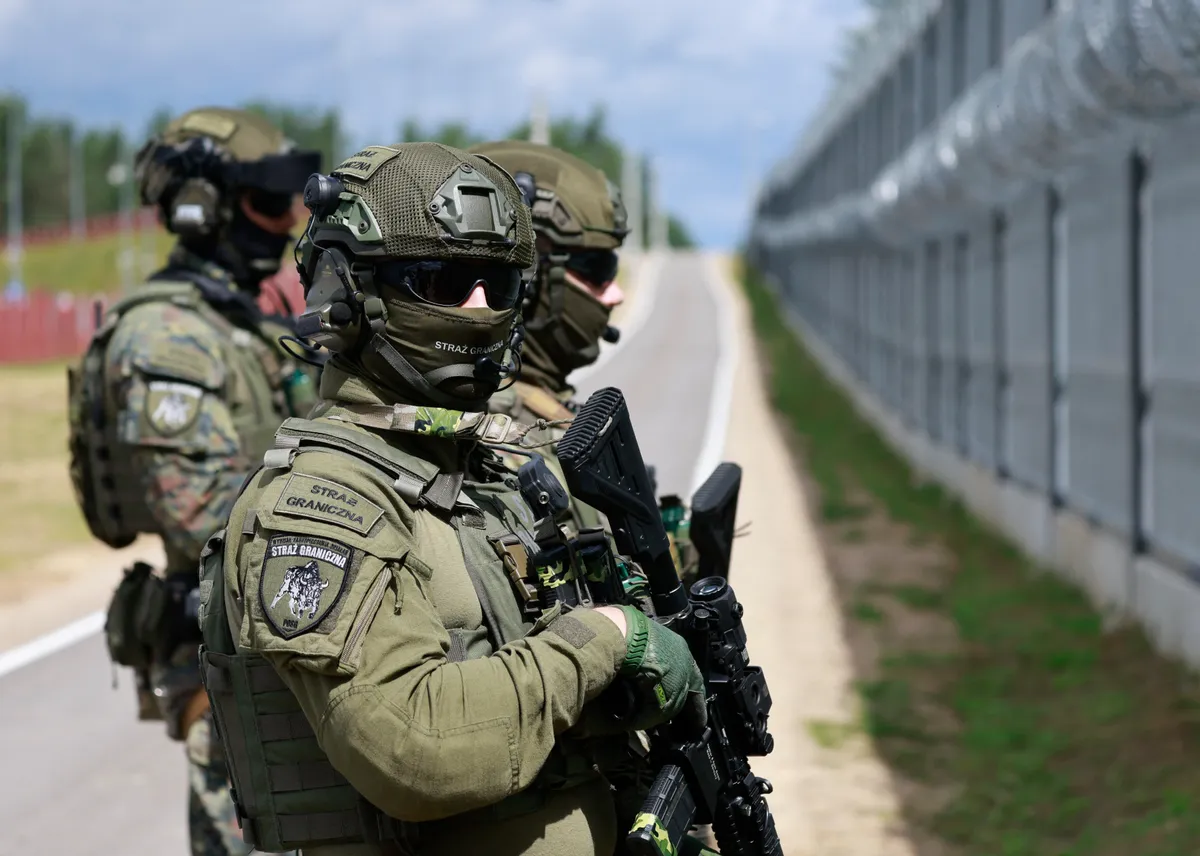
Poland passed a bill allowing border guards to shoot at migrants.

In August 2024, Andrzej Duda, who was then Poland’s president, signed legislative amendments that broadened the conditions under which border security forces are permitted to use firearms during attacks on the national border. The updated law also provides a conditional waiver of criminal liability in specific scenarios. Even prior to these changes, border personnel already possessed the authority to use firearms for self-defense.
Contrary to the implications of recent social media posts, the legislation was enacted in 2024 rather than as a brand-new measure. It does not grant permission for the indiscriminate use of firearms, though human rights advocates have expressed concern that the provisions could result in disproportionate force against migrants and diminish accountability for border agents. Furthermore, the text of the law does not explicitly mention migrants.
During the middle of 2026, social media users circulated claims asserting that Poland had enacted legislation granting border guards the authority to shoot at migrants.
The narrative gained traction on X and Facebook, with multiple accounts sharing a screenshot of a news report carrying the headline, “Poland passes bill allowing border guards to fire at illegal migrants.”
Because the viral posts and screenshots omitted the publication date of the original report as well as the timeline of the law’s passage, several users were led to assume the legislation was entirely current.

(Facebook user “David J. Harris Jr.”)
In reality, the Lebanese news organization Al Mayadeen originally published the article in August 2024, rather than recently, as online posts suggested. That year, Poland introduced amendments to pre-existing laws to permit border security personnel to employ firearms under tightly defined conditions. While the changes do not explicitly authorize attacks on migrants, critics and human rights groups contend that the legal terminology grants excessive leeway to security forces. Consequently, we categorize this claim as a mixture of accurate and inaccurate elements.
On August 14, 2024, the nation’s president at the time, Andrzej Duda, signed a bill that expanded the allowable contexts for deploying firearms against individuals at the border. The legislation protects border guards from criminal charges if they breach standard protocols regarding the use of force or weapons under precise conditions. An English translation of the relevant statute indicates (Page 3, Article 6, Section 2) (emphasis added):
A police officer, a Border Guard officer, or a Military Gendarmerie soldier does not commit a crime if, in connection with the performance of official duties or tasks, they use or employ measures of direct coercion or firearms in violation of the rules governing their use or employment, in the event of a direct and unlawful attack on the inviolability of the state border.
This legal protection is restricted to urgent situations—such as defending human life, health, or personal liberty, or confronting armed or dangerous individuals—where immediate intervention is necessary (Pages 3-4).
Under prior regulations (Page 15, Article 45, Section 1, Subsection D), officers already possessed the authority to use firearms against anyone attempting to breach the border using a vehicle, weapon, or other hazardous instruments. The 2024 modification broadened those criteria. Specifically, the updated text establishes (Page 4, Section 7) that firearms may be discharged when required to halt a direct and illegal assault on:
… the inviolability of the state border by a person who forces the crossing of the state border using a vehicle, firearm or other dangerous object, or who acts in another manner directly threatening the life, health or freedom of the authorized person or another person, or who acts with another person who uses such a weapon, object or method …
Crucially, the legislation does not specify that firearms may be deployed merely because an individual is a migrant or is attempting unauthorized entry.
In July 2024, the human rights organization Amnesty International voiced concerns over the proposed adjustments, arguing that the phrasing was overly broad and ambiguous, potentially paving the way for administrative abuse.
In a separate administrative move in June 2024, the Polish administration instituted a temporary buffer zone along the border, limiting independent oversight by requiring journalists and non-governmental organizations to obtain special permits for entry. This restricted zone has undergone continuous renewals and remains active as of October 2026.
The government advanced the legislation amid heightened friction along the Belarusian frontier. The push followed an incident where a migrant fatally stabbed Polish soldier Mateusz Sitek, alongside the subsequent detention of soldiers who had fired warning shots during border altercations. Following these events, the Polish parliament voted to approve the legislative updates.
For further context, historical reporting covers similar topics concerning migration dynamics in Europe, Italy, and along the U.S.-Mexico frontier.
Reporting assistance for translations was provided by Snopes fellow Aleksandra Wrona.
Sources
Christensen, Laerke. “Did 2 Migrants Scale Border Wall Using Ladder? We Investigated.” Snopes, 11 June 2026, https://www.snopes.com//news/2026/06/11/video-migrants-climbing-border-wall/. Accessed 7 Aug. 2026.
Palma, Bethania. “FACT CHECK: Did Migrants Destroy a Car in Italy?” Snopes, 13 Feb. 2018, https://www.snopes.com//fact-check/did-migrants-destroy-a-car-in-italy/. Accessed 7 Aug. 2026.
“Poland: New Firearms Regulations Risk Undermining the Rule of Law.” European Institutions Office, 10 July 2024, https://www.amnesty.eu/news/poland-new-firearms-regulations-risk-undermining-the-rule-of-law/. Accessed 7 Aug. 2026.
Poland’s New Firearms Bill Sparks Human Rights’ Concerns. 26 July 2024, https://www.bbc.com/news/articles/clly79jvy8do. Accessed 7 Aug. 2026.
“Przedłużenie strefy buforowej na granicy polsko-białoruskiej – Ministerstwo Spraw Wewnętrznych i Administracji – Portal Gov.pl.” Ministerstwo Spraw Wewnętrznych i Administracji, https://www.gov.pl/web/mswia/przedluzenie-strefy-buforowej-na-granicy-polsko-bialoruskiej2. Accessed 14 Oct. 2026.
Ptak, Alicja. “Poland Loosens Firearms Rules for Soldiers Defending Border amid Migration Crisis.” Notes From Poland, 16 Aug. 2024, https://notesfrompoland.com/2024/08/16/poland-introduces-law-loosening-firearms-rules-for-soldiers-defending-border-amid-migration-crisis/. Accessed 7 Aug. 2026.
Tilles, Daniel. “Polish Soldier Dies after Being Stabbed at Belarus Border Preventing Migrants Crossing.” Notes From Poland, 6 June 2024, https://notesfrompoland.com/2024/06/06/polish-solider-stabbed-at-belarus-border-dies-from-injuries/. Accessed 7 Aug. 2026.
“Warszawa, Dnia 16 Sierpnia 2024 r. Poz. 1248.” api.sejm.gov.pl, 16 Aug. 2024, https://api.sejm.gov.pl/eli/acts/DU/2026/244/text.pdf. Accessed 7 Aug. 2026.
“Warszawa, Dnia 16 Sierpnia 2024 r. Poz. 1248.” dziennikustaw.gov.pl, https://www.dziennikustaw.gov.pl/D2024000124801.pdf. Accessed 7 Aug. 2026.