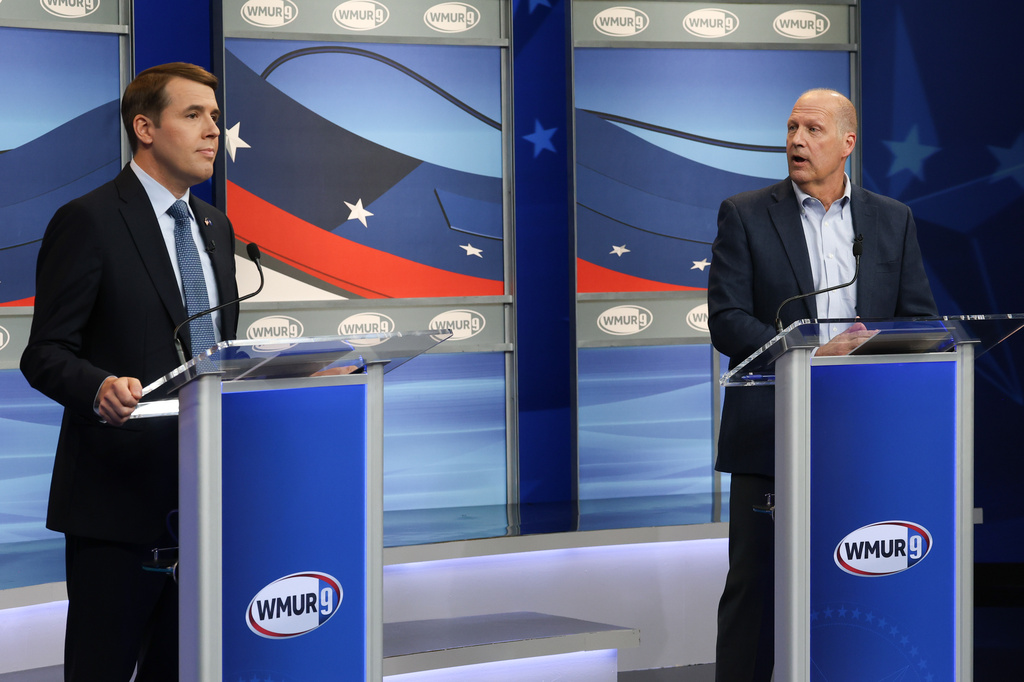
MANCHESTER, N.H. — With Election Day just days away, Democratic U.S. Rep. Chris Pappas and Republican former U.S. Sen. John E. Sununu went head-to-head over tackling the rising cost of living and making the stronger case to represent New Hampshire in the Senate.
While the contenders targeted each other’s voting records and financial backgrounds, the matchup remained comparatively civil relative to other heated Senate contests nationwide, concentrating heavily on economic policy, gas prices, and healthcare expenses.
Pappas sought to tie Sununu closely to President Donald Trump, though Sununu pushed back against some of Trump’s more controversial positions, including tariffs and military actions involving Iran. Conversely, Sununu linked Pappas directly to the administration of former President Joe Biden and national Democratic figures like Nancy Pelosi.
Pappas currently represents New Hampshire’s 1st Congressional District, while Sununu previously held a U.S. Senate seat from 2003 through 2009.
The event was moderated by WMUR-TV, a partner of PolitiFact, which subsequently evaluated several statements made during the debate.
Tariffs
Pappas: Sununu called tariffs “important. He said last fall that the impact was modest.”
Pappas elaborated, “Well, tell that to Judy from Hollis, who lost her job last fall. She works in the automotive industry. She was laid off of work with her coworkers. The impact on her was anything but modest.”
This framing lacks crucial context.
During an October 2025 media appearance following his campaign launch, Sununu expressed support for Trump’s approach of using tariffs as a leverage tool to eliminate international trade barriers. He argued that these duties signaled to other nations that trade practices needed to change.
“I think that message is an important one,” Sununu stated at the time. “I’d love for Congress and the president to settle on a tariff rate so that businesses can make good, consistent decisions. But the message that these countries have to do more to get rid of their nontariff barriers is a very fair one.”
Later, in a September 2025 radio interview, when questioned about his stance on the tariffs, Sununu noted that while fluctuating rates were concerning, the broader economic fallout had been limited.
“The courts are going to sort this out … Economic impact has been very modest,” he remarked. “It certainly hasn’t impacted inflation directly in any significant way, and that was a big concern. I think the most important thing is that we settle on a rate and stop going back and forth.”
On the debate stage, Sununu rejected Pappas’ characterization, calling it misleading. “Digging out one word is deceptive. Of course, they’re not modest,” he argued. “Otherwise, I wouldn’t have said that the trade war with Canada is a huge mistake.”
Indeed, Sununu publicly criticized sweeping 50% tariffs on select Canadian imports last August and has advocated for eliminating duties on building supplies.
Iran war
Sununu and Pappas clash over the Iran conflict
Sununu asserted that he had “said from the beginning it was a mistake to attack Iran without a plan for keeping (the Strait of Hormuz) open.”
Pappas countered, “You did support that operation at the beginning, and it was very clear from the outset that Donald Trump didn’t have a plan to keep the Strait open and to keep costs low for Granite Staters.”
Records show no public statements from Sununu at the onset of the conflict—initiated by the U.S. and Israel on Feb. 28—indicating it was a strategic error to strike without a plan for the Strait of Hormuz, a critical maritime route for crude oil traffic heavily influenced by Iran.
Instead, Sununu told WABC radio in March that the military approach “has been effective, very effective” with clear strategic aims.
Similarly, during a March 12 appearance on the New Hampshire Journal podcast, he emphasized that U.S. actions were aligned with national security goals, such as blocking Iran from obtaining nuclear weapons, dismantling its ballistic missile infrastructure, and curbing its support for international terrorism.
“Those are the objectives here, and I do think we’re on our way to achieving them,” Sununu maintained at the time.
However, his rhetoric evolved in the months that followed.
By August, Sununu told New Hampshire Public Radio that entering the conflict was “a tactical mistake” due to the absence of a safeguard for the Strait of Hormuz, a position he reiterated during a local community event in October.
Wealth and taxes
Pappas: Sununu “cashed in working for one of the biggest lobbying firms in Washington, D.C., and his net worth surged to an estimated $35 million.”
This claim stretches the facts.
It is not unusual for former lawmakers to leverage their public service experience professionally after leaving office.
According to financial disclosures, Sununu’s net worth falls between $7.9 million and $36.3 million—representing a clear increase since his departure from the Senate in January 2009. However, Pappas selectively cited the highest figure possible from the disclosure.
Furthermore, public records indicate that between 2009 and 2024, Sununu served on the board of directors for medical technology giant Boston Scientific, pulling in roughly $5 million in total compensation and stock options.
As for his work in Washington, Sununu spent about ten years associated with the prominent law firm Akin Gump Strauss Hauer & Feld LLP, which represents various corporate interests. Yet, he never filed mandatory federal disclosure forms required to lobby Congress or the executive branch, meaning he was never officially registered as a lobbyist.
Sununu: Pappas has “consistently voted to increase taxes.”
This assertion is also exaggerated. A comparable claim regarding Pappas allegedly casting 68 tax-increase votes was previously evaluated and rated False.
The vast majority of those 68 votes stem from routine procedural measures used to establish debate parameters rather than final votes on taxation. The compilation provided by Sununu’s campaign encompassed just 16 distinct bills, each subjected to roughly three procedural votes prior to final passage, alongside a nonbinding resolution.
Moreover, these legislative packages covered a broad array of policies. They included a $3.1 trillion pandemic relief measure featuring direct stimulus and targeted tax cuts, the $1.2 trillion Bipartisan Infrastructure Law, and the 2022 Inflation Reduction Act, which levied corporate fees while offering financial incentives for consumer clean-energy investments.
Several of these measures secured broad bipartisan backing in Congress.
In 2025, Pappas opposed the major tax and spending package championed by Trump, known as the One Big Beautiful Bill Act, which extended prior tax cuts and provided relief for seniors, tip earners, and overtime workers. Pappas explained that he voted alongside fellow Democrats against the bill due to accompanying reductions in healthcare funding.
Pappas’ team has also highlighted numerous instances where he voted in favor of tax cuts, including expansions of the child tax credit, which were omitted from Sununu’s critique.
Social Security
Pappas: “When John Sununu was in the Senate, yes, he did propose privatizing Social Security.”
This statement is rated Mostly True.
Throughout the late 1990s and early 2000s, lawmakers intensely debated restructuring Social Security by diverting a portion of its revenue into private investment accounts tied to stocks and bonds, moving away from the traditional model reliant strictly on payroll taxes.
Sununu actively championed this model beginning around 2000 and introduced relevant legislation in 2001, 2004, and 2005. Local reporting from that era highlighted his prominent role in national discussions aimed at addressing the program’s fiscal challenges through personal investment options.
During the debate, Sununu pushed back against how Pappas framed these proposals, insisting that claims of cutting people from the system were “not true” and pointing out that his bills would have preserved “a guaranteed minimum benefit for everyone.”
While Pappas omitted the detail that the proposed changes would not have been mandatory for current beneficiaries, Sununu’s past legislation—which ultimately failed to pass—relied on voluntary participation or age-based limits for new program participants.
PolitiFact New York Staff Writer Conor Amendola contributed to this report.