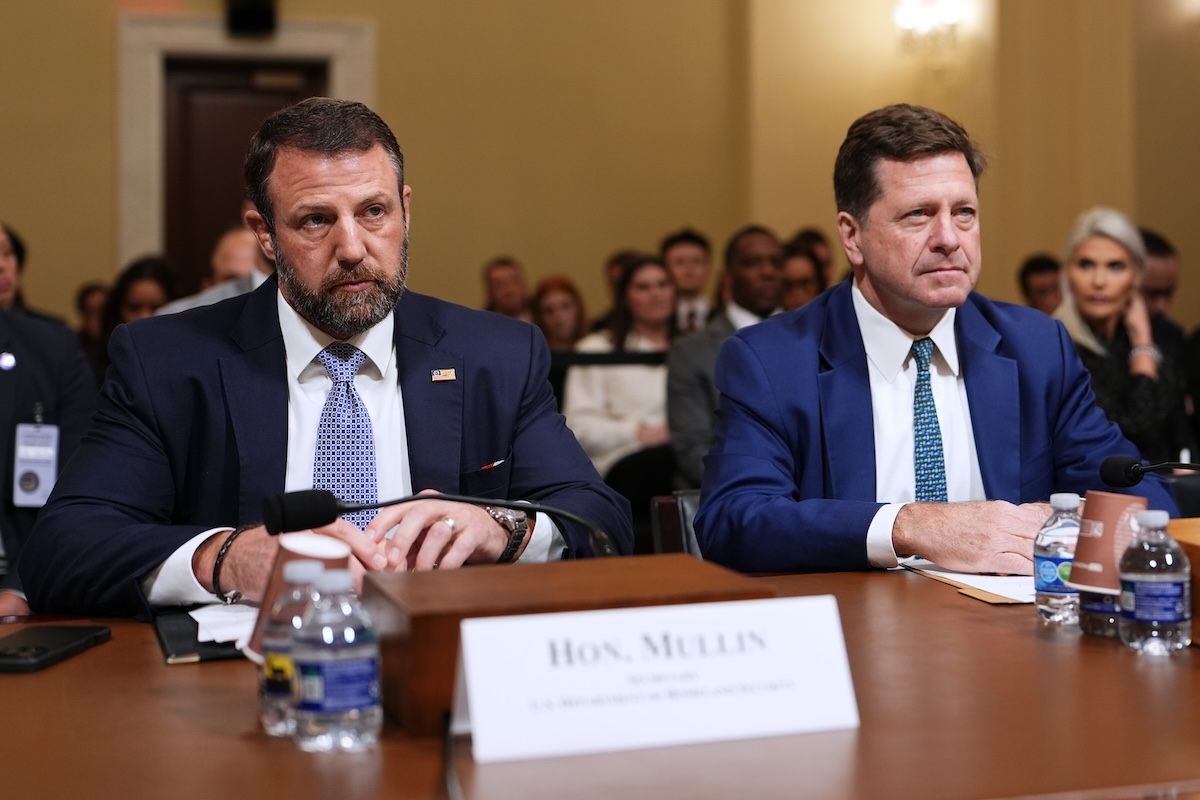
Following a turbulent week marked by widespread flight disruptions, sudden website outages, and emerging reports regarding a potential Iranian dirty bomb threat, congressional representatives questioned key administration officials, including Homeland Security Secretary Markwayne Mullin, regarding national security vulnerabilities.
Appearing before the House Homeland Security Committee alongside FBI Deputy Director Christopher Raia and Director of National Intelligence Jay Clayton, Mullin addressed the recent technical failures that disrupted operations at the Federal Aviation Administration, the National Security Agency, and major corporate platforms like Chase, Apple, and United Airlines. The officials clarified that these incidents were isolated and entirely unrelated to hostile cyberattacks.
“Based on current findings, these are distinct service disruptions tied to routine maintenance and technical updates,” Clayton testified on Nov. 18. “They do not stem from any coordinated, state-sponsored campaign.”
While refraining from blaming the outages on artificial intelligence integration, Clayton emphasized that AI is fundamentally transforming the digital security landscape by rapidly accelerating the scale and complexity of both offensive and defensive cyber operations.
Just hours after federal authorities lifted a nationwide ground stop on Nov. 13, Mullin boarded a government aircraft to attend a football game, a decision that drew intense scrutiny during the hearing. Defending his use of official transport to travel to the LSU-Texas matchup, Mullin stated he was honoring a family commitment and aimed to project confidence regarding the safety of commercial air travel.
His flight took off while hundreds of thousands of travelers were still dealing with the fallout of more than 9,000 canceled flights and 7,000 delays from the previous day, according to flight tracking data from FlightAware.
A closer look at several key claims and exchanges from the committee session reveals the underlying facts.
Did Mullin previously vote against infrastructure packages funding the FAA?
During the hearing, U.S. Rep. LaMonica McIver, D-N.J., questioned Mullin’s legislative record concerning aviation funding from his time in the House.
“You and Transportation Secretary Sean Duffy have criticized Congress for underfunding our aging air traffic control systems. Yet in 2021, Congress approved a bipartisan infrastructure law allocating $25 billion for aviation, including $5 billion dedicated to FAA facilities,” McIver noted. “How did you vote on that measure? … You voted against it.”
While Mullin did oppose that specific package, his legislative history shows support for other aviation funding bills.
In November 2021, while serving as the representative for Oklahoma’s 2nd District, Mullin joined the majority of House Republicans in voting against the Biden administration’s $1.2 trillion bipartisan infrastructure measure. The legislation contained $25 billion for total aviation needs, with $5 billion earmarked for FAA infrastructure and air traffic modernization.
Passage of the bill relied on bipartisan backing, securing “yes” votes from 13 House Republicans and 19 Senate Republicans.
Opponents of the bill, including Mullin, pointed to a Congressional Budget Office estimate that the measure would increase the federal deficit by $256 billion over a decade, arguing that the spending offsets were inadequate.
“Only a fraction of this massive package goes toward core infrastructure like roads and bridges, and Oklahoma would see very little of that funding,” Mullin explained in a statement released at the time.
Conversely, Mullin supported multiple other aviation investment bills during his career in the House, such as the 2016 FAA Extension, Safety, and Security Act, the 2017 Disaster Tax Relief and Airport and Airway Extension Act, and the bipartisan 2018 FAA Reauthorization Act. Later, as a senator, he voted in favor of the FAA Reauthorization Act of 2024, which committed $17.8 billion to FAA facilities through fiscal year 2028.
Were federal cybersecurity workforces drastically reduced under the current administration?
U.S. Rep. Dan Goldman, D-N.Y., claimed that the current administration had severely depleted cyber defense personnel across the Department of Homeland Security and the FBI.
The administration “has hollowed out the cybersecurity teams we had in place,” Goldman asserted. “Staffing at CISA has plummeted because the administration wanted to obscure election integrity efforts, and the FBI has let go of numerous cyber agents over unrelated investigative disputes.”
This characterization is partially accurate.
Documentation, oversight correspondence, and news reports confirm significant downsizing at the Cybersecurity and Infrastructure Security Agency (CISA) beginning in early 2025. However, reductions at the FBI have affected the agency more broadly rather than targeting its cyber units specifically.
Since the administration took office, CISA has shed nearly a third of its personnel—roughly 1,100 positions—following budget reductions that stripped about $135 million from its operating funds. The White House’s 2027 budget proposal seeks an additional $700 million reduction from the agency’s roughly $2.5 billion baseline.
Driven by the Department of Government Efficiency, these cost-cutting measures have involved laying off probationary employees, offering buyouts, encouraging early retirements, and terminating specific initiatives like election security divisions.
Additionally, on his first day in office, President Trump dissolved the DHS advisory Cyber Safety Review Board, which had been actively investigating foreign espionage targeting U.S. telecom and government networks.
At the FBI, workforce reductions since January 2025 have not been explicitly focused on cyber specialists. The administration trimmed the bureau’s fiscal 2026 budget by $545 million, eliminating more than 1,500 roles, which included about 700 vacant agent positions. The Department of Justice stated these cuts aimed to streamline functions and prioritize border security and violent crime.
The administration has since requested increased funding for the bureau, proposing a 17.8% budget boost and the addition of thousands of personnel. Meanwhile, reports indicate that roughly 10 FBI employees, including special agents and analysts, were dismissed in February in connection with the Mar-a-Lago classified documents probe.
How accessible is the creation and deployment of a dirty bomb?
Lawmakers also pressed officials regarding recent intelligence reports indicating that Iran has explored options to target senior U.S. figures using chemical agents or a radiological dispersion device, commonly known as a dirty bomb, in Washington, D.C.
Mullin assured the committee that the reported threat was not immediate.
While some lawmakers characterized a dirty bomb as simple to construct and smuggle, security and defense experts emphasize that the reality is more nuanced. Such devices are far less complex and destructive than traditional nuclear weapons, but their technical challenges and potential impacts depend heavily on design and execution.
A dirty bomb pairs conventional explosives with radioactive material intended to be scattered by the blast. According to the Nuclear Regulatory Commission, the primary danger of such a device stems from the conventional explosion itself rather than the radiation, which typically is not sufficient to cause mass fatalities or severe illness. However, the resulting contamination can generate widespread panic, disrupt properties, and require expensive remediation.
Experts note that while assembling the explosive component may be straightforward, contaminating a targeted urban area requires advanced demolition expertise. Furthermore, acquiring regulated radioactive materials introduces significant hurdles, making the execution technically demanding, resource-intensive, and less lethal than traditional weaponry.