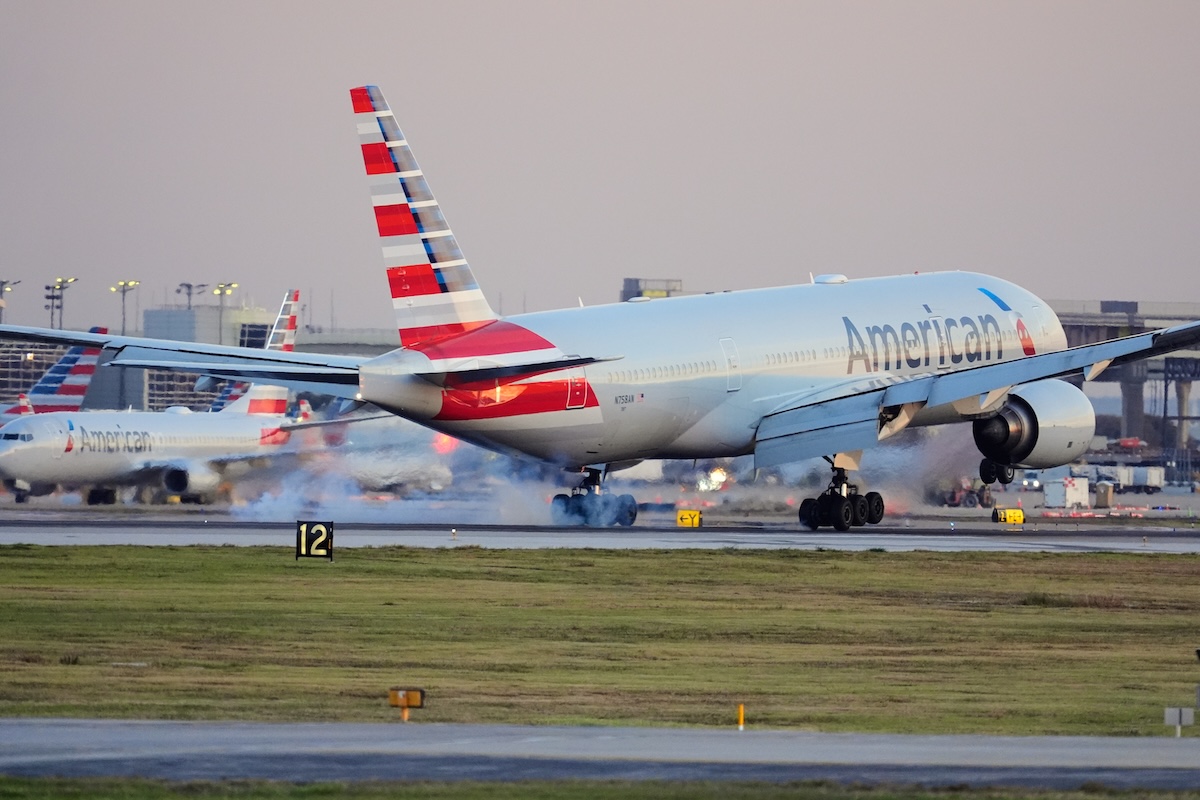
Following a nationwide Federal Aviation Administration (FAA) ground stop on November 13 that heavily disrupted air travel, lawmakers from both sides of the aisle have pointed fingers at each other.
The rare halt brought flights across the country to a standstill. According to Trump administration officials, the incident was triggered when a routine router upgrade—part of ongoing FAA system modernizations—overwhelmed legacy infrastructure. In response, the agency announced a temporary halt to router installations while the outage is investigated.
President Donald Trump, Transportation Secretary Sean Duffy, and other conservatives placed the blame on former President Joe Biden’s administration, citing alleged fund mismanagement and a failure to prioritize aviation infrastructure improvements.
Conversely, Democrats argued that the current administration was deflecting accountability. They noted that Republicans have held unified control of the federal government for nearly two years and that Congress has previously supplied billions for FAA upgrades.
However, pointing blame at a single political party overlooks a broader history. Documented evidence spanning more than two decades shows that modernizing the national air traffic communications network has faced chronic delays and setbacks under administrations and congressional majorities of both parties.
“Modernization programs can take years to move from planning and procurement through testing and deployment,” noted Mike O’Donnell, a former senior FAA official who now works as a consultant and adjunct professor at Embry-Riddle Aeronautical University. He added that frequent leadership changes make it difficult to sustain accountability and priorities across initiatives.
Trump criticizes the Biden administration over past FAA spending
A day after the travel ban was lifted, Trump described the FAA under Biden as a “disaster.”
“Everything they touched turned bad. Big money spent unwisely, making an old and broken system worse than when they began,” Trump posted Nov. 15 on Truth Social. He also told reporters that former Transportation Secretary Pete Buttigieg “totally ruined it,” a claim that Buttigieg disputed.
“The Democrats really — it’s very old — but what they did really set back the system a long way,” Trump said.
When asked for clarification, a White House spokesperson pointed back to the president’s public statements.
Public records, audits, and FAA reviews do not support assertions that the previous administration degraded the system or improperly handled physical cabling.
This is not a new critique from Trump. Following a Cabinet meeting in July 2025, he claimed the prior administration used hundreds of contractors to improperly splice infrastructure components, wasting billions.
O’Donnell stated that to link the recent outage to the Biden administration, “I’d want to see evidence that a specific decision affected the system that failed, its safeguards, or the FAA’s ability to respond.” No such evidence has emerged.
During that same 2025 Cabinet meeting, Duffy asserted that the Biden FAA entered into a 15-year contract to address telecommunications updates, adding that “the system is failing today.”
His remarks alluded to a long-standing initiative to upgrade a network dating back to the 1980s by replacing aging copper wires with fiber-optic cables across numerous facilities.
A representative for Buttigieg’s political action committee directed inquiries to a 2023 contract awarded to Verizon to spearhead the upgrade. The agreement spanned up to 15 years and was valued at $2.4 billion, including final option years for support.
In August, the Trump administration restructured the contract, designating AT&T as the lead project manager to accelerate deployment while transitioning Verizon to a secondary role.
The revised arrangement began with a $74.3 million planning order, though the FAA noted that total obligations are expected to grow into a multi-billion-dollar agreement over its 15-year window. The exact expenditures from the original contract and the final cost of the new arrangement remain unclear.

A multi-decade history of modernization delays
Difficulties in updating FAA systems have persisted through various administrations and congresses, with records indicating challenges originating as far back as George W. Bush’s first term in the early 2000s.
- 2006: A Department of Transportation inspector general report found that an ongoing FAA upgrade was falling behind schedule and unlikely to finish on time.
- 2008: A follow-up evaluation reiterated that delays meant the agency would rely on legacy equipment longer than anticipated.
- 2010: Following a 2009 communications disruption, the inspector general advised Congress that critical outage risks remained due to integration hurdles involving contractors.
- 2023: An independent safety review commissioned by the FAA warned that tech deployments could introduce airspace disruptions and stressed the necessity of maintaining older systems during transitions.
- 2024: The Government Accountability Office reported that dozens of FAA systems were unsustainable due to aging hardware and a slow modernization pace.
- 2026: Deputy Transportation Inspector General Mitch Behm testified before the House, noting that more than two decades of oversight audits revealed chronic cost increases, schedule overruns, and delayed technological capabilities.

Congressional funding and telecommunications allocation specifics
Democrats have pointed to the One Big Beautiful Bill Act—a tax and spending package signed by Trump in 2025—as proof that substantial resources were provided to the agency.
Rep. Rosa DeLauro (D-Conn.) stated Nov. 15 that the FAA received over $12.5 billion in recent funding that remains largely unspent.
While the overall funding figure is accurate, DeLauro overstated the portion designated specifically for communications updates.
Out of the $12.5 billion total, $4.75 billion was earmarked for telecommunications and systems modernization. The remaining funds were allocated for separate initiatives, including radar updates, runway safety tools, and a new air traffic control facility.
The Department of Transportation noted that Duffy has consistently sought resources for software updates, previously stating in July 2025 that the scope of the project means the provided funds are substantial but face massive demands.
According to the Office of Management and Budget and the Transportation Department, current reserves are sufficient to finish the copper-to-fiber transition, which is roughly 70% complete. Duffy indicated on CNN that all $12.5 billion is scheduled to be deployed by the end of 2028.
Before his tenure as transportation secretary, Duffy previously questioned requests for additional funding following earlier disruptions, suggesting substantial pandemic-era appropriations should have covered system needs.
Budget experts emphasize that phasing expenditures is standard practice for major federal initiatives.
“While more money may be necessary, you don’t need it all at once — that is a recipe for waste,” observed Steve Ellis, president of Taxpayers for Common Sense. “It took a long time for these problems to develop, and it is going to take a while to fix them.”
Questions regarding government workforce reductions
Following the start of Trump’s second term in early 2025, the administration implemented broad federal spending and staffing reductions through the Department of Government Efficiency (DOGE), overseen by Elon Musk.
During a November 15 appearance on CBS News’ “Face the Nation,” Rep. Jim Himes (D-Conn.) argued that workforce reductions led to 1,300 FAA departures and 400 probationary firings, linking those cuts directly to the operational issues experienced by travelers.
While Himes’ layoff figures align with reports from news organizations, establishing a direct link between those departures and the recent router outage remains speculative.
The employees dismissed in early 2025 primarily supported aircraft safety inspectors, facility maintenance, and pilot navigation maps, according to Associated Press reporting.
It remains unconfirmed how many, if any, of those affected personnel would have been involved in managing telecommunications upgrades, which are primarily executed by external contractors.
RELATED: In Congress, did Sean Duffy vote against upgrading air traffic control systems? Here’s what we know
RELATED: Did Trump’s FAA slash the staffing target for air traffic control?