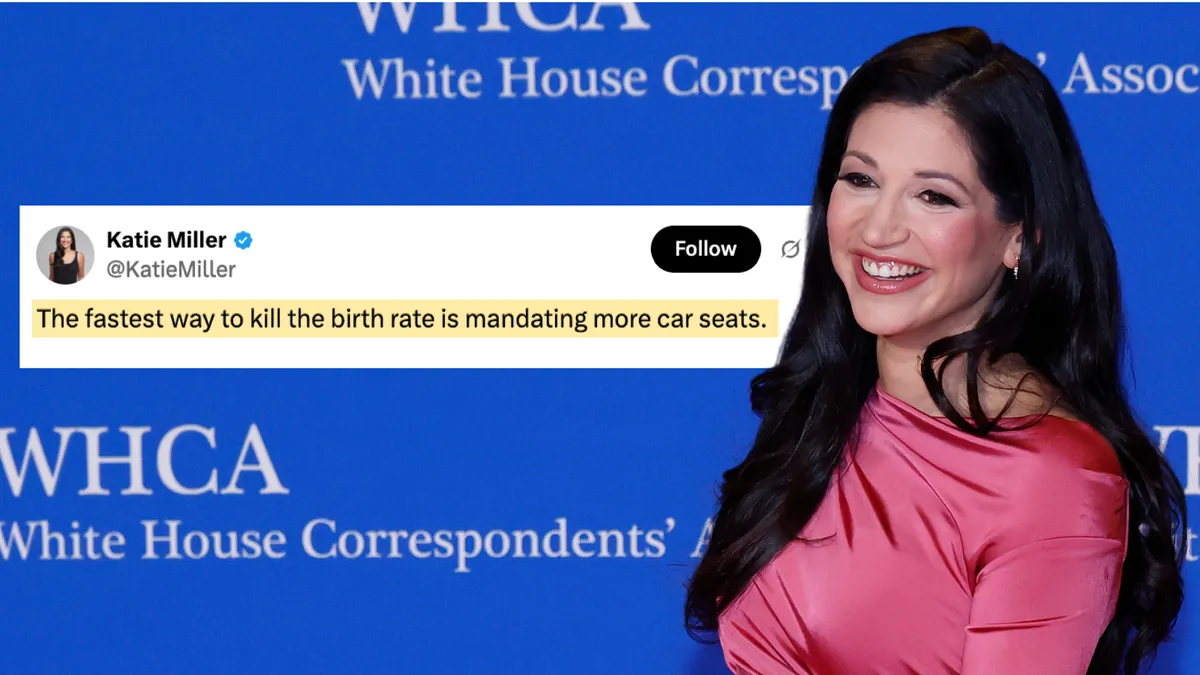
In late November, Katie Miller, a conservative commentator and wife of White House Chief of Staff Stephen Miller, posted on X: “The fastest way to kill the birth rate is mandating more car seats.”

Late in November, rumors circulated across social media regarding a post attributed to Katie Miller, a conservative podcaster and the wife of White House Chief of Staff Stephen Miller, which asserted that strict car seat mandates act as a major deterrent to having children.
As an example, a widely shared video (archived) on Facebook featured a user stating, “Katie Miller, the wife of Chief of Staff Stephen Miller, wants you to know that the fastest way to kill birth rates is mandating more car seats.”
The clip displayed what appeared to be a genuine screenshot of Miller’s account. Similar discussions quickly popped up on Instagram, Facebook, and X, prompting readers to verify the authenticity of the quote.
Investigation confirmed that the post was indeed authentic, having been published by Miller on November 25. Consequently, the statement is considered accurately attributed.
Although a 2024 academic study indicated that stringent car seat regulations might discourage some parents from expanding their families further, it did not categorize these laws as the single “fastest way” to suppress birth rates.
Requests for comment were sent to Miller, the researchers behind the study, and demographic experts, with updates to follow should replies be received.
What Miller Posted Online
On November 25, Miller shared a message (archived) on X that opened with the assertion, “The fastest way to kill the birth rate is mandating more car seats.”
Within the thread, she elaborated that modern car seats complicate parenting logistics, pointing to challenges involving vehicle interior widths, anchor installations, and the general hassle of traveling with bulky equipment. She added that the logistical hurdles of car seats served as a tangible limitation on her own family size.
The complete text of her post stated:
The fastest way to kill the birth rate is mandating more car seats.
Car seats make motherhood significantly more complicated and difficult, from vehicle width and anchors to traveling with them.
I’m not alone in saying that a limiting factor on the number of children we have is car seats.
Miller’s commentary was issued in response to another post discussing updated vehicle safety regulations in California.
California Governor Gavin Newsom approved Assembly Bill 435 in October 2025. Set to take effect on January 1, 2027, the law mandates that children between the ages of 8 and 15 utilize a specialized child restraint system unless they meet five specific benchmarks for safe seatbelt utilization regarding fit and posture. The regulation does not institute a blanket booster seat requirement for all minors under 16.
Do Safety Mandates Impact Fertility?
Existing demographic research does point to a correlation between mandatory car seat laws and family planning choices.
Published in the Journal of Law and Economics, a 2024 study entitled “Car Seats as Contraception” explored the interplay between child restraint legislation and U.S. birth rates. (An earlier draft had been released online in 2020.)
Authors Jordan Nickerson and David Solomon discovered that couples who already had two children legally required to use car seats exhibited a 0.73 percentage point lower probability of having a third child within a given year. This trend was primarily observed in households with access to an automobile and a resident father, leading the researchers to deduce that spatial constraints—such as fitting three car seats across a standard back seat—played a major role. They calculated that these laws may have prevented roughly 8,000 births nationwide in 2017 while simultaneously saving the lives of 57 children involved in traffic accidents.
Although the findings support the notion that car seat laws can deter larger families, the research did not weigh their impact against broader socioeconomic drivers of declining birth rates, nor did it brand them as the “fastest” deterrent. Furthermore, because the study preceded California’s recent legislative update, it did not evaluate the regional consequences of the new mandate.
Conversely, public health organizations emphasize the undeniable safety benefits of these devices. Data from the Centers for Disease Control and Prevention indicates that proper car seat usage decreases the likelihood of crash-related injuries by 71% to 82% relative to standard seatbelts alone, while booster seats lower severe injury risks by 45% for children aged 4 to 8.
Those interested in related political commentary can also review previous analyses regarding whether Vice President JD Vance expressed similar views on vehicle safety regulations.