U.S. President Donald Trump assisted a farmer’s widow in settling her debts to save her fifth-generation family farm in Georgia following her husband’s tragic suicide to prevent its foreclosure auction.

Online discussions frequently highlight an event from 1986 involving U.S. President Donald Trump stepping in to rescue a Georgia farm from foreclosure after the owner’s tragic death.
A widely shared narrative describes the background of the event:
On a February morning in 1986, a Georgia farmer named Leonard Hill walked out of his house twenty minutes before the bank was set to auction off his land. He never came back inside.
He took his own life that morning, believing his life insurance policy would cover the debts that had buried his family. It did not come close.
Leonard left behind a widow, Annabel Hill, who was 66 years old at the time. The threatened farm had been in her family for five generations.
Years of drought had devastated the crops and income. By the time Leonard passed away, the family owed over $300,000 to the bank, a sum his death did nothing to reduce.
An Atlanta businessman named Frank Argenbright later learned of the family’s plight and began making calls to find someone capable of intervening.
Those efforts eventually reached a then-40-year-old New York real estate developer named Donald Trump.
The story has repeatedly surfaced across various social media platforms, including Facebook, Instagram, and X, prompting inquiries into its factual accuracy.
Historical archives from prominent news organizations—such as The Associated Press and The New York Times—confirm that the core of the story is true. Trump did indeed help organize fundraising efforts for Annabell Hill after her husband, Leonard Dozier Hill III, died by suicide in 1986 in an attempt to save their ancestral property.
While minor discrepancies existed across various reports regarding the exact acreage, total debt, and final funds raised, contemporary media records consistently show that Trump and Texas farmer Tom McKamy provided the critical financial contributions necessary to keep the land in the Hill family’s hands.
Neither the family nor other involved parties have disputed the account. Trump and the Hills’ daughter, Betsy Sharp, publicly revisited the story during a 2016 campaign rally.
Key Financial Intervention by Trump and Supporters
Reports from late 1986 detailed that the farm was originally scheduled for auction on February 4, 1986. Following Leonard Hill’s death, the bank rescheduled the foreclosure auction for September 2.
According to Associated Press coverage at the time, a Trump spokesperson stated that Trump halted the impending auction by providing an initial $20,000 payment and committing to help raise the remaining $173,000 required to preserve the 705-acre property.
By mid-September 1986, publications like Time noted that Trump and Georgia businessman Frank Argenbright Jr. had successfully raised roughly $77,000 toward the total goal.
Further reporting indicated that total fundraising eventually surpassed $180,000. Representatives for Trump and other donors covered the remaining financial deficit to clear the mortgage completely.
Trump’s Account in “The Art of the Deal”
Trump documented his involvement in his 1987 book, “The Art of the Deal.” He recounted seeing the story on the news, feeling compelled to help, and contacting the bank holding the mortgage.
That really got me going. I said to the guy, “You listen to me. If you do foreclose, I’ll personally bring a lawsuit for murder against you and your bank…” An hour later I got a call back from the banker, and he said, “Don’t worry, we’re going to work it out, Mr. Trump.”
By the end of the week, we’d raised $40,000… As a Christmas present to Mrs. Hill and her family, we’ve scheduled a mortgage-burning ceremony for Christmas Eve in the atrium of Trump Tower.
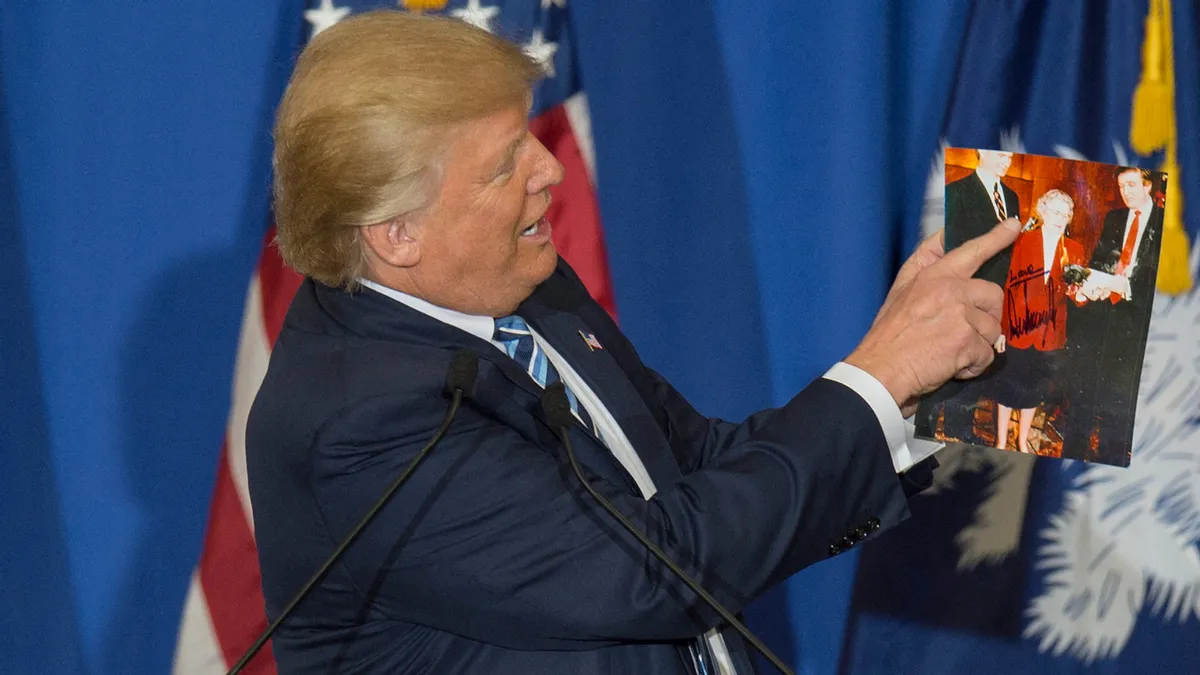
True to his word, Trump hosted a mortgage-burning ceremony on December 23, 1986, where he and Annabel Hill were photographed holding a burning document in front of a Christmas tree.
Decades later, during a 2016 campaign stop in South Carolina, Trump brought Betsy Sharp on stage, where she expressed gratitude for his assistance in keeping her family’s generational farmland intact.