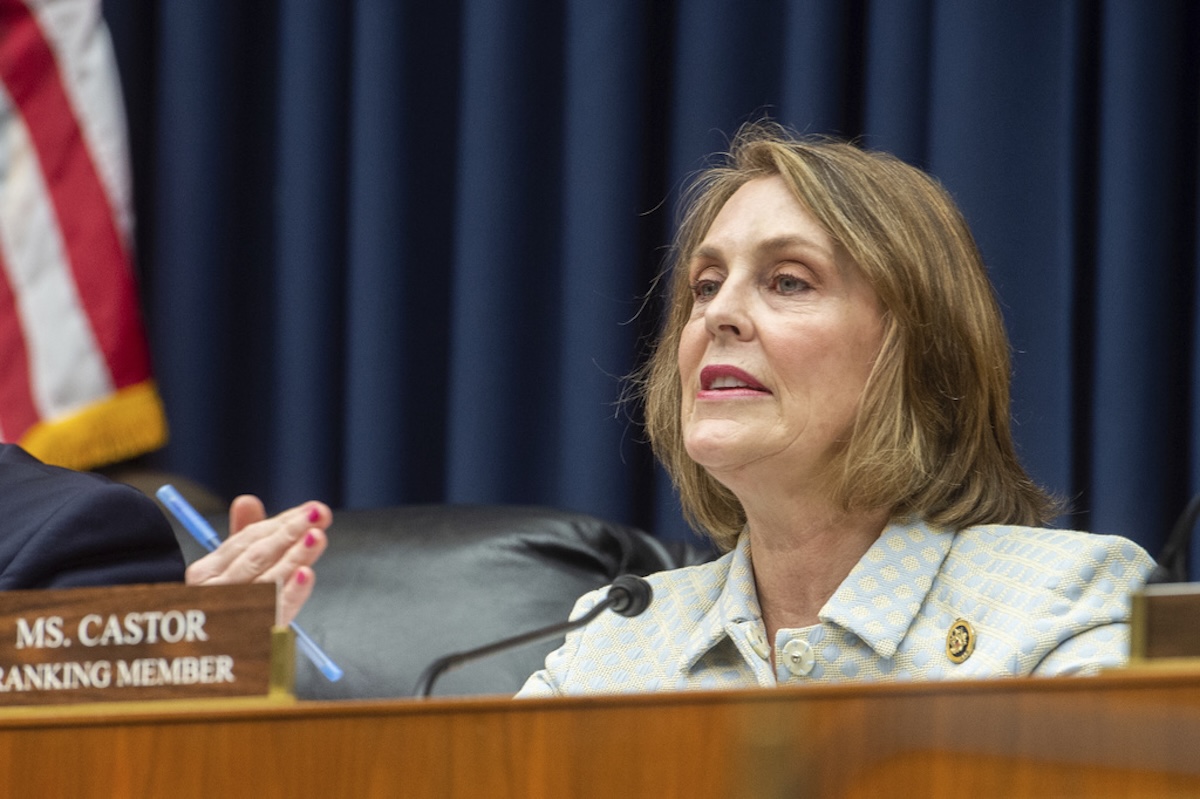
Conservative super PACs are targeting Florida voters with television commercials claiming that Democratic U.S. Representative Kathy Castor has repeatedly broken federal laws designed to prevent insider trading among lawmakers.
One commercial from the pro-Republican super PAC Club for Growth Action asserts that throughout her two decades in office, Castor manipulated the system and routinely violated insider trading regulations. The ad alleges she executed more than 200 stock transactions valued at up to $2.6 million, growing her personal wealth to as much as $31 million through suspicious investments.
Castor, who first took office in 2007, faces a reelection battle against Republican challenger Mike Beltran in Florida’s 14th Congressional District, which was redrawn ahead of the 2026 midterms to favor conservative voters. Because Club for Growth Action operates as a super PAC, it faces no fundraising or spending limits in federal elections.
With public disapproval of lawmakers trading stocks running high, the issue has emerged as a central theme in the midterm elections. Additional attack ads promoting the narrative that Castor broke insider-trading laws have also been deployed by the Congressional Leadership Fund, another conservative super PAC working to secure a Republican majority in the House.
However, this serious accusation relies heavily on a flawed premise: a 2021 financial filing that initially appeared to show Castor missing the mandatory 45-day reporting window for stock purchases. The political ads failed to mention a subsequent correction submitted by Castor, which proved the initial report contained a typo and that her disclosures were actually submitted on time. While a review of her history did reveal two late disclosures in 2017, filing paperwork late does not constitute insider trading.
Correction of filing date errors
The Club for Growth Action commercial drew upon 2021 reports from Business Insider and the Foundation for Accountability and Civic Trust (FACT), an ethics watchdog group that urged the Office of Congressional Ethics to investigate Castor and two other representatives for allegedly missing deadlines to report up to $45,000 in stock purchases. There is no public record indicating whether the office pursued an investigation.
Under the Stop Trading on Congressional Knowledge (STOCK) Act of 2012, members of Congress must disclose specific stock transactions within 45 days of execution or within 30 days of receiving notification.
For a brief period in 2021, paperwork suggested Castor had missed the deadline for trades made the previous year, which would have constituted a violation. Yet, this impression was the result of a clerical mistake that was quickly fixed.
The initial filing indicated that Castor purchased Berkshire Hathaway stock three times in 2020—on June 18, June 25, and July 15—but did not report them until June 27, 2021. Because transactions are disclosed in predetermined financial brackets, each purchase was valued between $1,001 and $15,000, bringing the aggregate total to an estimated $3,000 to $45,000.
Crucially, neither the initial media reports nor the watchdog complaint acknowledged that two days later, Castor submitted an amended filing correcting the transaction years from 2020 to 2021. This correction confirmed that the purchases were indeed reported well within the legally mandated 45-day window.
R. Blake Chisam, former chief counsel and staff director for the House Committee on Ethics, noted that the paperwork clearly reflected a typographical error rather than an intentional omission, emphasizing that it provides no basis for accusations of improper trading or misuse of confidential information.
Dan Schwager, another former chief counsel and staff director for the committee, echoed this perspective, explaining that such clerical mistakes are common administrative oversights rather than deliberate infractions. He noted that numerous lawmakers from both political parties frequently submit amendments to correct minor paperwork errors.
An independent review of all 36 periodic transaction reports—encompassing 78 individual trades—filed by Castor since the passage of the STOCK Act revealed only two late reports submitted in 2017 concerning three trades from 2016. All other filings were either submitted on time or appropriately amended.
A representative for Castor’s campaign attributed the 2017 delayed filings to administrative oversight, noting that the House Ethics Committee issued no fines or penalties. Furthermore, Castor’s office highlighted her legislative record on the matter, pointing out her vote in favor of the Stop Insider Trading Act, which passed the House 232-198 to ban members of Congress, their spouses, and dependent children from purchasing individual stocks while requiring public notice prior to any sales.
Stock transactions do not indicate misconduct
Castor acquired shares of Berkshire Hathaway on multiple additional occasions throughout 2021. According to historical OpenSecrets figures, she is one of numerous legislators from both sides of the aisle who have invested in the multinational conglomerate formerly managed by billionaire Warren Buffett. The holding company encompasses a vast array of subsidiary businesses spanning insurance, energy, and transportation, including well-known entities like Geico and BNSF Railway.
Describing the investments, Chisam noted that purchasing shares in a widely diversified, long-term holding company like Berkshire Hathaway represents standard, conventional investing.
The Club for Growth Action advertisements offer no further instances of Castor breaching the STOCK Act. Meanwhile, a publication from the National Republican Congressional Committee referenced an online article claiming Castor sold shares prior to the World Health Organization declaring COVID-19 a global pandemic. Inquiries sent to the House Ethics Committee and the Office of Congressional Conduct regarding potential investigations went unanswered, and Castor faces no official charges of wrongdoing.
Club for Growth Action did not respond to inquiries explaining how it calculated that Castor executed over 200 trades totaling up to $2.6 million. Although the group pointed to financial disclosures spanning from 2014 to 2025, tracking the specific trades referenced in the ad remains difficult.
The claim regarding her net worth reaching up to $31 million appears accurate based on her 2025 financial disclosure, which listed combined assets for Castor and her spouse ranging between $7.9 million and $31.9 million with zero reported liabilities. Even so, experts advise caution regarding such figures.
Chisam cautioned that calculating net worth by simply adding together the maximum values of every reported financial bracket generates a striking headline figure rather than an accurate reflection of actual wealth, noting that true net worth is typically much lower.
Conclusion
Assertions that Castor repeatedly violated laws against congressional insider trading rely heavily on a misinterpreted financial disclosure featuring a simple typographical error regarding the transaction year. Castor promptly corrected the record days later, proving the purchases were disclosed within the required timeframe.
While public filings confirm two late disclosures involving three trades from 2016, the remainder of her transactions were properly disclosed or subsequently amended.
Because the accusations contain a kernel of truth while omitting essential context that refutes claims of insider trading, the assertions are rated as mostly false.