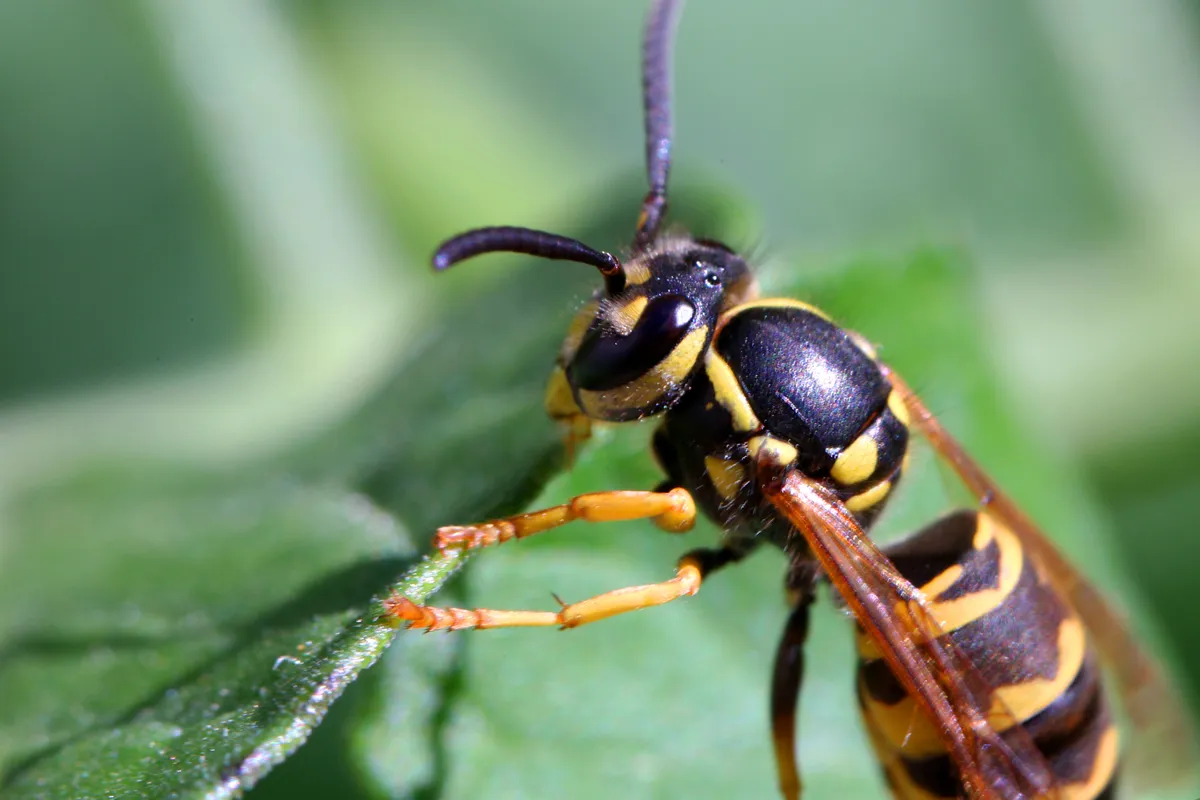
Wasps can remember human faces.

A team of researchers successfully trained a specific wasp species to identify human faces within a controlled laboratory environment. Additional studies demonstrate that another wasp species can visually recognize the faces of fellow wasps.
With approximately 150,000 distinct wasp species documented by experts, generalizing these laboratory outcomes to the entire family is scientifically inaccurate. Furthermore, there is no proof that wasps retain memories of human faces following casual, everyday encounters.
Wasps frequently face an unfavorable reputation, often viewed by the general public as more volatile, aggressive counterparts to bees equipped with an especially painful sting.
Fueling this apprehension is a long-standing rumor circulating for years that warns of their ability to recall individual human features. Inquiries from curious readers often center on whether these insects truly possess facial memory.
Such claims tap into the widespread belief that wasps act out of malice, with various online discussions even suggesting they hold grudges and actively pursue vengeance against humans.
To separate fact from fiction, researchers specializing in wasp behavior and cognitive abilities were consulted to evaluate the validity of these ideas.
Ultimately, while laboratory tests show that a single species can be trained to recognize human faces under artificial conditions, no proof exists that random encounters lead wasps to remember people. Because the vast majority of wasp species have not been studied in this manner, labeling the rumor as universally true is incorrect, making the claim mostly false with a grain of truth.
Setting the Stage
According to Elizabeth Tibbetts, a professor of ecology and evolutionary biology at the University of Michigan, thousands of wasp species exist worldwide. Princeton University Press places this estimate closer to 150,000 recognized species.
Contrary to popular belief, Tibbetts notes that the vast majority of these species are incapable of stinging, with hornets and yellowjackets serving as notable exceptions. Their social structures vary wildly as well. While some establish large colonies featuring queens and complex hierarchies, a significant number lead entirely solitary lives.
Because of this immense diversity—which includes variations like wingless females—applying behavioral traits across the entire group is fundamentally flawed. Existing scientific literature examining facial recognition focuses exclusively on a tiny fraction of species, meaning sweeping conclusions cannot be drawn for the entire insect family without extensive additional study.
Can Wasps Recognize Human Faces?
Adrian Dyer, an associate professor of physiology at Monash University in Australia who investigates the cognitive faculties of bees and wasps, has successfully trained western honey bees (Apis mellifera) and common wasps (Vespula vulgaris) to distinguish between images of human faces using standard visual testing methods.
During a 2017 study led by Dyer, common wasps were presented with two platforms displaying distinct human faces. One choice provided a sugary reward, while the other administered bitter quinine hemisulfate. Following several days of associative training, researchers removed the substances and tested the insects. The wasps reliably selected the face associated with the sugar reward, even in the absence of the treat and when introduced to novel faces. Their performance only faltered when the images were inverted.
Dyer emphasizes that this experiment highlights the remarkable learning capacity of these insects rather than an innate ability. Unlike humans—who display facial recognition tendencies within hours of birth—wasps required rigorous training to master the task in a laboratory environment.
Consequently, swatting at a wasp outdoors does not mean the insect will store your facial features in its memory and hunt you down later. “The wasps are acting in the way they evolved to act,” Dyer noted. “They are not trying to seek revenge.”
Recognition Among Nest-Mates
Tibbetts’ research primarily centers on Polistes fuscatus, the northern paper wasp. Commonly found in wooded areas and near human settlements throughout the eastern United States, they will sting if provoked, though Tibbetts describes them as surprisingly gentle. “I didn’t get stung until after I completed my PhD,” she remarked.
Early in her academic career, Tibbetts observed that these paper wasps possessed distinct facial and abdominal patterns, alongside individual behavioral traits. Intrigued by these complex social dynamics, she decided to test whether the insects could visually distinguish individual members of their colony by painting different facial markings onto specific wasps and returning them to their nests.
Initially, colony members displayed heightened aggression toward the altered wasps through lunging and biting, though notably, none were driven out of the nest—a typical reaction when outsiders attempt to invade, which insects normally manage via chemical scent markers.
Within a couple of hours, the hostility subsided as the colony adapted to the new appearance of their peers. Tibbetts concluded that the insects utilized visual facial patterns for identification, and the initial aggression simply reflected the colony recalibrating its social hierarchy.
Since publishing her initial findings in 2002, Tibbetts has continued uncovering sophisticated behaviors in paper wasps. Subsequent studies revealed that these insects engage in social eavesdropping by altering how they treat nest-mates after witnessing fights, and that they process facial features holistically much like humans do. Additional experiments involving hybrid colonies demonstrated that while P. fuscatus excelled at facial recognition naturally, related species like P. metricus could acquire basic recognition skills when raised alongside them.
Ultimately, these findings demonstrate that sophisticated cognitive functions do not require a massive mammalian brain. Dyer points out that honey bees operate with roughly a million neurons, a stark contrast to the 50 to 100 billion neurons found in human brains.
Sources
“Adrian Dyer.” MONASH OPINION & ANALYSIS, 14 Jan. 2026, https://lens.monash.edu/@adrian-dyer/.
An Introduction to Eusociality | Learn Science at Scitable. https://www.nature.com/scitable/knowledge/library/an-introduction-to-eusociality-15788128/. Accessed 6 Nov. 2026.
Avarguès-Weber, A., et al. “Recognition of Human Face Images by the Free Flying Wasp Vespula Vulgaris.” Animal Behavior and Cognition, vol. 4, no. 3, Aug. 2017, pp. 314–23. DOI.org (Crossref), https://doi.org/10.26451/abc.04.03.09.2017.
Baracchi, D., et al. ‘Speed and Accuracy in Nest-Mate Recognition: A Hover Wasp Prioritizes Face Recognition over Colony Odour Cues to Minimize Intrusion by Outsiders’. Proceedings of the Royal Society B: Biological Sciences, vol. 282, no. 1802, Mar. 2015, p. 20142750. PubMed Central, https://doi.org/10.1098/rspb.2014.2750.
Cely Ortiz, Christian, and Elizabeth A. Tibbetts. ‘Visual and Chemical Signals Provide Different Information in Polistes Fuscatus Wasps’. Ethology, vol. 127, no. 3, Mar. 2021, pp. 231–37. DOI.org (Crossref), https://doi.org/10.1111/eth.13119.
Dyer, Adrian G., et al. “Honeybee ( Apis Mellifera ) Vision Can Discriminate between and Recognise Images of Human Faces.” Journal of Experimental Biology, vol. 208, no. 24, Dec. 2005, pp. 4709–14. DOI.org (Crossref), https://doi.org/10.1242/jeb.01929.
Goriely, Alain. “Eighty-Six Billion and Counting: Do We Know the Number of Neurons in the Human Brain?” Brain, vol. 148, no. 3, Mar. 2025, pp. 689–91. DOI.org (Crossref), https://doi.org/10.1093/brain/awae390.
“How Wasps Recognize Faces.” NOVA | PBS, https://www.pbs.org/wgbh/nova/articles/northern-paper-wasp-face/. Accessed 6 Nov. 2026.
Johnson, Mark H., et al. “Newborns’ Preferential Tracking of Face-like Stimuli and Its Subsequent Decline.” Cognition, vol. 40, nos. 1–2, Aug. 1991, pp. 1–19. DOI.org (Crossref), https://doi.org/10.1016/0010-0277(91)90045-6.
O’Grady, Cathleen. “Like Humans, Wasps Seem to Recognize Faces as More than the Sum of Their Parts.” Science, 19 Jan. 2021.
Osterloff, Emily. ‘Velvet Ants: Flamboyant and Fuzzy with Extreme PPE’. Natural History Museum, https://www.nhm.ac.uk/discover/velvet-ants-flamboyant-and-fuzzy-with-extreme-ppe.html.
Schumm, Zach. ‘Ask an Expert – Do Wasps Get a Bad Rap?’ Utah State University | Utah State Today, 27 Aug. 2021, https://www.usu.edu/today/story/ask-an-expert—do-wasps-get-a-bad-rap.
Tibbetts, Elizabeth A., Juanita Pardo-Sanchez, et al. “Individual Recognition Is Associated with Holistic Face Processing in Polistes Paper Wasps in a Species-Specific Way.” Proceedings of the Royal Society B: Biological Sciences, vol. 288, no. 1943, Jan. 2021, p. 20203010. DOI.org (Crossref), https://doi.org/10.1098/rspb.2020.3010.
Tibbetts, Elizabeth A., John Den Uyl, et al. “The Development and Evolution of Specialized Face Learning in Paper Wasps.” Animal Behaviour, vol. 147, Jan. 2019, pp. 1–7. DOI.org (Crossref), https://doi.org/10.1016/j.anbehav.2018.10.016.
Tibbetts, Elizabeth A. “Visual Signals of Individual Identity in the Wasp Polistes Fuscatus.” Proceedings of the Royal Society of London. Series B: Biological Sciences, vol. 269, no. 1499, July 2002, pp. 1423–28. DOI.org (Crossref), https://doi.org/10.1098/rspb.2002.2031.
Tibbetts, Elizabeth A., Ellery Wong, et al. “Wasps Use Social Eavesdropping to Learn about Individual Rivals.” Current Biology, vol. 30, no. 15, Aug. 2020, pp. 3007-3010.e2. DOI.org (Crossref), https://doi.org/10.1016/j.cub.2020.05.053.
van Noort, Simon, and Gavin Broad. ‘The Wonderful World of Wasps’. Princeton University Press, 20 Mar. 2024, https://press.princeton.edu/ideas/the-wonderful-world-of-wasps.
“Wasps | National Geographic.” Animals, 9 Nov. 2010, https://www.nationalgeographic.com/animals/invertebrates/facts/wasps.
Wasps That Recognize Faces Cooperate More, and May Be Smarter | Cornell Chronicle. https://news.cornell.edu/stories/2023/12/wasps-recognize-faces-cooperate-more-and-may-be-smarter. Accessed 6 Nov. 2026.