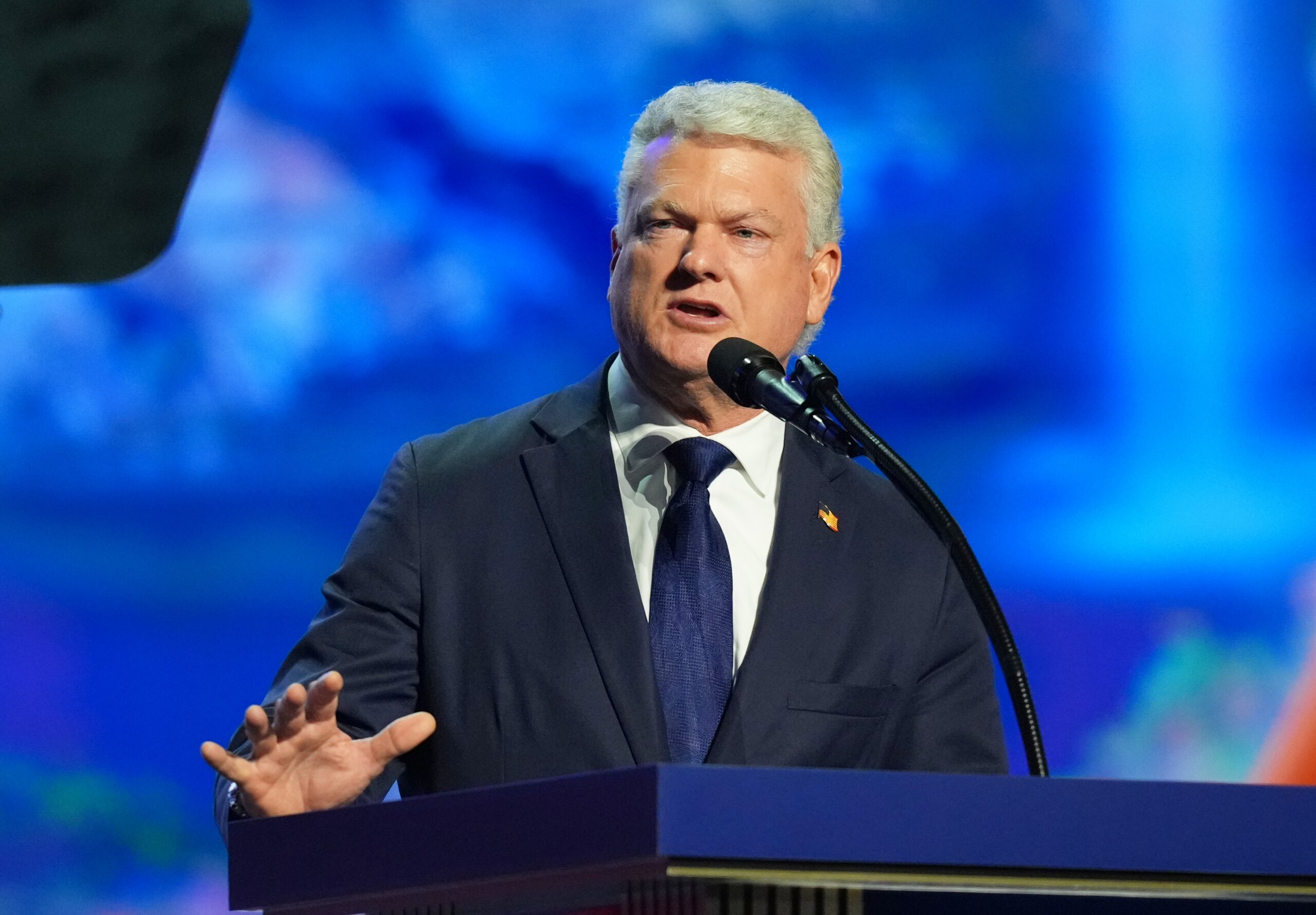
U.S. Senator Jon Ossoff, fighting to defend his Georgia Senate seat, has launched television commercials targeting older voters with allegations that his Republican challenger, Representative Mike Collins, intends to strip away their retirement security.
“Georgia Congressman Mike Collins voted to gut Social Security, and Mike Collins says he wants to push you off Social Security and back to work,” a narrator claims in a commercial broadcast on September 2, just before an audio excerpt of Collins speaking is played.
“‘Get off of Social Security. Get, get back into the workforce,’” Collins’ voice declares in the clip, leading the narrator to issue a final caution: “Mike Collins is attacking your retirement.”
The Ossoff campaign deployed the exact same Collins audio snippet in an August 7 TV spot centered around identical accusations. Both advertisements feature visuals of senior citizens before abruptly cutting to Collins’ recorded remarks.
However, Collins never stated that he intends to force elderly citizens off of Social Security.
Instead, Ossoff’s campaign relied on a heavily edited, out-of-context soundbite taken from a 2025 radio appearance. When examined in full, Collins’ actual remarks reveal he was addressing an entirely different subject.
During a June 2025 interview with Atlanta radio station XTRA 106.3, Collins discussed ongoing congressional efforts under Donald Trump aimed at curtailing government spending and shrinking the national deficit. He argued that reducing taxes and cutting regulations would draw corporations back to the United States, thereby expanding the taxpayer base and boosting government revenue.
“It’s just Business 101,” Collins explained during the segment. “You know, you’ve got spending and you’ve got revenue, and you set it up to where you can increase your revenue, and you do that by lowering taxes and making it more advantageous for people to work and to get off of Medicaid, get off of Social Security, get back into the workforce.”
While Ossoff’s campaign frames the issue around seniors, they are not the sole beneficiaries of Social Security. Although older Americans make up the majority of recipients, the program also distributes funds to the spouses and children of retired workers, surviving widows, dependent children of deceased workers, and individuals with disabilities alongside their families.
A representative for Ossoff defended the commercials, arguing that Collins failed to offer immediate clarification or context for his remarks either during the broadcast or afterward.
Even so, the complete transcript shows Collins was advocating for pro-growth tax policies designed to encourage workforce participation rather than directly ordering individuals to forfeit Medicaid and Social Security benefits.
“He was not talking about taking earned Social Security retirement benefits away from seniors,” countered Meyer Siegfried, a spokesperson for the Collins campaign.
Siegfried emphasized that Collins has never advocated for removing elderly Americans from Social Security, accusing the Ossoff team of selectively lifting words out of a broader conversation concerning labor force trends and public assistance programs.
“Rep. Collins believes seniors who spent their lives paying into Social Security should receive the benefits they earned,” Siegfried noted.
Did Collins vote to ‘gut’ Social Security?
While Collins has cast votes on legislation that critics argue could diminish Social Security payouts over time, the claim that he voted to “gut” the program is an overstatement.
To substantiate the accusation, one of the ads cited a March 18 labor union letter from the AFL-CIO opposing House Joint Resolution 139. The measure proposed a constitutional amendment to mandate a balanced federal budget—a move labor advocates warned would force drastic cuts to safety-net programs like Social Security, Medicare, and Medicaid.
Collins voted in support of the resolution, though it ultimately failed to clear the House.
The proposed amendment contained no carve-outs protecting Social Security, Medicare, or Medicaid, and it demanded a two-thirds majority in both congressional chambers to enact or elevate any tax rates.
Additionally, the Ossoff campaign pointed to Collins’ support for the One Big Beautiful Bill Act passed in 2025. As noted in prior reports, the Committee for a Responsible Federal Budget warned that the package would slash Social Security tax revenues by $30 billion annually, potentially depleting the trust fund by 2032 rather than the 2033 projection outlined in the 2025 annual report from the Social Security Board of Trustees.
Ossoff’s team also referenced Collins’ 2014 congressional platform and his membership in the Republican Study Committee, both of which have previously advocated for a gradual increase in the retirement age.
Lifting the retirement age results in reduced benefits for those who retire ahead of the new threshold, while forcing individuals seeking full benefits to delay their exit from the workforce. Analysts at the Center on Budget and Policy Priorities indicated in 2023 that such adjustments would scale back payouts for all future retirees.
Conclusion
Across two television advertisements, Ossoff’s campaign asserts that Collins “voted to gut Social Security” and is determined to “push (older Americans) off Social Security and back to work.”
The spots rely on a heavily truncated audio quote stripped of its original context. Collins was not discussing senior retirement benefits, nor was he commanding older citizens to surrender their checks and secure employment.
Although the ads center on retirees, Social Security extends far beyond older adults, providing critical financial support to surviving family members, disabled workers, and dependents.
While Collins has backed legislative measures that fiscal analysts warn could eventually reduce benefits for certain groups, his record does not support the claim that he voted to completely dismantle the program.
The assertion contains a kernel of truth but deliberately leaves out crucial context that fundamentally alters the narrative. Therefore, the claim is rated Mostly False.