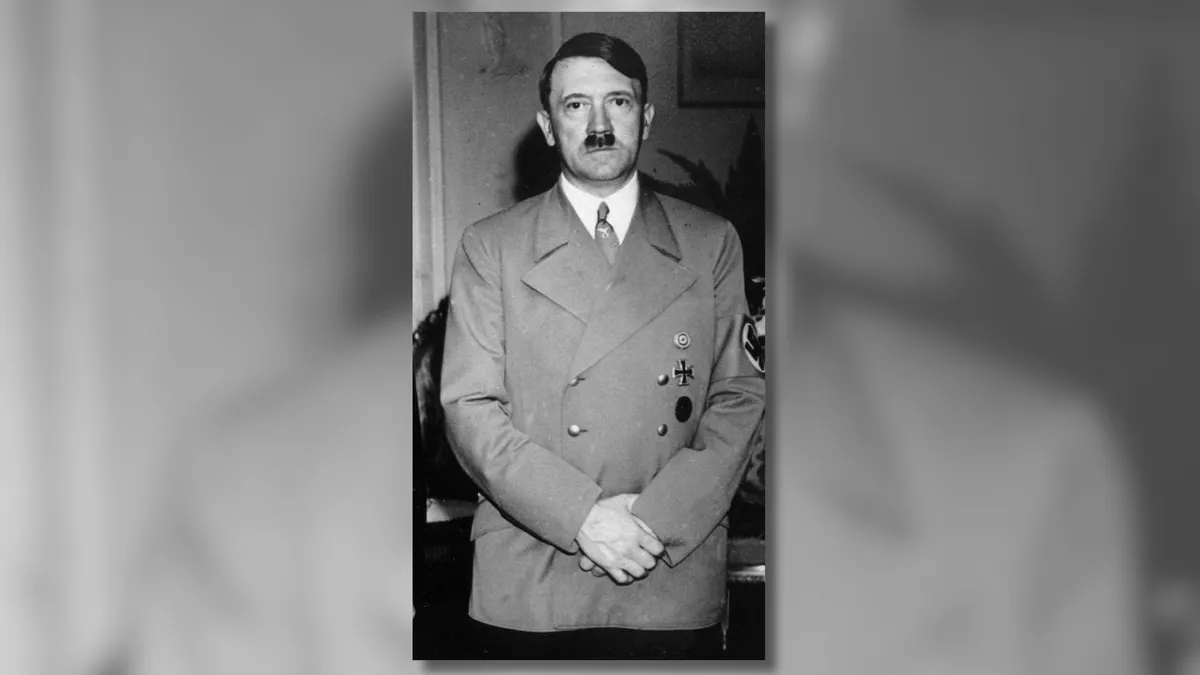
A vintage black-and-white photograph genuinely shows Adolf Hitler and other senior Nazi officials examining a scale model of a monumental triumphal arch planned for Berlin.

<input type="hidden" id="article_url" value="/fact-check/hitler-berlin-triumphal-arch-model/"/>
<p>In September 2026, a historical black-and-white image gained widespread traction online, purportedly capturing Adolf Hitler and high-ranking Nazi figures reviewing a miniature model of a colossal triumphal arch intended for Berlin.</p>
<p>Following a <a href="https://www.reddit.com/r/pics/comments/1wljsx8/hitler_and_other_top_nazis_inspect_a_scale_model/">Reddit post</a> (<a href="https://archive.ph/FXF6B">archived</a>) featuring the snapshot, many online users <a href="https://www.reddit.com/r/pics/comments/1wljsx8/comment/paz3sfr/?utm_source=share&utm_medium=web3x&utm_name=web3xcss&utm_term=1&utm_content=share_button">drew comparisons</a> between the unrealized Nazi monument and U.S. President Donald Trump's <a href="https://apnews.com/article/trump-arch-drones-snippers-national-security-ef9212f98c337a6a142b338c1861da97">proposal</a> to build a massive triumphal arch near Arlington National Cemetery in Washington, D.C.</p>
<p>Inquiries poured in asking whether the historical photograph was real.</p>
<p>The image is entirely authentic.</p>
<p>As part of their grandiose ambitions, the Nazi regime intended to extensively redesign Berlin and rename the capital city "<a href="https://www.museumsportal-berlin.de/en/exhibitions/mythos-germania/">Germania</a>." Chief architect <a href="https://www.britannica.com/biography/Albert-Speer">Albert Speer</a> spearheaded the project and constructed an elaborate physical model of the planned metropolis.</p>
<p>The display featured a staggering triumphal arch, and the circulated photo genuinely depicts Hitler inspecting this miniature conceptual design.</p>
<p>A <a href="https://www.snopes.com/articles/400681/how-to-perform-reverse-image-searches/">reverse image search</a> traces the picture to the stock photography library <a href="https://www.alamy.com/adolf-hitler-and-other-party-functionaries-inspect-the-modell-of-the-triumphal-arch-which-was-planned-to-be-built-after-the-end-of-the-war-in-berlin-undated-picture-image247140567.html">Alamy</a>, which credits it to the archives of the German daily publication <a href="https://www.sueddeutsche.de/">Süddeutsche Zeitung</a>.</p>
<p>While the database lists the capture date as Jan. 1, 1939, it also notes the image is generally "undated" with Berlin designated as the location. The archival description reads:</p>
<blockquote>
<p>Adolf Hitler inspects a modell of a planned triumphal arch. Adolf Hitler and other party functionaries inspect the modell of the triumphal arch, which was planned to be built after the end of the war in Berlin. Undated picture. Date created: 01/01/1939-31/12/1945</p>
</blockquote>
<p>A spokesperson for *Süddeutsche Zeitung* confirmed that the outlet licenses authentic historical materials from its collection through Alamy, verifying the image's origin within a trusted journalistic archive.</p>
<p>Furthermore, running the photograph through multiple artificial intelligence detection tools yielded zero evidence of digital tampering or synthetic generation.</p>
<h2>A History of Triumphal Arches</h2>
<p>Architectural historians trace the concept of the triumphal arch back to ancient Rome. During the Roman Republic, the Senate bestowed a <a href="https://www.worldhistory.org/Roman_Triumph/">"triumph"</a>—an elaborate victory parade—upon successful generals and their armies. <a href="https://www.britannica.com/topic/triumphal-arch">Encyclopædia Britannica</a> notes that three arches were erected during this era, though none have survived.</p>
<p>The tradition expanded significantly during the imperial period, when emperors frequently commissioned arches to commemorate their own campaigns, regardless of actual military merit. Three prominent examples—the Arches of <a href="https://www.turismoroma.it/en/places/arch-titus">Titus</a>, <a href="https://www.turismoroma.it/en/places/arco-di-settimio-severo">Septimius Severus</a>, and <a href="https://www.italia.it/en/lazio/rome/arch-of-constantine">Constantine</a>—remain <a href="https://www.italia.it/en/lazio/rome/arch-of-constantine#:~:text=three%20triumphal%20arches%20in%20Rome%20today">intact in Rome</a>.</p>
<p>Global architectural styles have long referenced these ancient structures, most notably the <a href="https://www.britannica.com/topic/Arc-de-Triomphe">Arc de Triomphe</a> in Paris, built to honor Napoleon Bonaparte's victories. Other variations serve distinct purposes, such as New York City's <a href="https://www.nycgovparks.org/parks/washington-square-park/monuments/1657">Washington Square Arch</a>, which marked the centennial of George Washington's inauguration, and New Delhi's <a href="https://www.britannica.com/topic/India-Gate">India Gate</a>, which functions as a war memorial.</p>
<p>Donald Trump first proposed a Washington, D.C., triumphal arch in late 2025. When questioned by CBS News regarding its honoree, Trump reportedly pointed to himself. The proposed 250-foot structure—designed to <a href="https://parkplanning.nps.gov/projectHome.cfm?projectID=136973">mark</a> the United States' sestercentennial—has faced <a href="https://democracyforward.org/news/press-releases/arlington-county-takes-legal-action-to-stop-trumps-250-foot-tall-vanity-project/">legal challenges</a> over proper approval channels and potential disruptions to local aviation safety and emergency infrastructure.</p>
<h2>The Nazis, Art, and Architecture</h2>
<p>Beyond its campaigns of hatred, persecution, and genocide, the Nazi Party sought to completely overhaul German society, attempting a cultural and ideological "rebirth" that positioned the state as an absolute, mandatory belief system. Italian philosopher Umberto Eco addressed this totalitarian impulse in his 1995 essay "<a href="https://www.nybooks.com/articles/1995/06/22/ur-fascism/">Ur-Fascism</a>," noting that under such regimes, disagreement and diversity are strictly suppressed.</p>
<p>This ideological purge extended directly into arts and culture. In 1937, the regime confiscated thousands of modern artworks deemed offensive to German sensibilities, displaying them publicly in Munich as "<a href="https://encyclopedia.ushmm.org/content/en/article/degenerate-art-1">Degenerate Art</a>."</p>
<p>Modern architecture faced similar hostility; the influential <a href="https://www.metmuseum.org/essays/the-bauhaus-1919-1933">Bauhaus</a> school was <a href="https://www.bauhaus.de/en/discover/article/the-bauhaus-in-exile/#:~:text=The%20Bauhaus%20was%20forced%20to%20close%20down%20in%201933%20due%20to%20pressure%20from%20the%20Nazis.">forced to close</a> under Nazi pressure in 1933, allowing architects like Albert Speer to rise rapidly within the regime's inner circle.</p>
<p>While the vast majority of Speer's architectural visions for Germania were never built, one notable relic still exists: the "<a href="https://schwerbelastungskoerper.de/von-berlin-zu-germania/">Schwerbelastungskörper</a>" (heavy load-bearing body), a massive concrete cylinder situated in Berlin's Tempelhof district.</p>
<p>According to historical documentation and <a href="https://www.theguardian.com/cities/2016/apr/14/story-of-cities-hitler-germania-berlin-nazis">The Guardian</a>, engineers constructed the 1941 structure—partially using <a href="https://www.theguardian.com/cities/2016/apr/14/story-of-cities-hitler-germania-berlin-nazis#:~:text=French%20PoWs%20were%20among%20those%20deployed%20in%20its%20construction.">forced labor and prisoners of war</a>—to test whether Berlin's marshy ground could support the extreme weight of the planned triumphal arch's northeast pillar.</p>Sources
‘Arlington County Takes Legal Action to Stop Trump’s 250-Foot-Tall Vanity Project’. Democracy Forward, 8 Oct. 2026, https://democracyforward.org/news/press-releases/arlington-county-takes-legal-action-to-stop-trumps-250-foot-tall-vanity-project/.
“Calls for Nazi Art in Munich to Be Taken Down.” Dw.Com, https://www.dw.com/en/calls-for-nazi-art-in-munich-to-be-taken-down/a-63368860. Accessed 28 Sept. 2026.
Connolly, Kate. “Story of Cities #22: How Hitler’s Plans for Germania Would Have Torn Berlin Apart.” The Guardian, 14 Apr. 2016. Cities. The Guardian, https://www.theguardian.com/cities/2016/apr/14/story-of-cities-hitler-germania-berlin-nazis.
“‘Degenerate’ Art.” Holocaust Encyclopedia, https://encyclopedia.ushmm.org/content/en/article/degenerate-art-1. Accessed 28 Sept. 2026.
‘Der Schwerbelastungskörper’. Informationsort Schwerbelastungskoerper, https://schwerbelastungskoerper.de/der-schwerbelastungskoerper/. Accessed 9 Oct. 2026.
Eco, Umberto. “Ur-Fascism.” The New York Review of Books, vol. 42, no. 11, 22 June 1995. www.nybooks.com, https://www.nybooks.com/articles/1995/06/22/ur-fascism/.
ParkPlanning – Triumphal Arch at Memorial Circle. https://parkplanning.nps.gov/projectHome.cfm?projectID=136973. Accessed 9 Oct. 2026.
Rennie, Daniel. “The Story Of Welthauptstadt Germania, Hitler’s Design To Raze Berlin And Rebuild It As A World Capital.” All That’s Interesting, 13 July 2025, https://allthatsinteresting.com/welthauptstadt-germania.
Severo, Arco di Settimio, et al. ‘Arco Di Settimio Severo’. Turismo Roma, 14 Feb. 2023, https://www.turismoroma.it/en/places/arco-di-settimio-severo.
‘The Bauhaus in Exile: What Happened After Its Closure in 1933’. Das Bauhaus-Archiv / Museum Für Gestaltung, https://www.bauhaus.de/en/discover/article/the-bauhaus-in-exile/. Accessed 9 Oct. 2026.
Tito, Arco di, et al. ‘The Arch of Titus’. Turismo Roma, 1 Dec. 2022, https://www.turismoroma.it/en/places/arch-titus.
‘Travertine Arch’. Italia.It, https://www.italia.it/en/lazio/rome/arch-of-constantine. Accessed 9 Oct. 2026.
‘Triumphal Arch – Washington, DC’. U.S. Commission of Fine Arts, 16 Apr. 2026, https://www.cfa.gov/system/files/meeting-materials/1-CFA-16APR26-1-EOP_DOI_Arch-pres%20%5BApr9%5D.pdf.
‘Von Berlin zu „Germania“’. Informationsort Schwerbelastungskoerper, https://schwerbelastungskoerper.de/von-berlin-zu-germania/. Accessed 9 Oct. 2026.