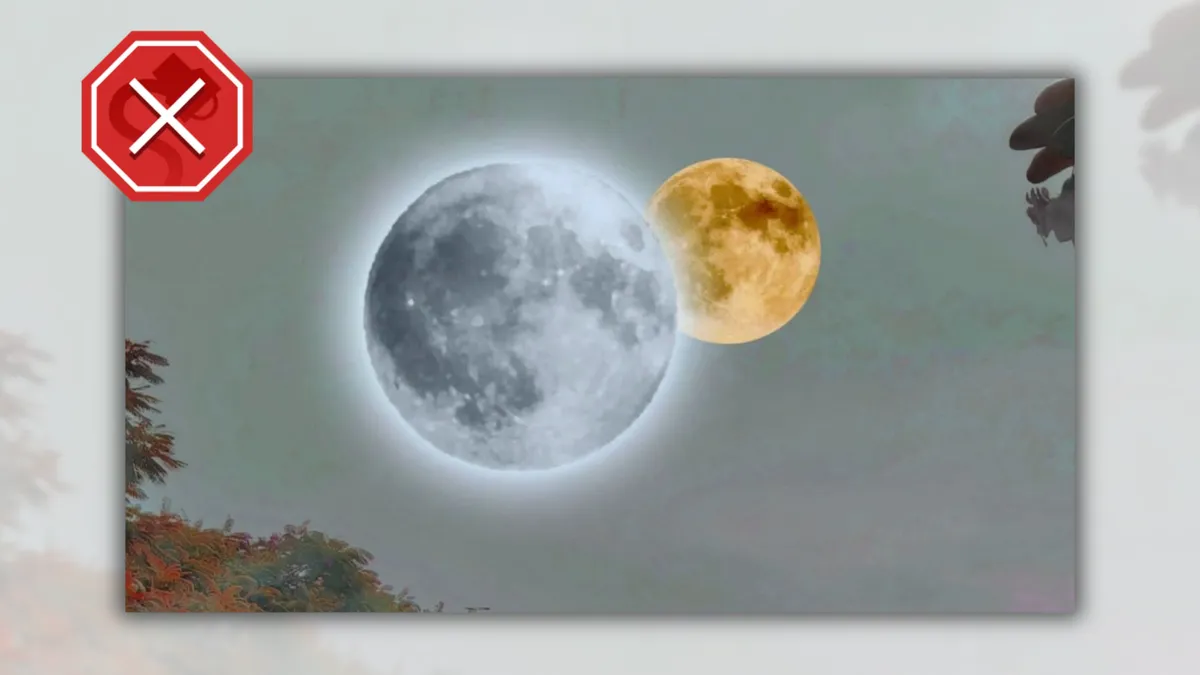
A “two-moon night” will occur on September 29, 2026.

The celestial body mentioned in viral posts, asteroid 2025 PN7, cannot be seen with the naked eye, binoculars, or even standard amateur telescopes. Because its solar orbit closely mirrors Earth’s, it is classified as a “quasi-moon.”
Social media platforms began circulating rumors in late September 2026 claiming that September 29 would feature two moons in the night sky. For instance, an image shared in a Facebook post stated that “Earth may seem to have two moons in the sky.” The accompanying text claimed:
😯👉🌙✨ A RARE “TWO-MOON” NIGHT IS COMING! ✨🌙
On September 29, 2026, skywatchers may notice an unusual celestial event. Earth’s natural Moon will share the night sky with asteroid 2025 PN7, a small object described as a temporary quasi-moon. 🌌🔭
Although 2025 PN7 is not a true second moon, its unusual relationship with Earth makes it an interesting object to learn about.
It’s a beautiful reminder that our cosmic neighborhood is constantly changing. Look up, find a clear and dark location, and enjoy the night sky! 🌠✨
Various other Facebook pages and video posts echoed this narrative, frequently displaying imagery of Earth’s moon alongside a smaller, brownish duplicate. Numerous inquiries poured in from readers wondering if the phenomenon was real.
In reality, the asteroid in question, 2025 PN7, is entirely invisible to the naked eye, binoculars, and amateur telescopes, leading to a “false” rating for the claim.
NASA’s official September 2026 skywatching guide makes no mention of a “two-moon night” among its monthly highlights because no such visible event is taking place.
Data from NASA’s small-body database confirms that asteroid 2025 PN7 is far too tiny, distant, and dim to be seen. A closer look at the numbers explains why:
The Las Cumbres Observatory estimates the asteroid’s diameter at roughly 60 feet—about the length of a single bowling lane. This is less than a third of the length of a Boeing 787 passenger jet, which ranges from 186 to 224 feet. By contrast, Earth’s actual moon spans 2,159 miles across, roughly a quarter of our planet’s diameter.
Beyond being vastly smaller, the asteroid is also situated at a much greater distance. While NASA notes that Earth’s moon orbits at an average distance of about 238,000 miles, the asteroid’s closest approach in 2026 kept it nearly 2.8 million miles away from Earth—more than 11 times the Earth-moon distance.
Astronomers measure the visibility of celestial objects using apparent magnitude, where lower values indicate brighter objects and higher values designate dimmer ones. For comparison, the sun has a magnitude of -26.5, and a full moon sits at -12.5.
Given its tiny size and immense distance, asteroid 2025 PN7 falls well short of those brightness levels. According to NASA’s Ephemeris table, the asteroid’s apparent magnitude on September 29 is 24.373, peaking at just under 21 during its brightest night of 2026 on August 4.
Under optimal dark-sky conditions, the human eye can typically discern objects up to an apparent magnitude of roughly 6.5. Binoculars extend that limit to about magnitude 10, while standard amateur telescopes can generally capture objects up to magnitude 14 or 16.
As a designated “quasi-moon,” 2025 PN7 actually orbits the sun rather than Earth. It only mimics a lunar orbit from our perspective because its trajectory around the sun closely parallels Earth’s own path.