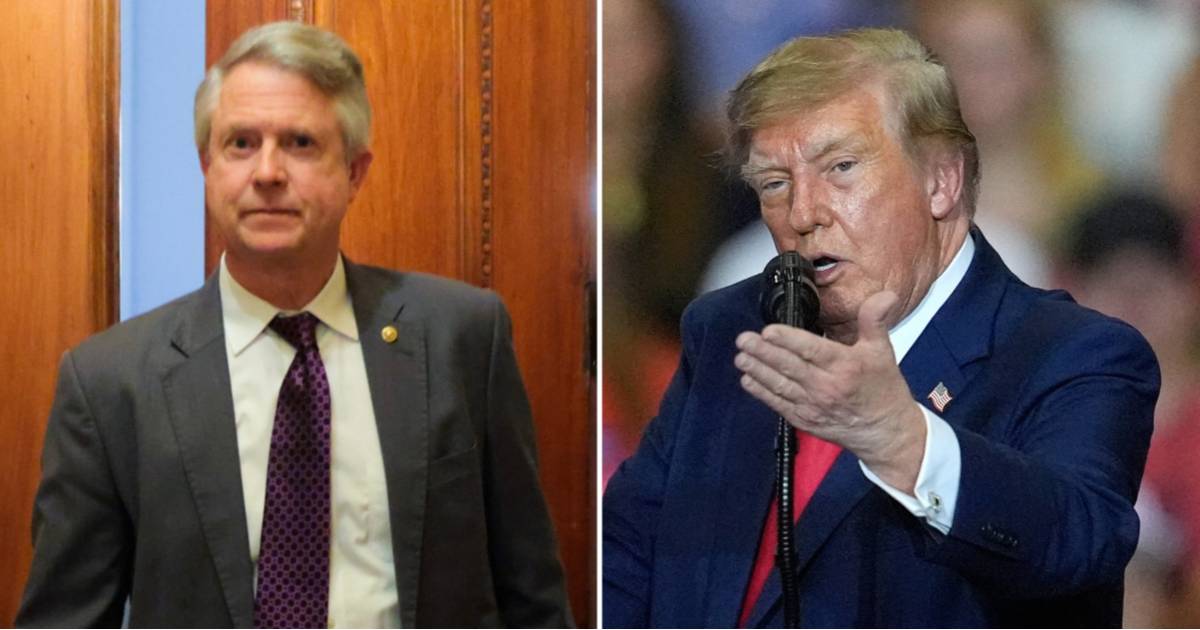
Trump falsely claims federal law forced Sen. Roger Marshall to sue patients for unpaid medical bills
PARK CITY, KANSAS — Donald Trump recently defended Sen. Roger Marshall over his past medical debt collection practices, asserting that the Kansas Republican was legally obligated to sue patients who fell behind on their bills. According to Trump, failing to aggressively pursue these debts could have resulted in criminal charges and arrest.
The assertion has reignited scrutiny regarding Marshall’s history as an obstetrician-gynecologist. Previous investigations revealed that Marshall’s practice filed hundreds of lawsuits against patients with unpaid balances, applied an 18% annual interest rate, and, in some instances, led to patient arrests after they missed mandated court appearances.
While speaking at a campaign rally in Park City, Kansas, Trump pushed back against the criticism. “He was given a bum rap because he was mandated by law to request, strongly, money owed from patients,” Trump told the crowd. He further claimed that failing to collect the funds would mean “breaking a very strong criminal law, and he would be subject to criminal arrest and liability.”
The Fact Check: Is there a law requiring doctors to sue patients?
No. Legal experts and policy guidelines confirm that no federal or state law forces healthcare providers to sue patients over unpaid medical bills.
Medical practices and hospitals maintain wide discretion in managing delinquent accounts. Providers are legally permitted to offer charity care, write off debts for financially struggling patients, or utilize alternative collection methods that do not involve litigation.
During an interview with CNN, Marshall defended his record by stating that his practice provided millions of dollars in charity care annually and wrote off numerous bills each month.
However, investigators note that while Marshall’s office pursued litigation, the 18% interest rate applied to unpaid bills was notably higher than the regional average for Kansas medical practices. Furthermore, no existing statute mandates an 18% interest rate or penalizes doctors for forgiving medical debt.
White House defense falls short
In response to inquiries, the White House pointed to two specific federal regulations—one civil and one criminal—which require healthcare providers serving certain federal benefit programs to make “reasonable efforts” to collect payments.
Despite this, the very federal guidelines cited by the White House explicitly exempt providers from these collection requirements when patients demonstrate genuine financial hardship. The Office of the Inspector General has confirmed it does not penalize medical providers who choose to waive fees or forgive debts for patients facing economic difficulties.