During a recent campaign appearance alongside former President Bill Clinton, Florida Democratic gubernatorial candidate David Jolly argued that the state needs to confront and stop sugarcoating American history.
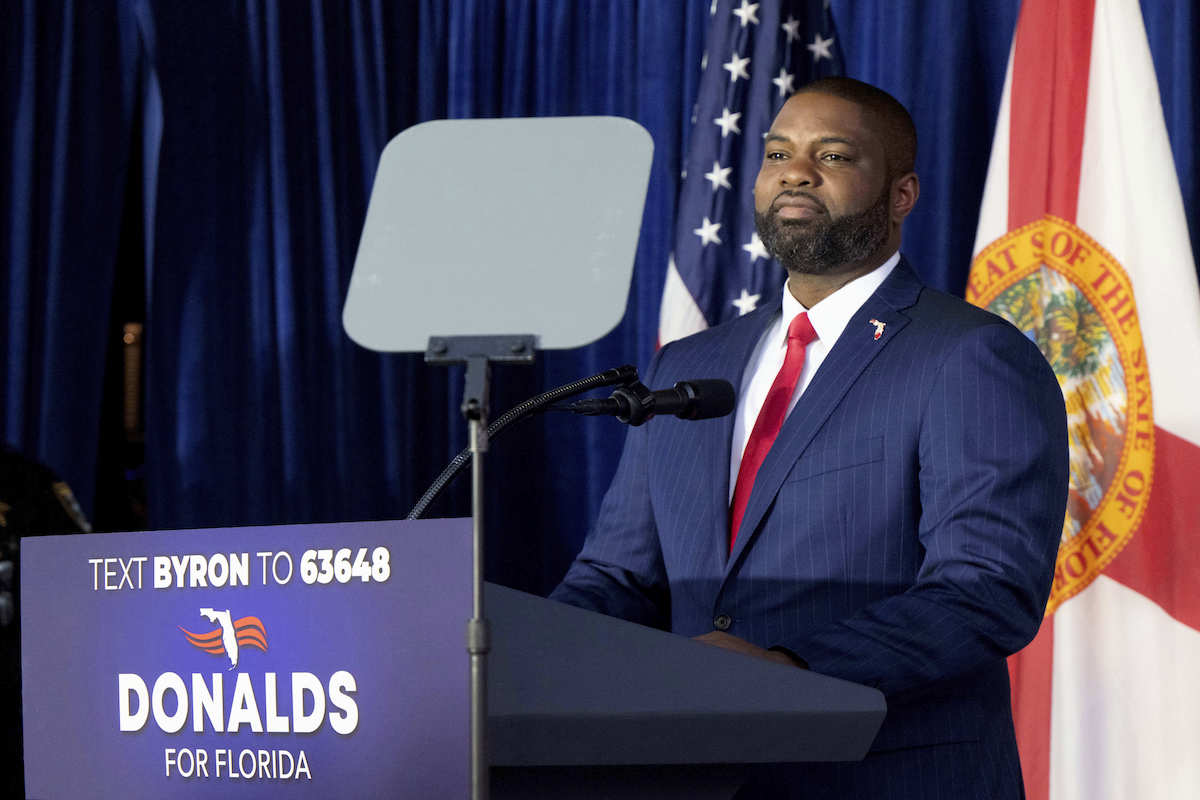
Speaking on Oct. 20 at the Koinonia Worship Center—a historically Black, non-denominational church in Hollywood, Florida—Jolly claimed that his Republican opponent, U.S. Rep. Byron Donalds, had previously praised elements of the Jim Crow era, the period from the late 1800s to the mid-1960s defined by state-sponsored discrimination against Black people in the South.
“If the test is our goodness, we are failing right now. We are failing right now…When we’re a state that actually suggested years ago that we might want to teach our kids the ‘good parts’ of slavery,” Jolly said. “Or, when my opponent suggests there were good parts of Jim Crow.”
This follows actions taken by Florida officials in 2023 to revise certain Black history curriculum guidelines, suggesting that enslaved individuals sometimes acquired skills that proved beneficial to them.
Want fact-driven reporting on Florida? Sign up for our Florida midterms newsletter.
However, Jolly’s assertion that Donalds praised aspects of Jim Crow lacks crucial context. Donalds never endorsed the discriminatory laws of the period; rather, his 2024 remarks focused on historical trends regarding Black family structure and conservative voting patterns.
During a Philadelphia event in 2024 aimed at rallying Black voter support for Donald Trump’s reelection, Donalds pointed to what he called a “reinvigoration of the Black family,” highlighting younger generations establishing households and helping drive the “revival of a Black middle class in America,” as reported by The Philadelphia Inquirer.
It was in this context that he referenced the past.
“During Jim Crow, the Black family was together,” Donalds remarked at the gathering. “During Jim Crow, more Black people were not just conservative — Black people have always been conservative-minded — but more Black people voted conservatively.”
Donalds attributed subsequent shifts in family structures to President Lyndon Johnson’s Great Society anti-poverty initiatives, which critics argue inadvertently contributed to the breakdown of nuclear families.
Jim Crow laws arose in the decades following Reconstruction and were ultimately dismantled by the Civil Rights Act and the Voting Rights Act.
Facing immediate backlash, Donalds clarified on MSNBC later in 2024 that he was not expressing nostalgia for Jim Crow, but was instead drawing attention to data showing that “the marriage rates of Black Americans were significantly higher than any other time since then in American history” before experiencing a subsequent decline.
While Donalds’ campaign did not reply to inquiries regarding his original remarks, Jolly’s team pointed to subsequent comments where Donalds reiterated his stance.
During an interview for a documentary series hosted by former Obama White House Communications Director Jennifer Palmieri, Donalds addressed the controversy.
“I said exactly what I meant … I was talking about marriage rates for Black families,” Donalds told Palmieri. “The data is clear. Marriage rates were higher in the Black community during that period of time. When Lyndon Johnson’s Great Society came in, that’s when we saw marriage rates in the Black family plummet.”
He accused President Joe Biden’s campaign of deliberately misconstruing his words for political gain, calling the accusation that he supported Jim Crow “crazy.”
Donalds’ comments primarily focused on family cohesion during the Jim Crow era
When previous investigations examined Donalds’ comments, research indicated that while divorce rates climbed for both white and Black couples between 1940 and 1980, the increase was sharper among Black women. Census figures show the percentage of Black women aged 40 to 44 who had ever been married dropped from 94% in 1930 to 63% in 2012.
Although some conservative analysts attribute these changes to government assistance programs that permitted single-parent households, sociologists and researchers emphasize that the causes are multifaceted. Other significant factors include the loss of manufacturing jobs impacting Black men in the 1970s and 1980s, alongside rising college attainment and employment rates among Black women.
Furthermore, historians note that verifying claims about Black voting patterns during the Jim Crow era is challenging, primarily because systemic disenfranchisement prevented most Black Southerners from voting, and modern political conservatism largely took shape as an organized movement in the 1950s.
Our ruling
Jolly asserted that Donalds “suggested there were good parts of Jim Crow.”
In 2024, Donalds did highlight certain social indicators from that era, noting that Black families were more unified and that Black Americans historically held more conservative viewpoints. However, he was not endorsing the discriminatory and racist laws of the period, contrary to the implication in Jolly’s remarks.
Because Jolly’s statement contains an element of truth but omits vital context and misrepresents the original intent, it is rated Half True.
RELATED: Fact-checking Byron Donalds’ ‘Jim Crow’ comments on Black families, conservatism