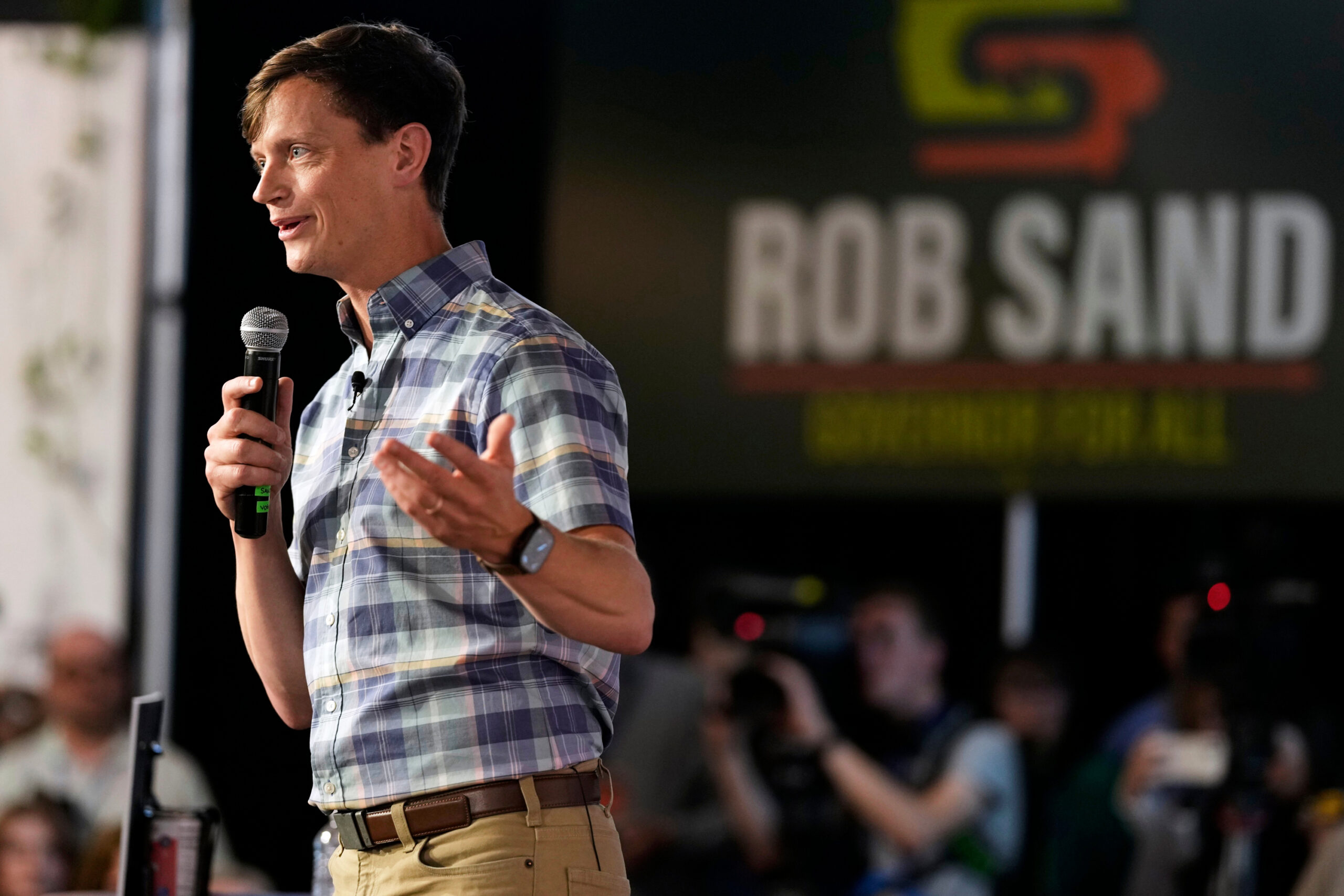
During a gubernatorial campaign commercial shared across his social media platforms, Democratic State Auditor Rob Sand argued that Iowa’s public education system has dropped in national standing.
“I want us to get back to having the best public schools in the country, not in the bottom half,” Sand stated in the ad.
A vocal critic of Iowa’s Education Savings Account initiative—which lets families redirect state education funds toward private school tuition—Sand has pushed for mandatory annual financial reviews, income caps for eligibility, and restrictions on how much private institutions can raise tuition.
When approached by PolitiFact, Sand’s campaign provided a personal reflection on the state of schools during his youth, though it did not cite specific records showing Iowa ever held the absolute top spot nationally.
“Growing up in Decorah, Iowa, our schools were among the finest in America,” Sand noted in an email to PolitiFact, pointing to the state quarter’s “Foundation in Education” inscription as a testament to that legacy. He added that public institutions have faced funding shortages as resources shifted toward private vouchers.
Data from the Education Data Initiative shows that Iowa invests $17,804 per student from combined local, state, and federal sources, positioning the state 34th in total K-12 spending and 35th in overall funding..
While comprehensive data proving Iowa’s schools were definitively ranked number one overall is lacking, state students did secure leading scores in specific disciplines throughout the 1990s when Sand was a student. Because multiple organizations evaluate public education annually using varying metrics, standings fluctuate. When *U.S. News & World Report* first launched its K-12 state rankings in 2017, Iowa came in sixth, but that position has since declined, with Iowa landing at 26th place for K-12 education in 2026.
Federal records from the National Assessment of Educational Progress (The Nation’s Report Card) reveal that Iowa tied for the nation’s highest score in eighth-grade mathematics in both 1992 and 1996. Furthermore, fourth-grade math students claimed second place nationally in 1992, and average scores in reading and math during various points in the 1990s sat 11 points above the national average.
Conversely, Carol Burris—executive director of the advocacy group Network for Public Education—assigned Iowa a grade of “D” and awarded the state just 47 out of 100 possible points in their 2026 evaluations. Their scoring system weighs privatization and voucher expansions, homeschooling regulations, funding levels, and classroom working conditions, placing Iowa 19th from the bottom in public school evaluations.
“Our evaluations measure the level of backing public education receives from the governor and state legislature,” Burris explained, emphasizing that the assessment focuses on legislative policies and governance.
A 2026 report from the Annie E. Casey Foundation, analyzing 2024 data, indicates a decline in Iowa’s educational performance, citing reduced preschool enrollment, lower reading comprehension rates among fourth and eighth graders, and a drop in high school graduation rates. Overall, the philanthropic organization dedicated to children’s welfare ranked Iowa 27th in education.
By 2024, 70% of fourth graders tested below reading proficiency, compared to 66% in 2019. Similarly, eighth-grade math proficiency dropped, with 73% failing to reach proficiency in 2024, up from 67% in 2019.
However, the foundation noted that Iowa is not alone, as 47 states experienced declines between 2019 and 2024, with three of the four major national indicators—reading, math, and preschool attendance—worsening across the country.
Margaret Buckton, a long-serving lobbyist representing the Rural School Advocates of Iowa and the Urban Education Network of Iowa, supported Sand’s perspective, noting a sharp decline in Iowa’s standing over recent decades.
“Iowa adopted state standards later than others,” Buckton remarked. “We transitioned our assessments and spent years adjusting to those shifts. We haven’t received the institutional backing seen in other states, and shifting demographics mean we must invest more resources, specialized programs, and staff to support students who begin behind.”
While acknowledging Iowa’s stellar reputation for standardized test scores in the 1990s, Buckton pointed out that current achievement levels for fourth-grade reading and eighth-grade math now hover close to national averages.
Our ruling
Sand claimed that Iowa previously possessed “the best public schools in the country,” but currently sits “in the bottom half.”
While various educational evaluators show that Iowa earned top-tier marks in specific areas decades ago, it was never universally ranked number one. State standings have indeed slid over the past thirty years, with at least one organization currently placing Iowa’s K-12 system at 26th nationwide.
We rate Sand’s statement as Half True.