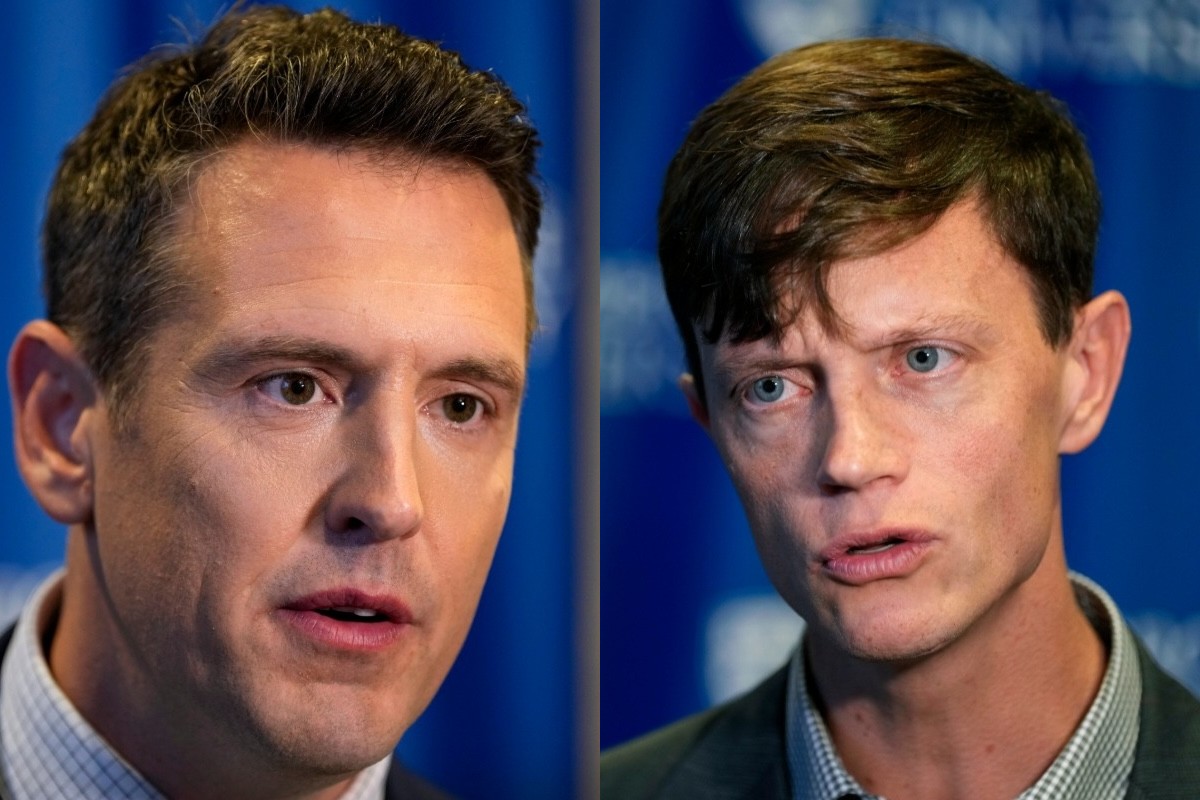
On Oct. 6, Democratic Iowa Auditor Rob Sand and Republican businessman Zach Lahn squared off in their inaugural gubernatorial debate, locking horns over state residency, campaign financing, and pressing policy issues. Held at St. Ambrose University in Davenport and hosted by KWQC-TV, the event drew sharp contrasts between the two candidates as independent fact-checkers subsequently reviewed several of their key claims.
The debate heated up early when Sand pressed Lahn on his ties to Kansas, questioning his voting history there and arguing that Lahn could not serve as a full-time governor for Iowa. Lahn fired back by targeting Sand’s financial backing, asserting that the Democrat relied heavily on wealthy family contributions and accused him of masking more progressive stances behind a moderate facade. The candidates also sparred over public education rankings, tax policy, and potential strategies to combat Iowa’s elevated cancer rates.
Residency and Voting Records
Sand frequently labels Lahn a “part-time Iowan” due to his travel between Iowa and Wichita, Kansas. Lahn attributes the interstate travel to a shared family custody agreement, noting that both he and his wife have children from prior marriages residing in Kansas. While Lahn owns a family farm in Belle Plaine, Iowa—acquired in 2014—he also maintains a residence in Kechi, Kansas. Flight logs from Lahn’s company plane showed 37 trips to Wichita between October 2025 and May 2026, including 75 overnight stays in Wichita compared to 51 in Belle Plaine. Lahn maintains he established full-time residency in Iowa in 2023.
Regarding voting history, fact-checks confirmed Sand’s assertion that Lahn cast ballots in Kansas during the 2018 and 2020 general elections, as well as the August 2022 primary. Lahn subsequently voted in Iowa’s 2024 general election and a Belle Plaine municipal vote in November 2025, prior to which his last recorded Iowa ballot was cast in 2016.
Campaign Financing and Family Contributions
Lahn criticized Sand’s fundraising, claiming he received unprecedented financial support from relatives. State campaign finance data confirms this is largely accurate: unlike federal regulations, Iowa law imposes no caps on personal campaign donations. Sand has brought in over $10 million this cycle from members of his wife’s family, who operate an Ankeny-based holding company. Overall, relatives of Sand’s wife—including his wife, Christine Lauridsen Sand, who serves as CEO of the Lauridsen Group, and her father, Nixon Lauridsen—have funneled roughly $13 million into his campaigns since 2018, contributing to a record-breaking $37.8 million raised overall for the current cycle.
On the Republican side, Lahn’s leading contributor is the Republican Governors Association, which has provided $15.5 million. Lahn’s total fundraising also includes approximately $10 million secured since the campaign’s launch, alongside a $2.5 million personal loan.
Environmental Concerns and Cancer Rates
Addressing Iowa’s high cancer rates, Lahn proposed tackling elevated nitrate levels in the state’s water supply and tied the issue directly to Sand’s family business, claiming that campaign donations derived partly from selling high-nitrate fertilizers. Sand disputed the claim, stating his in-laws’ business does not sell such products.
Context reveals that Lahn was referencing the Lauridsen Group, where one subsidiary—Boyer Valley Co.—manufactures organic, nitrogen-rich fertilizers derived from chicken byproducts. While organic fertilizers generally feature lower nutrient concentrations and release elements more slowly than synthetic alternatives, they still break down into nitrates via soil microorganisms and can contribute to water pollution if mismanaged. Furthermore, Boyer Valley primarily markets its goods for gardening, whereas agricultural nitrogen pollution concerns typically center on large-scale farming operations.
Education and Tax Policy Claims
During discussions on public schooling, Sand asserted that Iowa’s public education system has slipped into the “bottom half” nationally. Fact-checks indicate this is largely accurate; while Iowa historically ranked near the top for K-12 education, prominent modern assessments place it lower. U.S. News & World Report dropped Iowa from sixth nationally in 2017 to 26th by 2026, while a 2026 report by the Annie E. Casey Foundation placed the state 27th, citing dips in preschool enrollment and reading proficiency compared to 2019 figures.
Conversely, Lahn claimed that an average family of four would save $7,500 annually under the tax cuts criticized by Sand—a statement rated false. While Sand opposed state income tax cuts implementing a flat 3.8% rate in 2025 (projected to save a typical household roughly $410) and federal legislation making 2017 tax cuts permanent while impacting Medicaid and rural hospitals (saving roughly $3,100 on average in 2026 according to the Tax Foundation), the combined savings total closer to $3,500 rather than Lahn’s cited $7,500 figure.