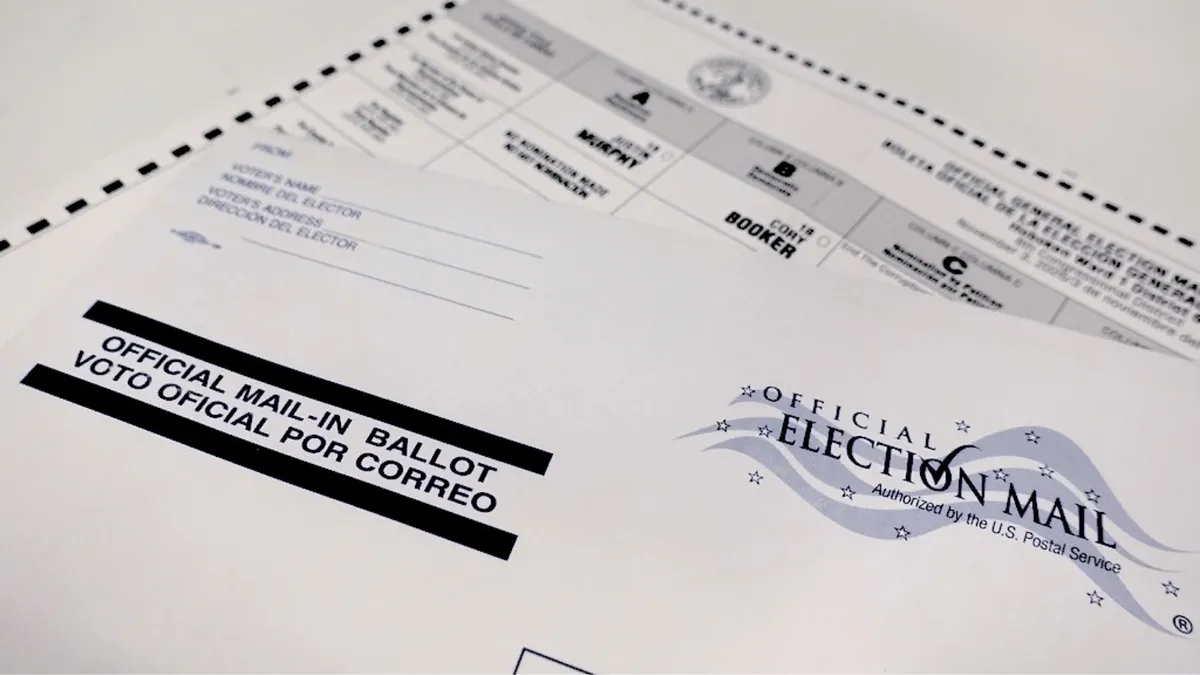
Elections in the United States have been decided by illegal votes submitted for deceased individuals who remained on voter registration lists.

- Historically, the assertion that ballots cast in the names of deceased voters still on rolls have swung U.S. election outcomes is untrue.
- This narrative gained significant traction through Donald Trump’s “Stop the Steal” messaging leading up to and following the 2020 presidential race.
- Numerous investigations—including an analysis reportedly funded by Trump himself—have concluded that while isolated incidents happen, the volume of ballots cast and counted for dead individuals is far too minuscule to alter any election results.
- Furthermore, not all instances of deceased voting stem from deliberate fraud. Some occurrences are administrative mishaps or timing-related situations, such as a voter casting an early mail-in ballot and passing away prior to Election Day (though several jurisdictions officially accept these).
The persistent narrative that American election outcomes are manipulated by ballots illegally submitted on behalf of dead voters re-emerged as the 2026 midterms approached.
While this myth circulates during every election cycle, it amplified dramatically around the 2020 presidential contest due to Donald Trump’s repeated claims, which also preceded the January 6, 2021, Capitol riot.
More recently, Trump has continued to suggest that deceased voters are participating in large numbers.
“Hundreds of thousands of noncitizens and dead people are listed and active on the voter rolls, and yet we still have elections with no voter ID, no proof of citizenship and tens of millions of ballots floating aimlessly through the mail,” he remarked during a July news conference (at 35:45).
We have determined this assertion is false.
This evaluation expands upon previous research by Snopes conducted prior to the 2024 presidential vote. Below is a breakdown of why claims of widespread fraud via deceased voters are unfounded:
How Frequently Are Ballots Cast in the Names of the Deceased?
In short: Although it occurs on rare occasions, research demonstrates that the frequency is statistically negligible and wholly insufficient to influence election outcomes.
Public confidence in the voting process has waned as mail-in voting has expanded, particularly in the wake of the COVID-19 pandemic, according to a 2020 Pew Research Center analysis.
All U.S. states provide some mechanism for absentee or mail-in voting, allowing citizens to mail their ballots rather than appear at a polling place. While some states mandate an application or a specific reason (such as a disability or illness) to receive an absentee ballot, eight states—California, Colorado, Hawaii, Nevada, Oregon, Utah, Vermont, and Washington—utilize an automatic mail-in voting model.

(ballotpedia.org)
Despite arguments that mail-in procedures make it easier for bad actors to cast ballots for deceased individuals, a 2020 Stanford University study focusing on Washington state—a leader in universal mail-in voting—discovered only 14 instances between 2011 and 2018 where a deceased person’s ballot was submitted an unusually long time after their passing. This accounted for a minuscule 0.0003% of all votes cast in Washington during that span, identified by matching full names and birthdates.
The researchers noted:
Even these few cases may reflect two individuals with the same name and birth date, or clerical errors, rather than fraud. If we relax requirements for matching middle names to accommodate people who may not have middle names, we estimate that there are an additional 43 cases of potential fraud, but these are more likely to be false positives. On the whole, the results suggest that it is extremely rare for dead people’s ballots to be counted as votes in Washington’s universal vote-by-mail system.
The study added that because Washington has refined its mail-in infrastructure over many years, other states might theoretically show slightly different figures, though still exceptionally low.
Following the 2020 election, Trump challenged results in six key swing states: Arizona, Georgia, Michigan, Nevada, Pennsylvania, and Wisconsin. In 2021, The Associated Press performed a comprehensive review of every alleged instance of voting irregularities in those jurisdictions, including ballots linked to deceased registrants.
The AP uncovered fewer than 475 total potential irregularities across all six states—a quantity entirely incapable of altering the national outcome.
Additionally, The Washington Post reported in 2023 that the Trump campaign compensated investigators $600,000 to examine potential anomalies in that same election. According to the Post, the investigation found “no reason to believe the final vote totals in five key states were fraudulent.” (The findings of this commissioned report have not been officially released to the public and only emerged after being subpoenaed by the Justice Department.)
Why Might a Deceased Person’s Ballot Be Counted?
Not every instance of a vote associated with a deceased person stems from malicious intent. Frequently, these situations arise from calendar logistics—for instance, a voter casts an absentee ballot early and passes away prior to Election Day (a scenario explicitly permitted in several states).
Infrequent administrative mistakes can also lead to living citizens being incorrectly labeled as deceased, or vice versa.
Intentional Fraud
There are indeed documented instances where individuals purposefully attempted to submit a ballot for a deceased family member, often because the ballot arrived at the household after the person’s death.
For example, 56-year-old Russel Hobbs of Washington state illegally signed and mailed his late wife’s ballot during the 2020 election, roughly three months after her passing. “I think [Hobbs] just tried to honor his deceased loved one,” his defense attorney stated to the Tacoma News Tribune. Hobbs ultimately received a sentence of 80 hours of community service.
In another 2020 occurrence, a Pennsylvania resident cast a ballot on behalf of his deceased mother. The state intercepted the illegal submission, and the individual was given five years of probation. “I was isolated last year in lockdown,” Bruce Bartman explained to the court. “I listened to too much propaganda and made a stupid mistake.”
Yet, despite such isolated occurrences—driven by grief, misinformation, or other factors—the sheer scale of these incidents remains far too minimal to impact any widespread election results.
Clerical and Data Inaccuracies
Election personnel and record-keepers are human and prone to mistakes, which can occasionally result in living voters being mistakenly flagged as deceased.
Jason Roberts, a political science professor at the University of North Carolina at Chapel Hill, noted in a 2022 interview with the AP that “election integrity groups scouring voter files often mistake a living voter for a deceased voter if they have similar names, birthdays or hometowns, resulting in false fraud claims.”
Similarly, the Brennan Center for Justice—a nonpartisan law and policy institute at NYU School of Law—observed that “a 2007 investigation of about 100 ‘dead voters’ in Missouri revealed that every single purported case was properly attributed either to a matching error, a problem in the underlying data, or a clerical error by elections officials or voters.”
What Happens If a Voter Dies Before Election Day?
State laws regarding ballots submitted by individuals who die prior to Election Day vary significantly. According to the National Conference of State Legislatures (NCSL), a nonpartisan research organization, 10 states explicitly allow such ballots to be tabulated, while 12 expressly forbid it. The NCSL report states:
- Ten states—Arkansas, Florida, Hawaii, Louisiana, Maryland, Massachusetts, Montana, North Dakota, Tennessee, and Virginia—have statutes explicitly permitting the counting of absentee ballots cast by individuals who pass away prior to Election Day. California allows this through administrative guidelines rather than legislation. Meanwhile, Connecticut counts these ballots exclusively if the deceased individual served in the armed forces.
- Twelve states—Delaware, Illinois, Indiana, Iowa, Michigan, Minnesota, Missouri, New Hampshire, New Jersey, Pennsylvania, South Dakota, and Wisconsin—have laws that explicitly prohibit counting absentee ballots from voters who die before Election Day. For instance, Missouri law stipulates that such ballots are only rejected if verifiable evidence of death is presented to election authorities before the opening of the polls while the envelope remains sealed. Michigan instructs clerks to make their “best effort to remove the absent voter ballot” and void it.
- At least two states—Kentucky and Mississippi—also bar the counting of ballots from deceased voters based on opinions issued by their respective state attorneys general rather than formal statutes.
Remaining states either lack specific statutes on the matter or permit absentee ballots to be challenged on the grounds that the voter passed away before election day.
What Safeguards Are in Place?
To mitigate both intentional and accidental votes attributed to deceased individuals, states enforce legal penalties and maintain rigorous voter list hygiene.
Punishments for deliberately submitting a ballot in a deceased person’s name can range from probation and monetary penalties to prison time, depending on state guidelines and the severity of the offense.
Furthermore, election offices continuously clean voter registration databases by cross-referencing death certificates, obituary notices, and motor vehicle records. The Help America Vote Act of 2002 mandates that states coordinate with state agencies responsible for tracking mortality statistics (typically vital statistics bureaus or departments of health) to ensure rolls stay current.
Additional verification channels used by various states include notifications from funeral homes, military branches, family member reports, and published death notices.