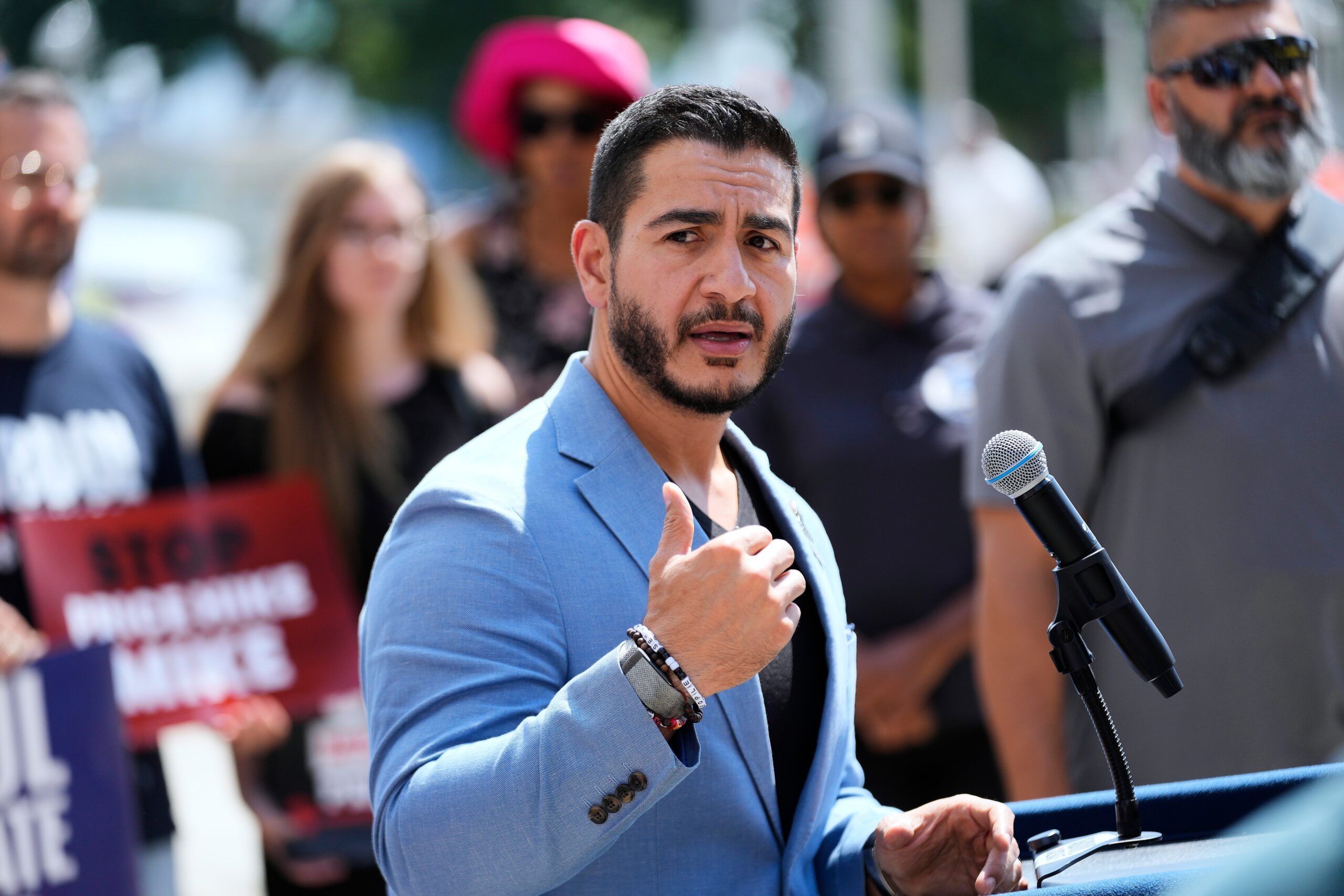
As the 25th anniversary of the September 11 terrorist attacks approaches, Michigan Democratic U.S. Senate candidate Abdul El-Sayed has criticized his Republican opponent, former U.S. Rep. Mike Rogers, claiming he repeatedly voted against funding for 9/11 first responders’ healthcare.
The dispute began when El-Sayed asserted on social media that Rogers had twice voted to deny healthcare to these responders. After Rogers dismissed the claim as entirely false, El-Sayed doubled down on X, posting a screenshot of a local news headline stating that Rogers actually opposed the healthcare provisions nine times.
You’re right. Sorry. Turns out you didn’t vote to deny 9/11 first responders healthcare twice. You did it NINE times. https://t.co/5XVlIMZzgP pic.twitter.com/I8vUT8fkAH
— Dr. Abdul El-Sayed (@AbdulElSayed) September 12, 2026
When questioned about the claim, El-Sayed’s campaign directed inquiries to reports detailing Rogers’ past legislative voting record.
In response, Rogers issued a statement describing 9/11 as one of the nation’s darkest days and called the allegation that he does not care about the victims completely unfounded.
“During my time in Congress, I advocated for a reliable, dedicated $150 million annual appropriation to directly address the needs of 9/11 survivors and their families,” Rogers stated.
While Rogers did vote against the landmark 2010 legislation establishing the World Trade Center Health Program—which allocated billions for first responders—the total count of nine opposition votes lacks important nuance.
The political clash follows earlier friction in the race, including a separate claim by Rogers regarding El-Sayed that was previously debunked as entirely inaccurate.
The 2010 First Responders Healthcare Legislation
Long-term medical care for 9/11 survivors and rescue workers finally coalesced into a permanent system with the passage of the 2010 James Zadroga 9/11 Health and Compensation Act, following years of fragmented programs and persistent advocacy.
Advanced by a Democratic-controlled Congress, the legislation ultimately secured $4.3 billion to cover health monitoring, medical treatment, and financial compensation for those affected.
Legislative archives show Rogers voted against the bill on the House floor on two separate occasions, alongside committee votes and procedural steps that bring the total opposition tally cited by critics to nine. However, on the final passage vote just before Christmas in 2010, Rogers was among a large group of lawmakers from both parties who did not cast a vote.
At the time, Rogers defended his opposition by citing the bill’s substantial cost and its creation of a multi-year mandatory funding stream rather than relying on routine congressional budget approvals. The original measure initially proposed $7.4 billion over a decade before being reduced to $4.3 billion over five years for final approval.
“Like every member of this committee, I fully support the 9/11 health program and believe the federal government has a responsibility to take care of first responders and survivors,” Rogers noted during a 2010 committee hearing, according to records. “But I also believe that we should not create an entitlement program.”
Instead, Rogers offered an alternative approach that would have maintained existing programs through a guaranteed $150 million annual budget subject to yearly legislative review.
Supporters of the Zadroga bill argued that annual funding was insufficient. Ben Chevat, former chief of staff to the bill’s primary sponsor, Rep. Carolyn Maloney, and current executive director of 9/11 Health Watch, noted that yearly appropriations leave healthcare funding vulnerable to shifting political priorities. Without mandatory funding, he argued, long-term care lacks certainty.
Examining the Other Votes
While Rogers clearly opposed the definitive long-term healthcare bill, the broader count of nine votes requires closer examination.
For instance, one referenced vote occurred in 2003, when Rogers opposed a motion seeking to inject $90 million into a Centers for Disease Control and Prevention monitoring initiative alongside broader grants. While that specific motion failed, Rogers later voted in favor of a separate spending measure that same year containing $90 million in FEMA funds designated for long-term health monitoring.
Critics also pointed to a 2007 vote against a comprehensive budget package containing $50 million for 9/11 health programs, as well as a subsequent vote upholding a presidential veto. Because that omnibus bill funded multiple federal departments beyond 9/11 care, Rogers opposed the final version, though he had voted in favor of earlier iterations that also included responder healthcare allocations.
The remaining votes cited in the tally include:
- A procedural vote against bringing the Zadroga bill to the floor.
- A vote supporting an amendment that would have halted funding if the national debt increased.
- A committee vote against advancing the Zadroga legislation.
- Backing a motion to return the bill to committee with instructions to lower the overall spending amount.
Conversely, the Rogers campaign highlighted numerous votes he cast immediately following the September 11 attacks, supporting emergency recovery aid, benefits for public safety workers, tax relief for impacted families, and measures to enhance aviation security.
In total, factoring in procedural hurdles and broad spending bills, the record shows nine votes against measures carrying 9/11 health funding, at least three votes supporting bills with similar provisions, and four early votes backing immediate post-9/11 relief packages.
Our Assessment
El-Sayed asserted that Rogers voted nine times to deny healthcare to 9/11 first responders.
The record confirms that Rogers opposed the foundational legislation that secured long-term medical monitoring, treatment, and compensation for victims, alongside various budget amendments and spending bills containing responder funds.
However, framing these votes as a flat rejection of first responder healthcare strips away necessary context. The tally includes procedural maneuvers and omnibus bills, while ignoring instances where Rogers supported legislation containing 9/11 health funding or voted for immediate post-disaster relief.
Because the claim contains elements of truth while omitting vital context, we rate the statement **Half True**.