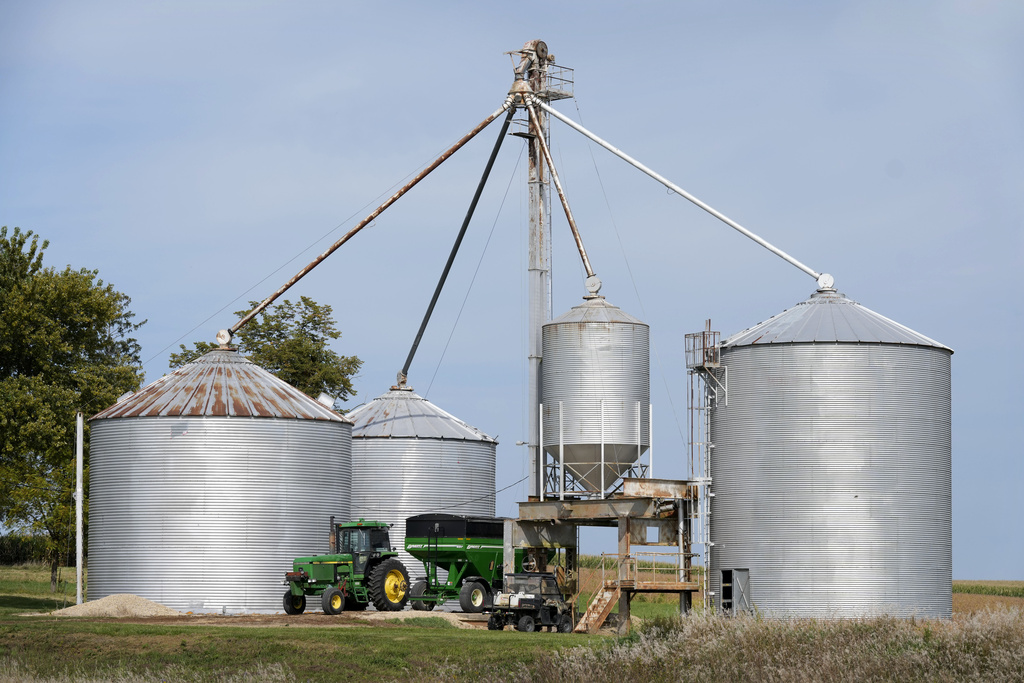
During an October 7 debate on Iowa PBS, Democratic U.S. Senate candidate Josh Turek asserted that President Donald Trump’s administrative actions—specifically pointing to tariffs and conflict involving Iran—are driving Iowa farms into severe financial distress and forcing widespread property losses.
We lead the nation in farm foreclosures now here in Iowa,
Turek stated during the exchange with his Republican opponent, U.S. Rep. Ashley Hinson.
However, when asked to back up this claim, Turek’s campaign relied on figures tracking farm bankruptcies rather than actual foreclosures. Experts note that public data comprehensively tracking national farm foreclosures does not exist. While bankruptcy filings are frequently used as a proxy for agricultural financial distress, they are distinct from foreclosures, as bankruptcy allows producers to restructure debt and retain their assets and land.
To support the assertion, the Turek campaign referenced a Farm Bureau report analyzing Chapter 12 farm bankruptcies. Chapter 12 is a specific legal designation tailored for family farmers and fishermen with steady annual incomes, allowing them to formulate a multi-year repayment plan to satisfy creditors while keeping their operations intact.
The data shows that while Iowa saw an increase—recording 18 Chapter 12 bankruptcies in 2025 compared to seven the previous year—it did not lead the nation. Arkansas led the country with 33 filings, followed by Georgia with 27, placing Iowa third overall. Iowa’s 2025 figures were comparable to Nebraska (17), Wisconsin (16), and Missouri (16). Across the entire United States, 315 Chapter 12 bankruptcies were filed in 2025, with the Midwest accounting for 121 of them, representing a 70% increase year-over-year.
Iowa State University agricultural economist Rabail Chandio confirmed that while definitive public data on farm foreclosures is largely unavailable, Chapter 12 filings serve as a reliable indicator of broader financial strain. Chandio noted that Iowa agriculture has experienced heightened financial pressure over the last half-decade—driven largely by global disruptions like the conflicts in Ukraine and the Middle East that inflate input costs—though the state is not currently at the absolute top of the national bankruptcy rankings.
Silvia Secchi, an environmental policy professor at the University of Iowa, also pointed out that the Farm Bureau figures cited by the campaign do not substantiate Turek’s specific claim, noting that the absolute numbers remain relatively low despite the upward trend.
Beyond Chapter 12, farms can also utilize Chapter 11 bankruptcy, which is designed for businesses and allows operations to continue running while restructuring liabilities. According to data compiled by the Farm Journal, Iowa did lead the nation in Chapter 11 farm filings between January 2021 and June 2026, with 26 operations seeking relief. Yet, when combining Chapter 11 and Chapter 12 filings, Iowa ranked third behind California and Arkansas.
Our ruling
Josh Turek claimed, We lead the nation in farm foreclosures now here in Iowa.
While the candidate spoke specifically about foreclosures, the evidence provided by his campaign centers entirely on bankruptcy filings. Because comprehensive public records tracking farm foreclosures do not exist, bankruptcy data is used to gauge financial hardship; however, entering bankruptcy does not automatically mean a farmer has lost their land or property.
Furthermore, while Iowa is experiencing growing economic pressure in the agricultural sector and ranks among the top states for bankruptcy filings—recording 18 Chapter 12 filings in 2025—it is not the national leader. Arkansas and Georgia both recorded higher totals that year.
Because the statement contains an element of truth regarding agricultural financial strain but misstates the data and conflates bankruptcies with foreclosures, this claim is rated Mostly False.