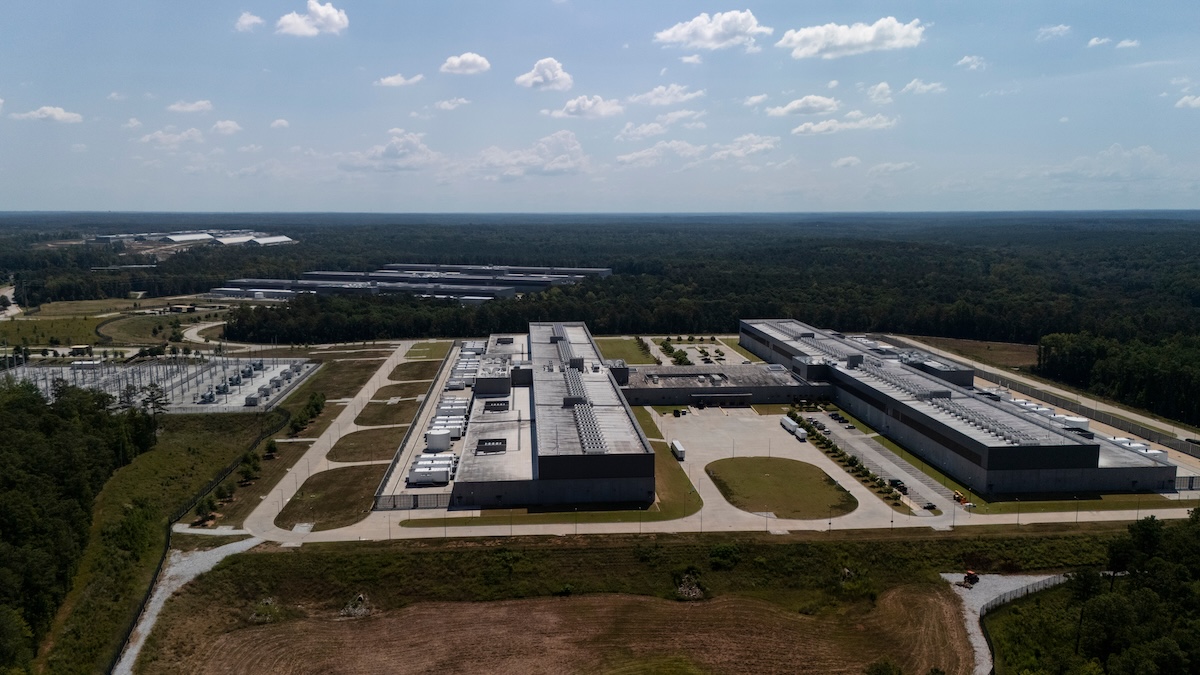
President Donald Trump has sought to dismiss widespread public backlash against U.S. data center developments by pointing the finger at a foreign rival: China.
“You know, a lot of people say that it’s a China PR thing,” Trump remarked to Fox News anchor Laura Ingraham on Sept. 10 when questioned about why local communities are rejecting data centers in their neighborhoods.
The comment came ahead of Trump’s scheduled meeting with Chinese leader Xi Jinping in Washington, arriving amid heightened demands for federal artificial intelligence regulations following incidents involving rogue automated agents and widespread discussions regarding existential tech threats—fears that Trump has previously dismissed as a “hoax.”
Trump is far from alone in attributing grassroots pushback to external meddling, particularly from Beijing.
Interior Secretary Doug Burgum has similarly blamed local resistance to data center expansion on “foreign source dark money,” “foreign psy-ops campaigns,” and “foreign-directed propaganda.”
“There’s a concentrated information propaganda war that’s geotargeted,” Burgum stated in May during an appearance on Fox Business. “Any place that’s trying to build data centers is getting bombarded with foreign-directed propaganda to try to block these from being built.”
On Capitol Hill, Republican lawmakers formally requested a briefing in June from the FBI and the President’s Council of Advisers on Science and Technology. They sought details on how the administration plans to combat foreign influence operations and “billionaire-backed activism” targeting domestic AI infrastructure.
Additionally, two House Republicans launched an inquiry in September, asking environmental organizations to disclose any connections to foreign funding and influence related to AI and energy policies.
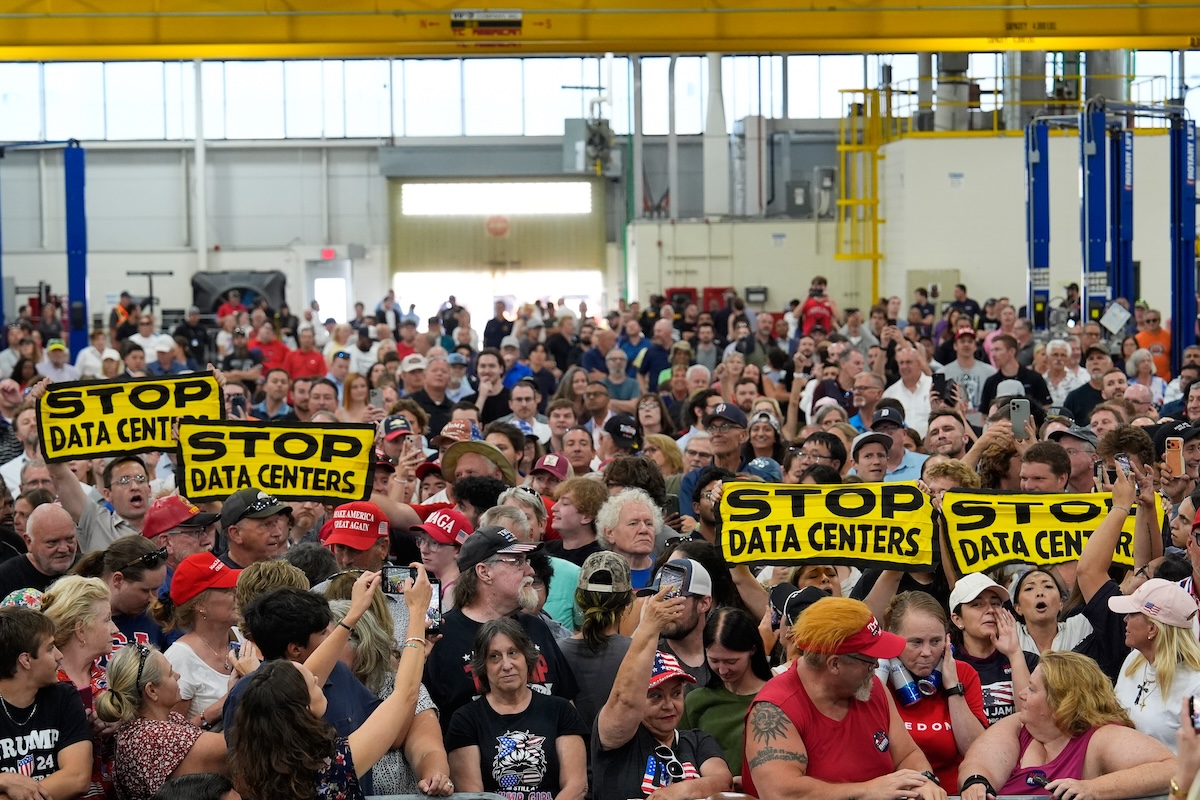
While intelligence reports have documented instances of Chinese influence campaigns attempting to amplify anti-data center sentiments, politicians have significantly inflated the impact of these efforts. In reality, the resistance movement spans a broad political spectrum and encompasses nearly every U.S. state.
“A political movement that stretches from Bernie Sanders to Steve Bannon isn’t the result of some mystical power China wields over the American people,” remarked Mitch Jones, managing director of policy and litigation for the anti-data center advocacy organization Food & Water Watch.
Reports tie funding to foreign actors, but critics say facts are distorted
Accusations regarding foreign interference in the data center controversy surged over the summer.
In May, businessman and television personality Kevin O’Leary—a vocal supporter of expanding data center infrastructure in Utah—claimed he possessed evidence that “two cells inside of Utah” were backed by foreign actors, specifically targeting the nonprofits Elevate Strategies and the Alliance for a Better Utah.
“These are proxies for the Chinese government,” O’Leary asserted on Fox Business.
Following a defamation lawsuit filed by the two groups and their founders, O’Leary retracted his claims, and Fox News anchors issued an on-air apology.
“Recently I appeared on various news programs and would like to clarify that I have no evidence that Alliance for a Better Utah, Elevate Strategies, Gabrielle Finlayson, Taylor Knuth or Josh Kanter are funded by China or the Chinese Communist Party,” O’Leary noted in a post on X on June 25.
GOP lawmakers relied heavily on reports from advocacy organizations like Power the Future and the Bitcoin Policy Institute when drafting their June inquiries.
An April publication by Power the Future alleged that the Sierra Club was under investigation for covert financial backing from China and Russia, referencing a 2020 inquiry where the EPA urged the Justice Department to probe environmental nonprofits for potential foreign funding. However, no public records indicate the Sierra Club was ever formally investigated or charged.
Similarly, the Bitcoin Policy Institute published an investigative report in May detailing alleged Chinese methods to steer U.S. conversations around data centers. The report claimed that foreign entities utilized English-language propaganda networks, various nonprofits, and foreign billionaires to influence American public opinion. It highlighted state-run Chinese media coverage blaming U.S. data centers for driving up domestic utility bills.
Yet, Sam Lyman, the report’s author, admitted to The New York Times that “there is an organic opposition to data centers,” characterizing the foreign activity his group tracked as merely a parallel, inorganic effort.
Darren Linvill, a Clemson University professor and co-director of its media forensics hub, pointed out that such reports often warp facts to push a misleading agenda.
“China has an extensive state media apparatus that they use for a range of propaganda and influence operations, but we don’t see a particular focus on this issue from Chinese state media,” Linvill explained. “Chinese state media mostly wants to talk about how great Chinese AI technology is, which is typical of their purpose.”
Jessica Brandt, a senior fellow for technology and national security at the Council on Foreign Relations, emphasized that foreign adversaries tend to exploit existing controversies rather than manufacture them from scratch.
“That’s what they do — work to amplify splits that already exist in our society. Evidence of an attempt is not evidence of success,” Brandt noted. “Their goal is to divide us, distract us, and prevent us from playing a forward-leaning role in the world that might constrain their interests.”
A digital threat intelligence firm, Alethea, also published findings indicating that Russia and Iran have similarly pushed anti-data center narratives via state-controlled media.
Tech firms trace social media influence campaigns, find limited reach
OpenAI has similarly flagged Chinese meddling in the broader AI debate, though its findings fell significantly short of the widespread disruption claimed by Trump and other officials.
In a June threat report, OpenAI announced it had banned two separate sets of ChatGPT accounts suspected of originating from China. These accounts leveraged OpenAI’s technology for influence campaigns “that promoted narratives in an attempt to manipulate a legitimate debate about American AI and wider tech policies.”
One cluster utilized ChatGPT to generate social media content suggesting data center construction was directly responsible for surging electricity rates. One such post featured a comic strip depicting a suited man holding cash alongside a family complaining about high utility bills.
Because OpenAI services are unavailable within China, the operators circumvented restrictions using virtual private networks (VPNs) to obscure their real locations.
Ultimately, OpenAI concluded the operation fell flat.
“The operation sought to exploit and amplify existing public concerns about energy prices and local impacts of data center development, but we found no evidence of meaningful breakout beyond its own activity,” the company reported.
Similarly, the X Safety Team announced in August that it had uncovered roughly 200 automated accounts “posting in a manner that could manipulate a legitimate debate about American AI and energy policy.”
The X Safety team conducted an investigation into suspected Chinese inauthentic accounts involved in influence operations:
We identified a bot farm of approximately 200,000 accounts. Within this farm, we found 200 accounts posting in a manner that could manipulate a legitimate… pic.twitter.com/Mj0SqerdlH
— Global Government Affairs (@GlobalAffairs) August 28, 2026
Linvill noted that the networks identified by OpenAI and X featured significant overlap. His research team spotted 70 accounts appearing in both datasets, noting that these accounts had zero followers and zero engagement prior to being suspended.
While the deployment of bots mirrors past Chinese influence strategies, Linvill emphasized scale: “If this were a topic they actually wanted to influence, we would see far more than 200 accounts.”
Surveys show rapid growth of domestic data center opposition
Even as tech conglomerates push forward with nationwide data center developments, grassroots resistance has surged exponentially.
A comprehensive survey conducted by the University of Pennsylvania’s Annenberg Public Policy Center between June and July revealed that 61% of U.S. adults oppose data center construction in their communities. This marks a sharp 12-percentage-point increase from the center’s February-to-March poll, which recorded 49% opposition. Notably, this resistance crossed party lines, commanding majorities among Democrats, Republicans, and independents alike.
Additionally, an August report compiled by the Coalition for Responsible Data Center Development, Evitable, and Together Against AI tracked 580 local resistance groups spanning nearly every state, representing a collective membership of roughly 640,000 individuals primarily organized through Facebook.
Data Center Watch, an independent tracking initiative run by AI security firm 10a Labs, reported that 45 projects worth nearly $68 billion were either delayed or blocked during the second quarter of 2026 alone.
For community organizers like Jones, the polling mirrors what is happening on the ground.
“People are organically drawn to this campaign by their real fears of what data centers will do to their communities,” Jones said. “Whether it’s the increased electricity rates, the increase in water rates or in some cases silting of wells, the destruction of wood and farmland, these are real issues that people see.”
PolitiFact Researcher Caryn Baird contributed to this report.
RELATED:Did you know most of your daily online activities rely on data centers? Here’s how it works
RELATED: Sam Altman exaggerates water use for growing an almond, 38,000 ChatGPT queries