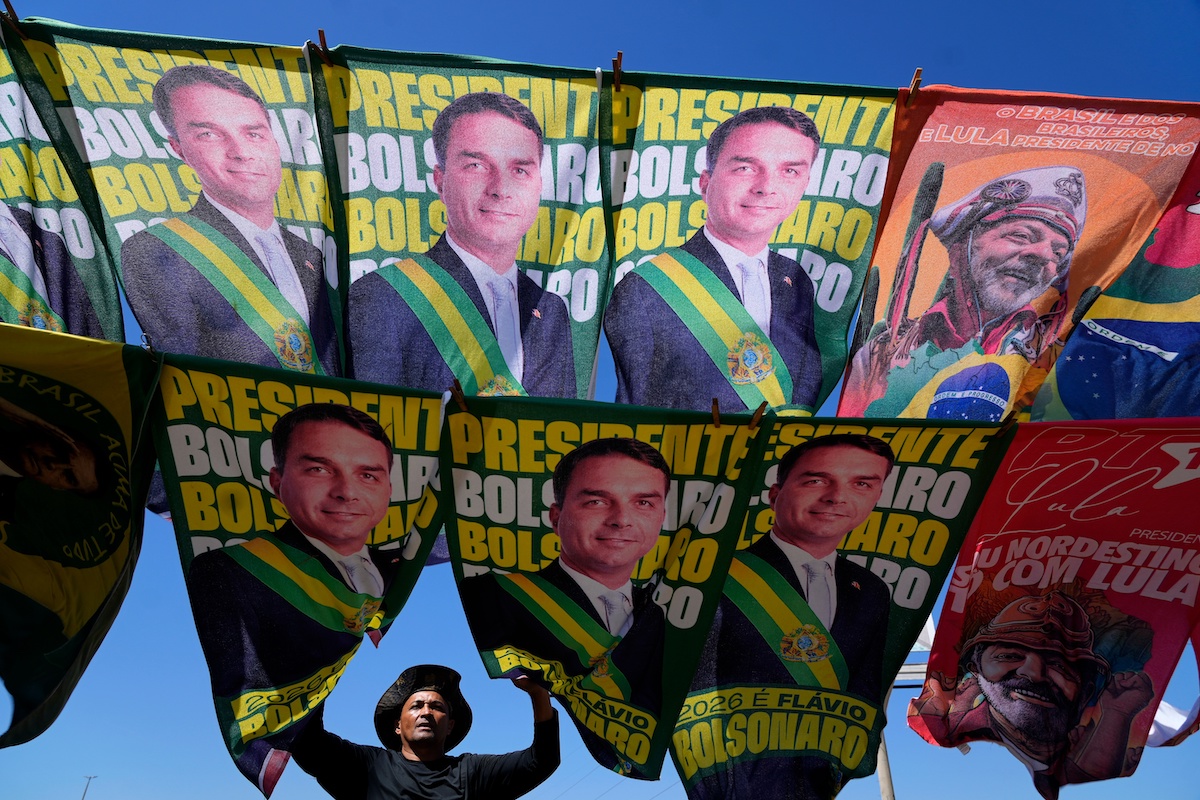
Following the swift preliminary results from the initial round of Brazil’s presidential election, Donald Trump used the outcome to attack the slower pace of vote counting in Democratic-leaning regions of the United States, labeling the process “corrupt.”
In the Oct. 4 vote, Sen. Flávio Bolsonaro—son of Brazil’s former president, who was sentenced to prison following a coup attempt after losing the 2022 race—led incumbent President Luiz Inácio Lula da Silva 47% to 45%. The two candidates are set to face off in an Oct. 25 runoff.
Commenting on the vote via Truth Social, Trump wrote: “125 Million People voted today in the first round of Brazil’s Presidential Election. The results came out shortly after the vote closed, on the SAME DAY! In Detroit, Philadelphia, California, and numerous other U.S. Cities and States, the results, with much smaller numbers, will often take weeks to Rig, I mean, calculate. Voting in America is CORRUPT!!!”
In a separate late-night post that was later removed, Trump made a nearly identical claim regarding India, despite the country not holding a presidential election that weekend.
By the time Trump published his remarks on Brazil, the race had clearly headed to a runoff, with nearly all ballots cast.
Experts note that the speed of tallying votes is not an indicator of election manipulation. The United States and Brazil operate under distinct electoral laws and frameworks.
For years, Trump has repeatedly promoted unverified claims regarding fraudulent elections, including in states like California. Adhering to state-mandated procedures is standard practice, not evidence of misconduct.
How Brazil Conducts Elections
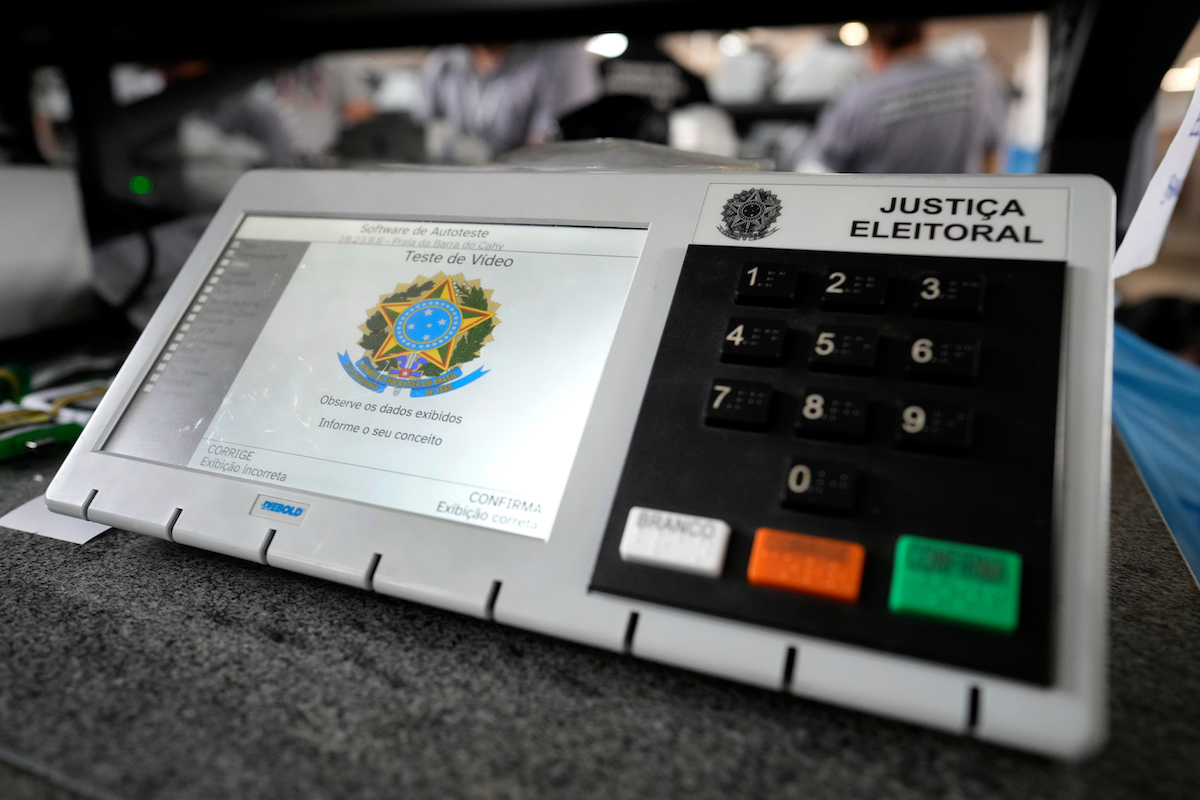
An electronic voting machine displays a test screen in Brasilia ahead of Brazil’s October general election. (AP)
According to Pablo Ortellado, a public policy professor at the University of São Paulo, Brazil does not use mail-in ballots. Voting occurs exclusively in person via electronic machines on a single national holiday, and participation is compulsory for citizens aged 18 to 70.
Elections are overseen by the Electoral Justice system, a specialized branch of the judiciary. At the national level, the Superior Electoral Court (TSE) establishes guidelines, overseeing 27 regional courts responsible for local execution.
“It is a single, nationally standardized system: the same machines, the same procedures and the same counting process across the whole country,” Ortellado explained. “That is a big part of why results come out within hours.”
To bolster confidence, the TSE established the Electoral Transparency Commission in 2021, bringing together independent experts and civic groups to audit the electoral framework.
Brazil has relied on electronic voting machines since 1996, utilizing devices subjected to multiple layers of security checks.
“Curiously, Brazil’s electronic voting system, which is indeed very fast and quite secure, draws heavy criticism precisely from the Brazilian right that is sympathetic to Trump,” Ortellado noted, adding that critics often point to the absence of a physical paper trail for verification.
Consequently, preliminary outcomes have historically been available almost immediately after polls close at 5 p.m., with roughly 99.9% of votes tallied by the end of the evening, according to Paulo Valle, a political scientist at the University of Central Florida and FGV in Brazil.
Eduardo Repilloza Fernández, general coordinator for Transparencia Electoral, highlighted that the process is entirely paperless, meaning “there’s no signatures to check, no physical paper-ballot tabulation systems. Voters do not get an individual receipt of their vote.”
How the U.S. Conducts Elections

A sheriff’s deputy and his K-9 inspect ballots at the L.A. County Ballot Processing Center during the California primary election. (AP)
Unlike Brazil’s centralized structure, U.S. elections are decentralized, with individual states setting guidelines and local municipalities managing administration.
State regulations determine mail-in ballot deadlines, when officials can begin processing and opening envelopes, and the statutory timelines for certifying final figures.
While clear leads allow media networks to project winners on election night, official tallies often require weeks of verification. When races are exceptionally tight, processing delays can occur regardless of mail-in volume. Conversely, high-volume mail-in states can report quickly if a candidate holds a dominant advantage. No U.S. state finalizes its official count on election night.
Trump specifically criticized California, where widespread mail-in voting requires accepting ballots postmarked by Election Day and received within a seven-day window.
While mail-in voting offers convenience—and is utilized by voters across the political spectrum, including Trump himself—it inherently requires more time for signature verification and processing by election workers.
Requests sent to the White House seeking evidence for Trump’s claims regarding intentional delays or rigging in California, Detroit, and Philadelphia did not receive an immediate reply.
Context From Brazil’s 2022 Election
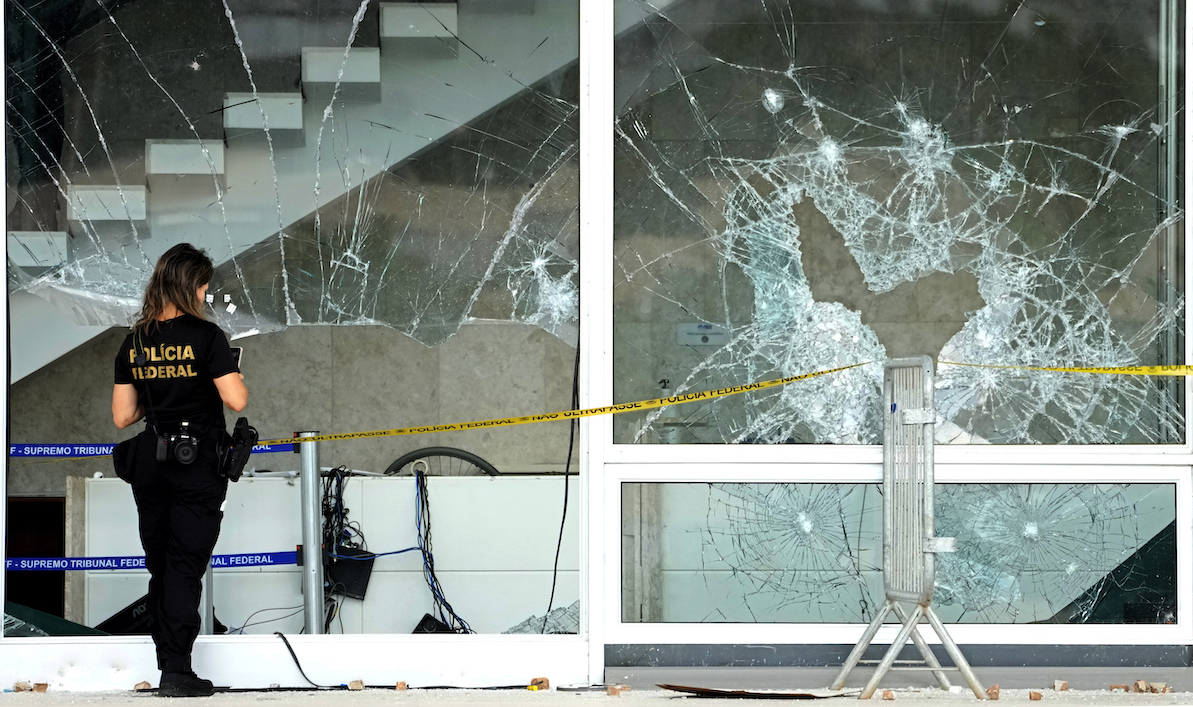
A forensic investigator outside the Brazilian Supreme Court following unrest sparked by supporters of Jair Bolsonaro disputing election results. (AP)
Following his narrow defeat in 2022, former President Jair Bolsonaro alleged electoral fraud, triggering widespread demonstrations by his base.
On Jan. 8, 2023, demonstrators breached federal buildings in Brasília, prompting extensive property damage. In March 2026, Bolsonaro was granted permission to serve a 27-year sentence under house arrest due to health concerns.
International observers, including the Atlanta-based Carter Center, reported no evidence of systemic fraud during the 2022 vote, and deployed monitoring teams again for the 2026 cycle.
Cesar Zucco, a professor of Brazilian studies at Columbia University, emphasized that Brazil’s digital voting infrastructure is secure, noting that skepticism regarding the process has originated primarily from Bolsonaro and his political allies.
Our Ruling
Trump asserted that Brazil’s rapid reporting of election returns demonstrates that jurisdictions like Detroit, Philadelphia, and California intentionally prolong their counts to manipulate outcomes.
This assertion lacks factual backing. The U.S. and Brazil utilize fundamentally different electoral frameworks. Brazil relies on a unified national system without mail-in ballots, whereas many U.S. states incorporate extensive mail-in voting, which requires additional time for secure verification.
Variations in counting timelines do not indicate electoral fraud.
We rate this claim Pants on Fire!
RELATED: Trump’s midterm rallies: A fact-checked guide to talking points, falsehoods
RELATED: Trump said the pace of California ballot counting proves a rigged election. Pants on Fire!