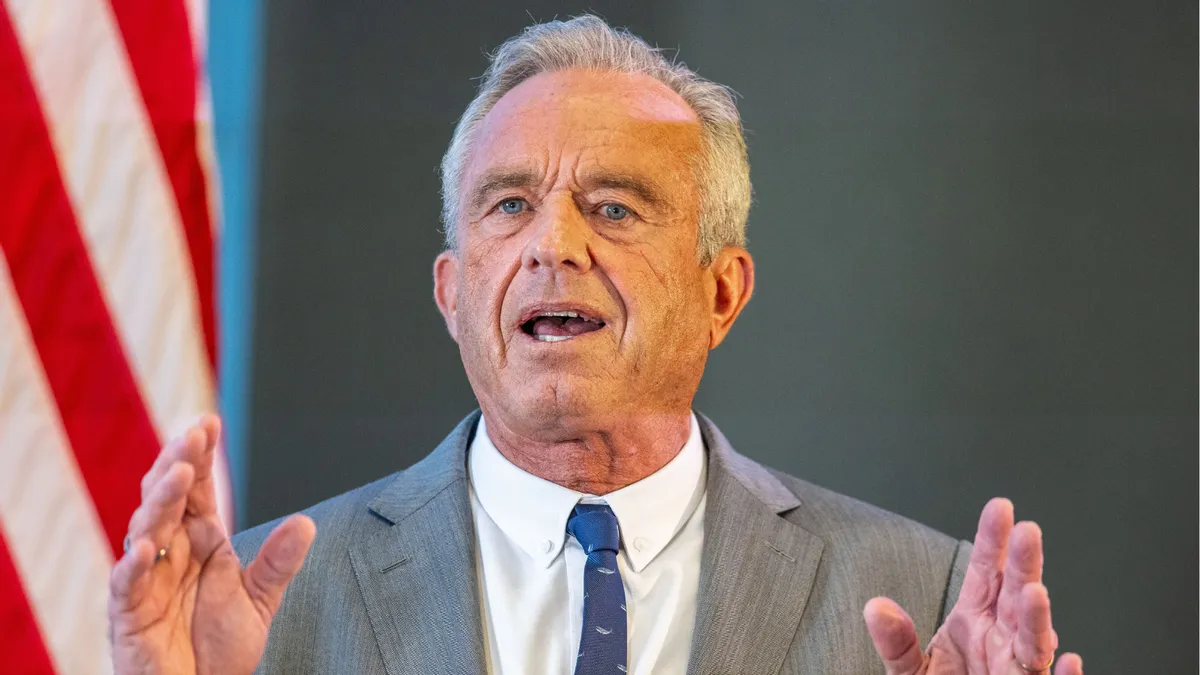
U.S. Secretary of Health and Human Services Robert F. Kennedy Jr. stated that individuals in hospice care were failing to pass away quickly enough and were placing an excessive financial burden on taxpayers.

Kennedy did not claim that legitimate hospice patients drive up taxpayer costs by staying in care too long. Instead, his remarks were specifically directed at fraudulent hospice operations in California.
In late August 2026, an online assertion (archived) gained traction alleging that U.S. Health and Human Services Secretary Robert F. Kennedy Jr. complained that hospice patients were not dying fast enough and were costing taxpayers too much money.
Independent journalist Aaron Rupar, for instance, posted a video excerpt of Kennedy on X and commented, “RFK Jr complains that people in hospice aren’t dying quick enough and therefore cost too much money.”
Similar interpretations of Kennedy’s statements quickly spread across Facebook (archived), Instagram (archived), Threads (archived), Bluesky (archived), and Reddit (archived), prompting numerous inquiries from readers.
While Kennedy did address the topic of hospice during an August 29 appearance on the Fox News program “Saturday in America,” social media summaries like Rupar’s failed to capture the actual meaning of his remarks.
Kennedy never stated that legitimate patients prolong costs by remaining in hospice care past expectations. Rather, he was highlighting illegal billing practices by fraudulent hospices in California that collected federal funds for phantom patients or individuals who remained on the books for years without actually receiving services.
In August 2026, The Associated Press reported on a specific instance where a California hospice fraudulently billed Medicare using the profile of a healthy 71-year-old woman.
During the “Saturday in America” town hall, Kennedy explained (at timestamp 52:52):
We closed down thousands of hospices in California, they didn’t have patients, they were just billing us. And the way we found them is because the patients would never die. And so, we could see, we’ve been paying for this guy for five years — usually, if you go to a hospice, it means you’ve got three months left to live — these people were never dying, they just had the patient numbers and we were being charged $6,000 a month and just paying, I think 8,000 of them, of these hospices. We’re talking about tens of billions of dollars stolen every year.
Consequently, online claims suggesting Kennedy complained that genuine hospice patients take too long to die are false. His focus was entirely on rooting out criminal healthcare fraud.
Inquiries were sent to the Department of Health and Human Services to clarify the timeline of the hospice closures and the total estimated financial losses linked to the alleged fraud schemes.
Medicare, the federal health insurance program for adults aged 65 and older, provides coverage for eligible hospice services. According to official guidelines, patients qualify if certified by medical professionals as having a terminal illness with a life expectancy of six months or fewer—distinguishing from Kennedy’s passing mention of a three-month expectation. The program covers hospice across two initial 90-day intervals followed by unlimited 60-day extensions.
Efforts to curb Medicare hospice fraud have been a central focus of the anti-fraud task force established by President Donald Trump in March 2026 and led by Vice President JD Vance.
Investigations by The Associated Press revealed that bad actors frequently established fake hospice fronts, deceived real citizens into enrolling, or hijacked identities to bill the government for unrendered care.
To combat these abuses, the Centers for Medicare and Medicaid Services announced a six-month nationwide enrollment freeze for new home health agencies and hospices in May 2026. Working alongside Vance’s task force, officials suspended federal payouts to roughly 800 suspect operations in Los Angeles alone, entities that had collected approximately $1.4 billion in Medicare funds throughout 2025.
Federal reports indicated that fraudulent hospice schemes were particularly widespread across Arizona, California, Georgia, Ohio, Nevada, and Texas.
Similarly, the California Department of Justice characterizes hospice fraud as a regional epidemic, noting that state-level investigations into Medi-Cal have yielded 51 convictions related to hospice crimes since 2021.
For additional reporting, Snopes maintains an ongoing collection of investigations regarding Medicare.