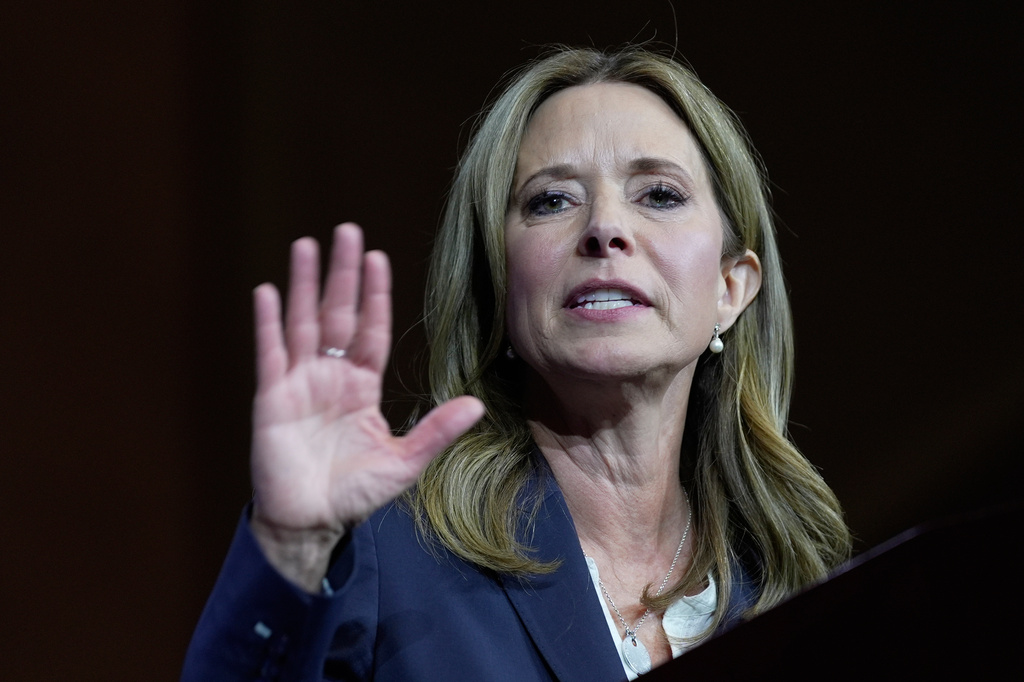
As recent polling indicates a tight race for the Ohio governorship between Democratic candidate Dr. Amy Acton and her Republican rival, Vivek Ramaswamy, former President Donald Trump has thrown his support behind Ramaswamy, encouraging voters to back the Republican nominee.
During an October 12 rally in Youngstown, Trump criticized Acton’s tenure as the state’s chief health officer during the COVID-19 pandemic, specifically pointing to pandemic-related business and school closures. He further cautioned the audience that her policy agenda would drive up the cost of living for residents.
“Amy Acton is trying to double your state income tax,” Trump declared during the event.
With Ramaswamy advocating for the complete elimination of the state income tax, his campaign and the Ohio Republican Party have frequently echoed Trump’s warning in the battle to succeed term-limited GOP Governor Mike DeWine. The assertion has surfaced across various campaign materials, including political advertisements, a dedicated website set up by the Ramaswamy team, social media updates, and official state GOP announcements.
When inquiries regarding evidence for this claim were directed to the White House, a spokesperson pointed toward the Republican National Committee, which subsequently referenced the Ramaswamy campaign’s specialized portal, “Can’t Afford Amy Acton.”
Calculations featured on that website project that Acton’s platform would demand over $21 billion in annual funding, arguing that the state would need to double individual income taxes to cover the expense. However, these figures rely on broad, unverified assumptions regarding the scope of Acton’s policy proposals and how extensively they would impact the general population.
Data from the Ohio Department of Taxation indicates that the state generated approximately $11 billion through individual income taxes during fiscal year 2025. Investigations found no factual backing to support the notion that Acton advocates for doubling those revenues via tax hikes.
While Acton’s platform introduces tax relief for working-class households alongside policy adjustments directed at wealthier earners and corporations, her campaign has yet to release a detailed fiscal breakdown of the total cost or funding mechanisms. Nevertheless, policy analysts note that the $21 billion projection is heavily inflated.
Overview of Acton’s Policy Platform
Acton’s platform features a dedicated tax cut for working families, designed to grant an extra $1,778 to married couples with two children who bring in an annual income of $60,000.
Her proposals also incorporate an earned income tax credit aimed at up to 775,000 households, as well as a child tax credit of $1,000 per year for children between the ages of 0 and 6, and $500 for those aged 7 through 18, applicable to families making up to $85,000. The campaign estimates this credit would reach more than 1.4 million children.
Additionally, her broader affordability strategy focuses on lowering prescription drug costs, relieving medical debt, cutting health insurance premiums, and addressing energy expenses. Her campaign suggests that boosting state funding for public education could simultaneously alleviate pressure on local property taxpayers.
Other elements of Acton’s platform involve closing existing tax loopholes for affluent residents and trimming tax exemptions historically granted to data centers.
Scrutinizing the Ramaswamy Campaign’s Projections
To substantiate its $21 billion annual price tag, the Ramaswamy website references several of Acton’s initiatives, such as childcare assistance and medical debt relief. However, independent reviews indicate these estimates are unrealistic and fail to reflect the actual specifics of Acton’s published plans.
As an illustration, the Ramaswamy campaign calculated that Acton’s medical debt relief strategy would impose a $15.1 billion annual burden on taxpayers. This figure was reached by taking an estimated 810,000 Ohioans believed to carry medical debt and multiplying that figure by $18,660, which reflects a nationwide average from 2021.
Daniel Skinner, an Ohio University health policy expert, pointed out that the $15.1 billion calculation lacks credibility because it incorrectly presumes that every single individual with medical debt would qualify. Furthermore, labeling the expense as “annual” is misleading, given that purchasing and clearing existing debt would fundamentally function as a one-time outlay.
The Ramaswamy platform also targets Acton’s childcare proposals. Following comments made by Acton regarding the $25,000 annual cost of childcare for two children, Republican critics interpreted her remarks as an endorsement of universal taxpayer-funded childcare, estimating the state-level price tag at $5.6 billion annually.
This figure was derived by multiplying all 520,000 Ohio households with children under the age of 6 by an assumed $13,000 per-child annual cost, and then subtracting the $1.1 billion the state currently invests through the Department of Children and Youth.
While Acton has expressed a desire to improve access to affordable preschool and childcare, she has not explicitly called for a universal, government-funded childcare model.
Ohio already operates a subsidy program for eligible families, where the state covers a portion of expenses while parents contribute via co-payments. Heather Smith, a childcare policy specialist at Policy Matters Ohio, emphasized that these family contributions must be factored into any serious cost projections for expanding program eligibility.
“Only families making under the federal poverty level are not required to pay a co-pay for child care, meaning the state government would not be shouldering the full cost of child care for all families if it were to expand eligibility,” Smith explained.
Conclusion
Trump’s assertion that Acton intends to double the state income tax is tied directly to the Ramaswamy campaign’s projection that her policy agenda would require over $21 billion in supplementary annual spending.
Nevertheless, that financial estimate relies on broad and poorly supported assumptions that vastly broaden who would benefit beyond the parameters of Acton’s actual proposals. The calculations also introduce unfounded premises, such as the claim that Acton supports universal paid childcare—a position she has not taken.
Although Acton’s platform centers on working-class tax relief and child credits, and while her campaign has not released a complete financing blueprint, representatives have maintained that she has no intention of raising state income taxes to fund these measures.
Consequently, the claim has been rated False.