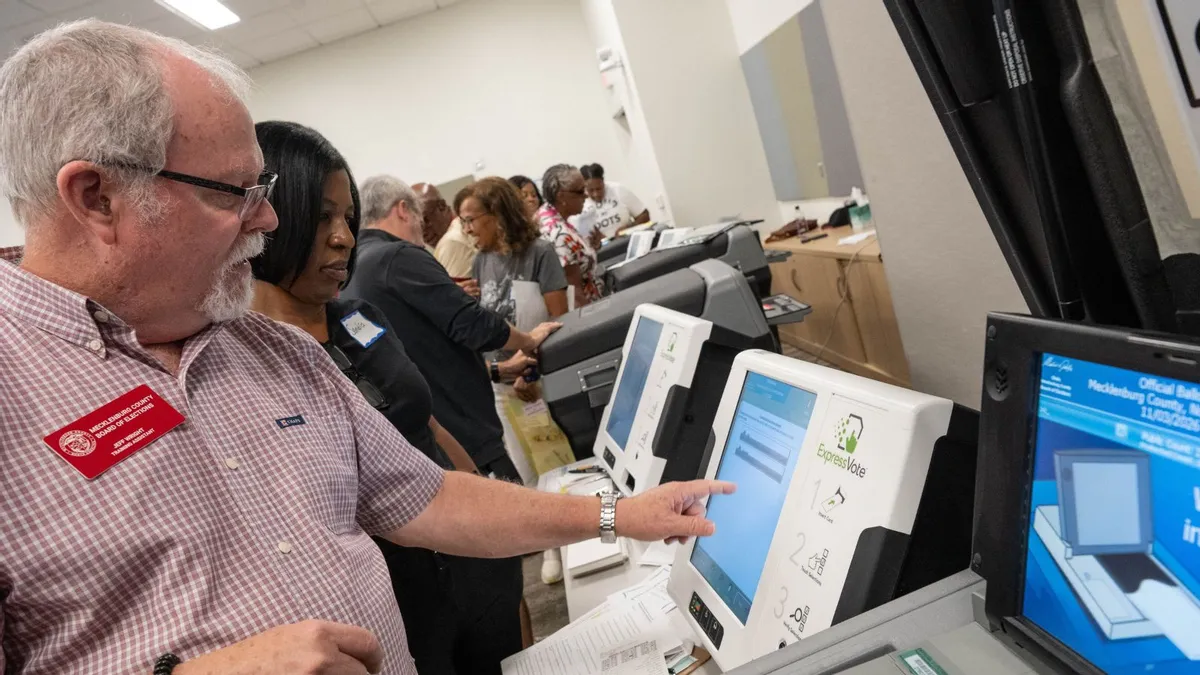
Electronic voting terminals in Florida, South Carolina, Tennessee, Texas, and select other states are intentionally altering citizens’ candidate selections during the 2026 midterm elections.

- Investigations have consistently discredited allegations that U.S. digital voting systems are manipulated to shift votes between political candidates. These conspiracy theories resurfaced prominently as early voting commenced for the 2026 midterms.
- There is zero proof that voting hardware actively alters ballots. Election authorities note that such complaints typically stem from user error or minor touch-screen calibration inaccuracies.
- American elections are handled through a decentralized framework where local and state authorities maintain strict oversight of equipment accuracy, and terminals undergo rigorous testing prior to deployment. Furthermore, these machines operate on closed, offline networks without internet connectivity.
As Election Day approaches, unverified claims have circulated online suggesting that digital voting equipment nationwide is automatically switching votes meant for Democrats over to Republican candidates across various midterm contests.
For instance, identical copy-and-paste warnings began circulating across social media channels, claiming voters were encountering difficulties registering selections for Democratic hopefuls without repeatedly overriding the terminal.
Similarly, public figures like Stella Parton—sister of the renowned country music icon—claimed online that her ballot choices kept defaulting to a Republican incumbent in Tennessee, urging the public not to let the election be manipulated.
While online rhetoric was widespread, verifiable accounts from individuals reporting actual, firsthand vote-switching malfunctions remained exceptionally rare.
Similar allegations have been investigated and debunked for over a decade, with digital rumors of this nature appearing as far back as 2008.
Just as in previous election cycles, investigators found no credible data indicating that software glitches or coordinated fraud schemes were altering votes. Instead, all available evidence points to unintentional user mistakes or touch-screen calibration issues. Consequently, the claim has been rated as false.
Before deployment, voting systems across the United States undergo extensive evaluations, often open to public observation.
Significantly, no territorial or state election office has reported instances of voters unknowingly submitting finalized ballots with incorrect selections. Available records indicate the matter primarily involved temporary interface hurdles that were resolved prior to final ballot submission.
Elections officials in the primary states associated with these rumors confirmed they have uncovered no evidence of widespread tampering. Representatives highlighted that standard voting procedures include built-in review steps and on-site poll workers to assist voters before they formally cast their ballots.
Understanding Voting System Security
Allegations of compromised voting infrastructure frequently overlook the rigorous oversight standards enforced across local, state, and federal levels, as well as the fundamentally decentralized nature of the American electoral process.
Because individual states and municipalities procure and manage their own voting hardware independently, orchestrating a synchronized, large-scale operation to manipulate election outcomes without detection is virtually impossible.
Data from the Bipartisan Policy Center indicates that the typical voting terminal in use is roughly seven years old, meaning most hardware has safely processed multiple prior elections. Federal regulations mandate that these systems remain “air-gapped”—meaning they are entirely isolated from the internet and wireless networks.
Even in rare configurations where scanners interface with external networks, they operate exclusively on secure, closed local networks.
Additionally, all voting technology must adhere to baseline criteria established by federal legislation, such as the Help America Vote Act, ensuring error rates remain exceptionally low and that citizens have the opportunity to review and amend their choices prior to casting a ballot. Many jurisdictions also incorporate a paper-record trail, allowing voters to verify their choices physically.
Florida
In Jacksonville, local media reported minor touch-screen sensitivity issues involving ExpressVote terminals during early voting periods.
Duval County Elections Supervisor Jerry Holland attributed these occurrences to user handling, advising voters to utilize the provided stylus rather than fingernails, which might inadvertently register selections on adjacent lines.
Holland emphasized that the equipment simply marks and prints the physical ballot for review, ensuring that voters retain full oversight before the document is scanned.
Kansas
In Johnson County, election administrators addressed minor touch-screen sensitivity concerns by recalibrating specific ballot-marking devices after receiving feedback from election judges.
Officials noted that the vast majority of reported concerns were raised after individuals had already completed voting and departed. Technicians promptly recalibrated the impacted screens upon notification.
Kansas regulations strictly prohibit internet connectivity for voting hardware and mandate public pre-election equipment testing.
Ohio
Despite widespread social media warnings alleging vote-switching in Ohio, local reporting yielded no credible accounts of such technical failures.
State election authorities dismissed the viral claims as deliberate misinformation, reiterating that Ohio mandates rigorous pre-election testing, bipartisan post-election audits, and relies on paper-backed audit trails.
South Carolina
Representatives for the South Carolina Election Commission noted that high-turnout elections occasionally prompt user inquiries regarding touch-screen sensitivity, but stressed that clear visual indicators and mandatory review screens allow voters to verify and correct their entries at multiple stages.
State statutes require voting systems to remain offline during elections and mandate that public testing procedures be accessible to the community.
Tennessee
Voters in select Tennessee counties reported localized screen-selection challenges, mirroring complaints shared by public figures regarding specific Senate races.
However, state authorities noted that out of hundreds of thousands of early ballots processed, formal complaints regarding technical errors remained statistically negligible. Local election administrators confirmed that equipment inspections revealed no mechanical discrepancies, recommending the use of a stylus or touching the precise center of selection boxes to ensure accuracy.
Tennessee utilizes systems that generate physical paper records, allowing citizens to double-check their choices prior to final submission alongside mandatory public testing protocols.
Texas
Texas election officials confirmed receiving no official reports of systemic vote-switching. Like several other jurisdictions, Texas machines generate verifiable paper records following electronic selection.
Cybersecurity experts and election administrators have previously explained that touch-sensitive interfaces on older voting terminals can occasionally require precise calibration, comparable to typing on a compact digital keyboard, rather than indicating any form of hardware tampering.
Texas voting terminals operate entirely offline and undergo mandatory public functionality tests ahead of every election.