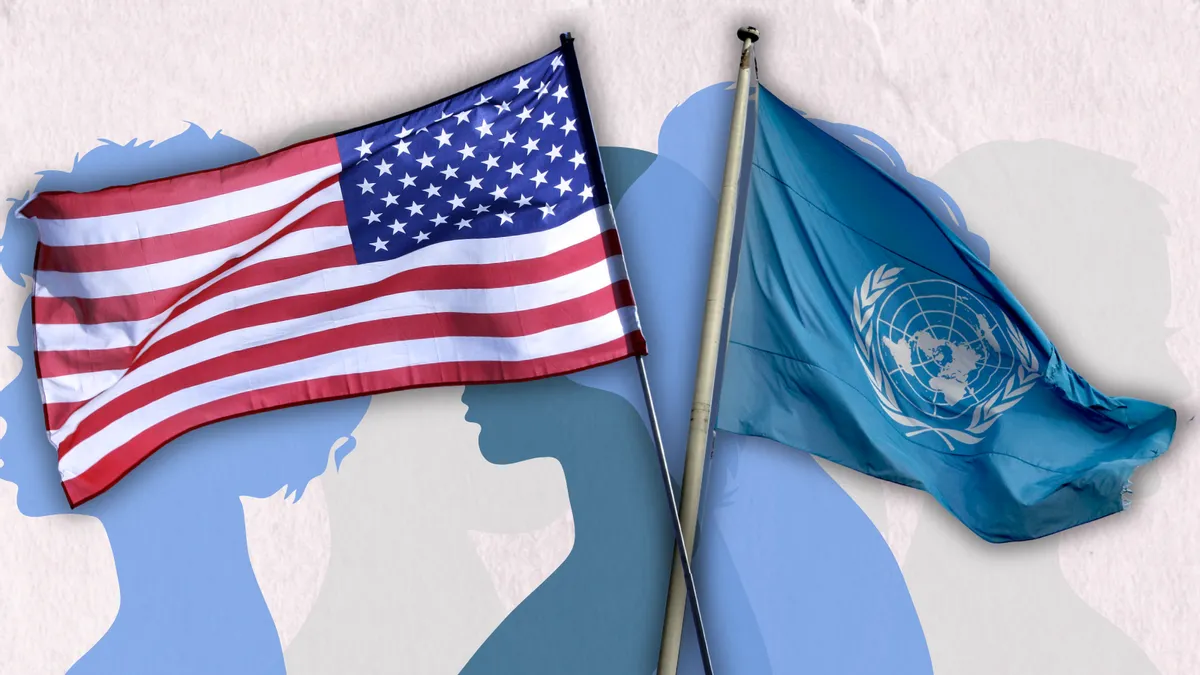
Did the United States stand alone as the sole opposing vote on a 37-1 UN resolution advancing women’s equality?
During the 70th session of the UN Commission on the Status of Women in March 2026, the U.S. indeed cast the lone dissenting vote against the committee’s agreed conclusions, which passed with 37 supporting votes.
These outcomes are classified as “agreed conclusions” (non-binding policy recommendations) rather than official UN resolutions. Furthermore, although the rumor gained significant traction during the General Assembly’s 81st session in September 2026, the vote actually took place months prior.
As international delegates gathered in New York for the 81st United Nations General Assembly in September 2026, social media platforms—including Facebook, X, and Threads—became vectors for viral assertions claiming that the United States was the sole opponent to a UN equality resolution that passed 37 to 1.
Viral posts declared: “The UN passed a resolution by a vote of 37-1 promoting women’s equality. The one opposing vote… the United States. Remember this.”
While the core voting dynamic is accurately reported, the viral narratives contain two key distortions: the vote occurred months earlier in March rather than September, and the legislative action was an “agreed conclusion” rather than a formal resolution.
The 37-1 tally took place in March 2026 during the adoption of the UN Commission on the Status of Women’s (CSW) strategic roadmap for its 70th session, with the U.S. standing alone in opposition.
The CSW is mandated to foster gender parity and empower women globally. The American delegation objected to the session’s policy benchmarks, which were designed to improve legal equity and justice access for women and girls.
Unlike binding UN resolutions—which represent official stances or binding mandates of UN bodies—agreed conclusions serve purely as directional recommendations for member nations. The CSW utilizes a completely distinct framework for drafting and passing actual resolutions.
The Specifics Behind the U.S. Opposition
The roadmap for the 70th CSW session focused heavily on eliminating legal discrimination, dismantling structural roadblocks, and bolstering judicial access for women and children by the year 2030.
The document pushed member states to guarantee independent legal remedies for victims of rights violations without discrimination, alongside more contentious provisions regarding international health frameworks.
Specifically, the text called to:
(r) Ensure universal access to sexual and reproductive health and reproductive rights as agreed in accordance with the Programme of Action of the International Conference on Population and Development and the Beijing Platform for Action and the outcome documents of their review conferences;
According to live session transcripts from March 9, the American delegation explicitly pointed to language surrounding reproductive healthcare as a primary driver for their negative vote.
U.S. Ambassador Dan Negrea voiced his delegation’s refusal to endorse terminology that included:
… ambiguous language promoting gender ideology, vague unqualified commitments to sexual and reproductive health that can be interpreted as implying abortion rights, censorship language or broad language on regulation of AI.
This opposition followed an executive order issued in January 2026 by President Donald Trump, which officially severed U.S. participation in UN Women—the supervisory body of the CSW.
Ambassador Negrea referenced this withdrawal during proceedings, arguing that UN Women actively championed policies regarding abortion and gender concepts contrary to American interests.
Ultimately, the conclusions passed with 37 votes in favor, six abstentions, and the U.S. casting the lone negative vote.
Later in the same session, the U.S. did register a formal vote against a distinct resolution titled “Women, the girl child and HIV and AIDS,” which urged intensified measures against high infection rates among women. Forty-three nations supported the measure, leaving the U.S. once again as the sole dissenting vote due to similar concerns over reproductive health terminology.
Sources
‘Commission on the Status of Women’. UN Women – Headquarters, https://www.unwomen.org/en/how-we-work/commission-on-the-status-of-women. Accessed 25 Sept. 2026.
Dag Hammarskjöld Library. Research Guides: About UN Documents: Resolutions & Decisions. Research guide. United Nations. Dag Hammarskjöld Library, https://research.un.org/en/docs/resolutions. Accessed 25 Sept. 2026.
‘Ensuring and Strengthening Access to Justice for All Women and Girls, Including by Promoting Inclusive and Equitable Legal Systems, Eliminating Discriminatory Laws, Policies and Practices, and Addressing Structural Barriers’. United Nations Economic and Social Council, 8 Mar. 2026, https://docs.un.org/en/E/CN.6/2026/L.2.
LIVE Blog – 70th Session of the Commission on the Status of Women | UN Meetings Coverage and Press Releases. 19 Mar. 2026, https://press.un.org/en/csw70.
‘Outcomes’. UN Women – Headquarters, https://www.unwomen.org/en/csw/outcomes. Accessed 25 Sept. 2026.
Presidential Memoranda. ‘Withdrawing the United States from International Organizations, Conventions, and Treaties That Are Contrary to the Interests of the United States’. The White House, 7 Jan. 2026, https://www.whitehouse.gov/presidential-actions/2026/01/withdrawing-the-united-states-from-international-organizations-conventions-and-treaties-that-are-contrary-to-the-interests-of-the-united-states/.
‘Women, the Girl Child and HIV and AIDS’. United Nations Economic and Social Council, 11 Mar. 2026, https://docs.un.org/en/E/CN.6/2026/L.3.