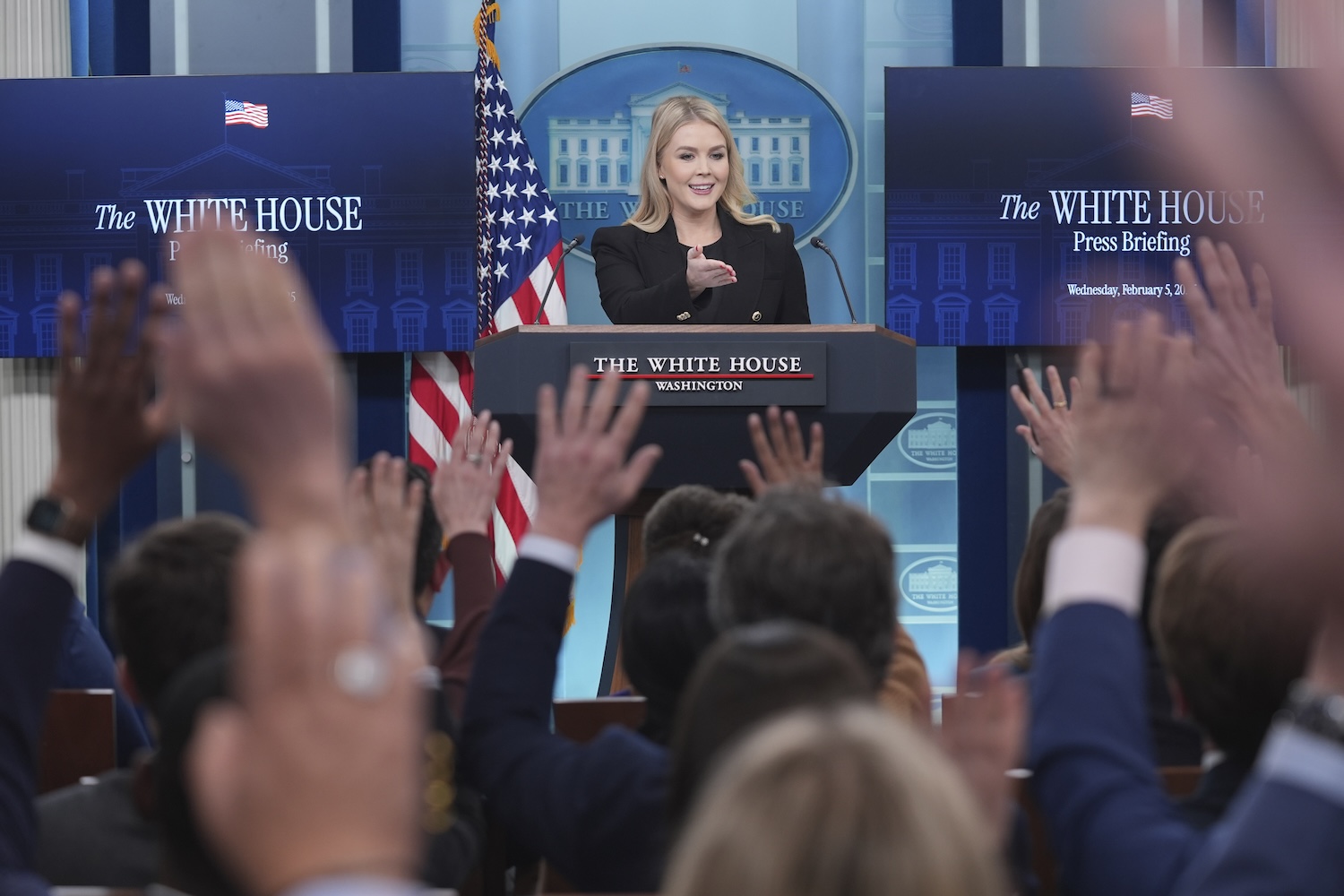
Karoline Leavitt is stepping down as White House press secretary at the close of August, planning to dedicate more time to her family following the arrival of her second child.
In a Truth Social statement on August 12 announcing her exit, President Donald Trump praised Leavitt as an authentic leader and counted her among the finest press secretaries in the nation’s history. He also noted she will transition into a key external advisory role for him.
Reflecting on her tenure, Leavitt described the position as the defining experience of her career.
At 28 years old, Leavitt holds the distinction of being the youngest person to ever serve as White House press secretary, having held the post since the start of Trump’s second administration.
Throughout her time facing the press corps on issues ranging from federal spending reductions to economic proposals, she consistently advanced the administration’s messaging, though several of her claims drew scrutiny and factual corrections.
Leavitt claimed Trump’s ‘Big Beautiful Bill’ wouldn’t increase the deficit. Records show it does.
As Republican lawmakers pushed forward Trump’s flagship tax and spending legislation—frequently referred to as the One Big Beautiful Bill—in May 2025, Leavitt sought to minimize the measure’s anticipated impact on the federal deficit.
“This bill does not add to the deficit,” she informed reporters at the time, adding, “In fact, according to the Council of Economic Advisors, this bill will save $1.6 trillion.”
That assertion was rated False. A deficit represents the yearly shortfall when government spending outpaces revenue, whereas federal debt is the cumulative total of past deficits and surpluses.
A broad range of independent fiscal evaluations indicated the legislation would actually expand the federal deficit by roughly $3 to $4 trillion over the subsequent decade, primarily because the tax cuts diminish incoming federal revenue far more than the concurrent spending cuts reduce outlays.
Analysts pointed out that Leavitt’s cited figure of $1.6 trillion in savings accounted exclusively for reduced spending while omitting the massive loss in tax receipts that ultimately drives up both the yearly deficit and overall national debt.
Leavitt labeled tariffs a ‘tax cut’ for Americans, despite the financial burden falling on consumers.
When the administration began rolling out new tariffs in early 2025, a statement from Leavitt startled many economists: “Tariffs are a tax cut for the American people.”
Experts quickly disputed that claim.
Drawing on extensive historical data, virtually all economists classify tariffs as tax increases rather than reductions, given that the underlying costs are predominantly absorbed by domestic consumers via elevated retail prices.
Historical studies regarding Trump’s initial term indicated that tariffs left consumers financially disadvantaged, and his subsequent proposals were even more expansive. Subsequent assessments calculated that the trade measures implemented in 2025—even with certain provisions later invalidated by the Supreme Court—cost the typical U.S. household somewhere between $1,000 and $1,700 that year.
Leavitt’s inaccurate assertion regarding $50 million in U.S. funding for Gaza condoms
Justifying the administration’s temporary freeze on foreign aid in early 2025, Leavitt claimed that Elon Musk’s Department of Government Efficiency had “found that there was about to be $50 million taxpayer dollars that went out the door to fund condoms in Gaza.”
That claim lacked factual support. There was no documentation showing the U.S. had allocated or planned to spend $50 million on contraceptives for the region.
While a State Department representative confirmed the freeze halted a $100 million assistance package destined for Gaza—funds that did encompass contraceptive programs—the specific humanitarian organization slated to manage the funds stated it did not utilize American grants to purchase condoms.
Although a broader international U.S. initiative does finance global contraception programs to the tune of roughly $60 million annually, official records show that Gaza was not a beneficiary of those resources.
During peak egg shortages, Leavitt attributed the crisis entirely to the Biden administration
Challenged by journalists over persistently high egg prices during Trump’s first week back in office, Leavitt directed the blame toward former President Joe Biden.
She asserted that the previous administration alongside the Department of Agriculture had “directed the mass killing of more than 100 million chickens,” which she argued precipitated the scarcity.
That statement was evaluated as Half True.
Government figures indicate that approximately 108 million commercial egg-producing birds perished following the onset of an avian influenza outbreak in 2022, succumbing either to the disease itself or through mandated culling.
Depopulating flocks—many of which would have succumbed to the virus regardless—is standard protocol designed to curtail the spread of infection. This disease-control practice is not exclusive to the Biden administration and was similarly enforced as USDA policy throughout Trump’s initial term.