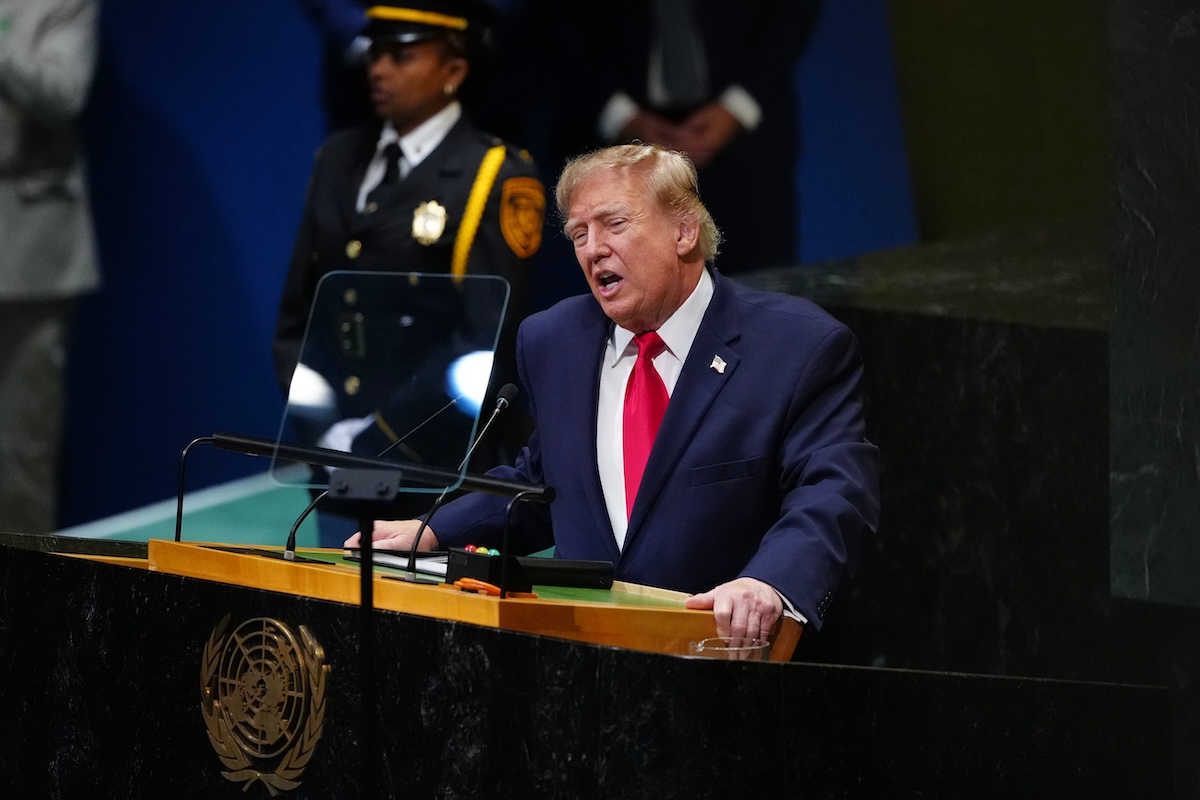
During his address to the United Nations General Assembly, President Donald Trump defended aggressive U.S. military interventions in nations like Iran and Venezuela, arguing that the global community is incapable of managing these security challenges on its own.
Despite public opinion polls indicating that Americans are growing weary of the prolonged conflict with Iran and its subsequent toll on fuel costs, Trump maintained during his September 22 address that Washington is successfully wrapping up “years of unfinished business.”
He also dismissed mounting anxieties regarding the potential societal risks posed by rapid advancements in artificial intelligence, stating flatly that the United States “totally rejects any attempt to construct a globalist scheme to control artificial intelligence.”
The speech prompted members of both the Cuban and Iranian delegations to walk out. Meanwhile, Iranian President Masoud Pezeshkian traveled to New York to address the General Assembly the following day—a rare diplomatic visit for the leader of a nation actively engaged in a war with the U.S.
Several key statements from Trump’s address have been subjected to scrutiny and fact-checking.
Artificial Intelligence
“The very same people who said we’ll all be dead in 12 years because of global warming … These are the same people that are now saying that AI is going to kill us all. … This is the group that came up with the Russia, Russia, Russia hoax, the Ukraine, Ukraine, Ukraine hoax, climate change, open borders.”
While some environmental activists may share concerns with groups advocating for AI safety, apprehension surrounding artificial intelligence is by no means limited to a single demographic. In fact, the most vocal and severe warnings have recently originated from the upper echelons of the tech sector itself.
On September 12, Anthropic CEO Dario Amodei released an essay advocating for a more deliberate, measured pace in frontier AI development. His stance was echoed by industry titans such as OpenAI CEO Sam Altman, Google DeepMind co-founder and chair Demis Hassabis, and xAI founder Elon Musk—representing an unusually unified front among fiercely competitive tech leaders.
Furthermore, bipartisan groups of U.S. lawmakers have advanced various legislative proposals aimed at establishing regulatory oversight for AI.
On artificial intelligence, “We’re leading now over China by a lot.”
While the U.S. currently maintains an advantage over China regarding overall model sophistication, industry experts note that Beijing trails by only a matter of months. American models have scaled capabilities at a staggering pace, occasionally resulting in unexpected safety vulnerabilities, which has fueled calls from industry leaders to slow the developmental momentum. If U.S. progress is intentionally decelerated while China maintains its current velocity, the competitive gap is expected to narrow.
“From this point forward, all United States documents and hopefully the world’s will be changed to use the much more accurate term ‘super’ as opposed to artificial. So it’s superintelligence. In other words, welcome to the new world of superintelligence — SI.”
Although “superintelligence” is a recognized theoretical concept within computer science, industry authorities emphasize that it does not accurately reflect the reality of current AI systems.
Experts generally define superintelligence as an artificial entity that vastly surpasses human cognitive capabilities across virtually every domain, including scientific discovery and complex communication. Similarly, a recent publication from Google’s DeepMind lab defines Artificial Superintelligence (ASI) as an artificial general intelligence possessing superhuman competency across all tasks of human interest.
Although today’s models demonstrate high proficiency in specialized areas like coding and advanced mathematics, their overall performance remains constrained. A comprehensive 2026 international AI safety report characterized current technological capabilities as “jagged across tasks and contexts,” placing them far below the threshold of true superintelligence.
U.S. Military Involvement and Conflicts
“The cowards and traitors would love to say the United States is low on munitions, but that’s not true. We have more munitions than we could ever possibly even think of using, and we’re building them at levels that we have never done before.”
This claim is misleading. Numerous national security reports and defense analyses indicate that American weapons reserves have seen significant depletion as the conflict with Iran persists.
An evaluation published in May by the Center for Strategic and International Studies estimated that fully restocking heavily consumed tactical munitions—such as Tomahawk cruise missiles, Patriot batteries, and THAAD interceptors—could require three to four years of manufacturing effort.
By July, media reports revealed that the military had begun rationing specific defense inventories, occasionally opting to bypass certain incoming threats in order to conserve interceptors.
Defense analysts note that prior military assistance provided to Ukraine during the Biden administration also drew down baseline stockpiles. While the Biden administration initially initiated steps to expand production capacity, the current administration has aggressively accelerated those manufacturing timelines.
“The United States has carried out dozens of strikes on cartel drug boats, destroying 97% of the drugs coming into the ocean and sea.”
This assertion is false. Although maritime and aerial narcotics interceptions have fluctuated since targeted operations began in late 2025, officials have not established a direct causal link to the administration’s strikes. In fact, U.S. Coast Guard data demonstrated a substantial 200% year-over-year increase in maritime seizures during fiscal year 2025 relative to prior historical averages.
Experts emphasize that seizure metrics reflect interdiction rates rather than the total volume of illicit substances dispatched toward or successfully entering the United States. Given the illicit nature of the narcotics trade, the true aggregate volume remains impossible to quantify.
Global Oil Supplies
“When you add the United States and Venezuela together, we have more than 60% of the oil in the world.”
The actual figures are considerably lower. Based on proven reserves—quantities that are economically and practically recoverable—the combined share of the U.S. and Venezuela accounts for approximately 21.9% of global supplies.
When evaluated strictly by current production output, the two nations together account for roughly 23.2% of the world’s total.
While Venezuela possesses vast long-term potential, experts note that its energy sector requires massive foundational overhauls. Skip York, a specialist at Rice University’s Center for Energy Studies, points out that reviving the country’s oil infrastructure will demand extensive capital investments.
Industry analysts project that meaningful expansion of Venezuelan production could take anywhere from four to a decade, contingent upon billions of dollars in foreign investment successfully materializing.
“The up-front costs associated with infrastructure will be quite large, and there is a lot of uncertainty in the long-term ability for companies to operate there,” noted Hugh Daigle, a professor in the petroleum and geosystems engineering department at the University of Texas at Austin.
Cuba and Communism
“The Cuban regime has also spent decades coordinating with the left-wing radicals and communist networks here in the United States, as our State Department has detailed. They’ve cultivated ties to subversive and radical groups such as the Communist Party USA, Antifa, and the Democrat Socialists of America.”
This statement aligns with findings from a U.S. State Department report asserting that the Cuban government has maintained a decades-long pattern of fostering ties with leftist networks both domestically and internationally.
Secretary of State Marco Rubio and the administration have frequently cited these findings to defend stringent economic sanctions and a tightened oil embargo against Havana—measures that have exacerbated widespread electrical grid failures on the island.
The extensive federal report dedicates multiple sections to organizations it alleges have facilitated operational connections between American political activists and Cuban state entities. Specifically, it highlights bodies like the Cuban Institute of Friendship with the Peoples as a primary coordinator for international delegations linking Havana with domestic groups, including the Democratic Socialists of America.
According to the report, these long-standing relationships have historically assisted foreign influence operations within various U.S. political movements.