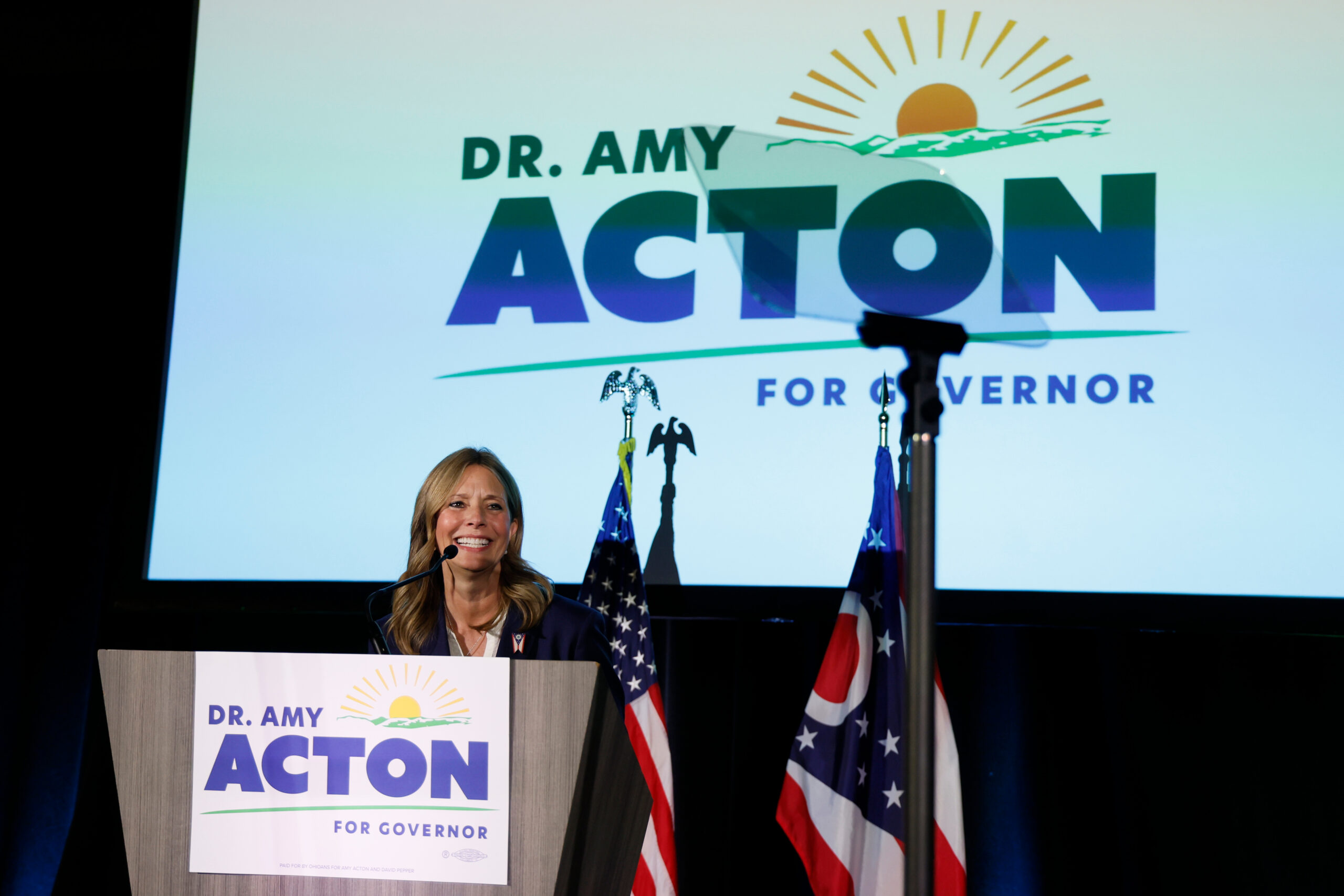
A political advertisement supporting Vivek Ramaswamy in the Ohio gubernatorial race targets his Democratic opponent, Dr. Amy Acton, questioning her medical background and alleging dishonesty regarding substance use.
The commercial, funded by the super PAC V-PAC: Victors, not Victims, asserts that the State Medical Board of Ohio once received an assessment labeling Acton’s medical proficiency as “insufficient.” It further claims that after assuring the board she was “clean,” police later discovered she had mixed alcohol with prescription medication. Additionally, the ad states that she “admitted to emotional or mental illness, drug addiction, or an alcohol problem.”
Although the spot is no longer running on television, it remains accessible online. However, its assertions rely on decades-old records—specifically referencing her initial 1990 medical internship, her 1994 licensure application, and a routine 2019 license renewal. Furthermore, the commercial presents incomplete information regarding a 2019 police visit to her residence, omitting key context.
Ohio voters are preparing for the November election to choose a successor to Republican Governor Mike DeWine, who is term-limited. Acton, a physician and former director of the Ohio Department of Health, gained widespread recognition during the COVID-19 pandemic after DeWine appointed her to lead the agency in 2019. Ramaswamy, a Republican, is a biotech entrepreneur and former presidential candidate.
Because super PACs can raise and spend unlimited funds to independently advocate for candidates, we examined the validity of the claims made in this ad.
Claim: “Acton’s medical training was described as ‘insufficient’ to Ohio’s Medical Board.”
This statement lacks necessary context.
Acton graduated with her medical degree from the Northeastern Ohio University College of Medicine in 1990. She completed her pediatric internship and residency at the Albert Einstein College of Medicine and Nationwide Children’s Hospital, followed by a preventive medicine residency at Ohio State University, where she also obtained a master’s degree in public health. She has held a valid medical license since June 16, 1994. Her subsequent professional background centered on preventive medicine, public health education at Ohio State, and leading the Ohio Department of Health through the early stages of the pandemic from 2019 to 2020.
The paperwork referenced in the ad predates her official licensure. When Acton first applied for her medical license in 1994, a supervising physician from a four-month stint in 1990 rated her knowledge during that specific internship period as “insufficient” on a board evaluation form.
Representatives for both Acton and V-PAC provided documentation of her medical board renewal forms, though the State Medical Board of Ohio did not independently verify the records upon inquiry.
Notably, a second evaluation included in that same 1994 application—conducted after she completed her residency in 1993—rated her medical knowledge as “excellent.”
Claim: Acton “admitted to emotional or mental illness, drug addiction, or an alcohol problem.”
This assertion is misleading.
The 1994 medical license application asked applicants if they had ever received outpatient treatment for “emotional or mental illness, drug addiction or abuse, or an alcohol problem.” Acton checked the box for “yes.”
According to her campaign, this answer pertained to counseling she pursued as an adult following childhood experiences with sexual abuse.
Because the application question combined multiple distinct issues into a single query, answering affirmatively does not mean she was acknowledging drug or alcohol abuse. The political ad fails to make this distinction clear.
Furthermore, the ad omits a separate question on the same form that specifically asked whether the applicant had ever suffered from chemical or alcohol dependency, or received treatment for drug or alcohol abuse. To that specific question, Acton answered no.
Claim: “Later, Acton told the medical board she was clean.”
This statement distorts the actual wording of the document and creates a false impression.
During a routine license renewal in May 2019, Acton answered “no” when asked if she currently had any drug or alcohol dependencies or addictions, based on campaign-provided records.
The renewal paperwork did not feature or require the use of the word “clean.”
Claim: “Days later, police came to her house, finding that she combined alcohol with prescription drugs.”
This claim lacks essential context.
Bexley police responded to a domestic call at Acton’s home in August 2019—several months, not days, after she renewed her medical credential.
According to the police report, Acton and her husband engaged in a verbal disagreement regarding her grueling hours as health director. The document indicates that Acton became distressed and pulled a mirror off the wall, causing it to shatter. She informed the responding officers that she had consumed an alcoholic beverage and taken a standard dose of her prescribed medication.
Her campaign clarified that she had a single drink at dinner and that the medication was a prescription she had taken reliably for years.
While a medical responder suggested she visit the hospital, Acton declined. The responding officer noted there was “no evidence of any physical violence,” categorized the event as a verbal dispute, and filed no charges or arrests.
Additionally, Acton’s husband, Eric Acton, publicly assumed responsibility for the situation, stating that he was the one who had consumed too much alcohol, as reported by NBC4 (WCMH-TV).