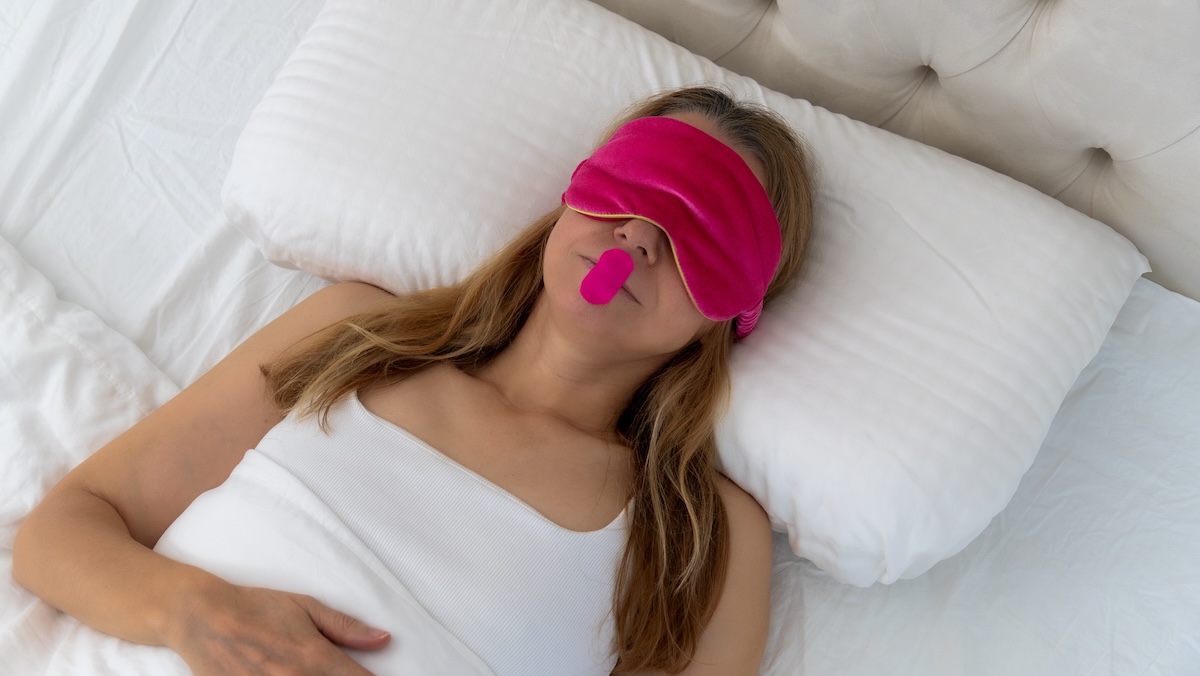
Once reserved for thriller movies and suspense novels, mouth tape has made a surprising leap to pharmacy aisles and social media feeds. Promoted widely online as a simple hack for better rest, the trend has gained traction thanks to endorsements from high-profile figures like soccer star Erling Haaland, wellness entrepreneur Gwyneth Paltrow, podcaster Joe Rogan, and reality TV personalities from shows like Love Island and Love Is Blind.
Advocates claim that sealing your lips at night ensures nasal breathing, which supposedly enhances sleep quality, freshens morning breath, improves dental hygiene, and might even sharpen your jawline. However, before investing in a pack of adhesive sleep strips, medical professionals urge caution.
“There is very little evidence to support mouth taping’s purported health benefits, and some clear evidence of risk and potential harm,” noted Dr. Brian Rotenberg, an ear, nose, and throat surgery professor at Western University in Canada. “In the absence of a known diagnosis for why one’s nose is blocked, it does not make sense to mouth tape.”
Nasal breathing has benefits, but mouth tape might not be your best option
Generally speaking, breathing through the nose is physiologically superior to breathing through the mouth.
“The nose warms, humidifies and filters inspired air,” explained Dr. Aatif Husain, a neurology professor and chief of the epilepsy, sleep, and clinical neurophysiology division at Duke University Medical Center.
Research indicates that this natural filtration can lower the risk of illness and allergies. Furthermore, preliminary studies suggest that resting while breathing through the nose is linked to lower blood pressure compared to oral breathing.
Conversely, breathing through the mouth while sleeping dries out the oral cavity, which can eventually contribute to dental issues, bad breath (halitosis), and receding gums, Husain noted.
Nighttime mouth breathing is also frequently connected to snoring and sleep apnea—a potentially serious disorder where breathing repeatedly stops and starts. Obstructive sleep apnea typically stems from a physical blockage in the airway, whereas central sleep apnea occurs when the brain fails to properly signal the muscles responsible for breathing.
While sealing your lips might seem like an effortless solution, Husain emphasized that it should never substitute a proper medical diagnosis for sleep troubles.
“Chronic mouth breathing is usually a sign of something else, such as nasal obstruction, allergies, deviated septum or sleep apnea,” Husain said. “It is better to find and treat that cause than to ‘tape over it.’”
Studies show most claims about mouth taping lack robust evidence
A systematic review published in 2025 analyzed 10 studies involving a total of 213 patients and concluded that current data fails to support mouth taping as a reliable clinical treatment for individuals experiencing sleep-disordered breathing.
For the vast majority of people, the evidence supporting mouth taping for obstructive sleep apnea and general mouth breathing was classified as “uncertain” and “minimal.” While some research pointed to minor reductions in snoring or mild sleep apnea severity, other investigations failed to replicate these results.
“The jury is still out as to the effectiveness of mouth taping in sleep apnea,” Husain remarked.
Another 2025 review evaluated nine studies, noting that very few viral social media claims regarding mouth taping have been rigorously tested. That paper called for higher-quality research and highlighted a distinct lack of consensus surrounding the practice’s supposed advantages.
That said, Rotenberg noted that under specific medical supervision, mouth taping might occasionally serve as a behavioral tool to encourage nasal breathing after an underlying nasal obstruction has been surgically corrected.
The hidden dangers of mouth taping
A paradox exists with mouth tape: individuals whose nasal passages are completely clear face the lowest risk from using it, yet they are also the ones who least need to rely on mouth breathing in the first place.
“Mouth breathing often occurs due to nasal obstruction from some cause,” Husain warned. “Mouth breathing is trying to compensate for that, and if one blocks that with tape, there may be serious consequences.”
The individuals most drawn to mouth taping are often chronic mouth breathers—the very demographic most likely to suffer from undiagnosed nasal obstructions, sleep apnea, or other underlying health conditions.
Additionally, masking symptoms like snoring with tape might prevent individuals from seeking a professional evaluation for serious sleep disorders. Left untreated, sleep apnea can trigger severe fatigue, headaches, concentration difficulties, and dangerous strain on the cardiovascular system.
Several studies highlighted in the 2025 reviews explicitly warned of adverse risks, including potential suffocation hazards for those with blocked nasal passages, as well as the danger of inhaling stomach contents should a person fall ill during the night while taped shut.
Because clinical studies on mouth tape typically exclude individuals with nasal obstructions, experts caution that using the product without addressing root causes carries significant health risks.
PolitiFact Staff Researcher Caryn Baird contributed to this report.
RELATED: Magnesium mocktails: Sleep improver and stress reducer? Or is it made up?