Claim:
During the Vietnam War, actor Jane Fonda allegedly betrayed U.S. prisoners of war (POWs) by handing hidden notes they gave her directly to their North Vietnamese captors.
Rating:
False
A persistent internet rumor claims that during a 1972 trip to Hanoi, North Vietnam, award-winning actor and antiwar activist Jane Fonda met with U.S. prisoners of war. According to the viral story, as cameras rolled, the captive soldiers discreetly slipped Fonda scraps of paper containing their Social Security numbers so she could smuggle them back to the U.S. to prove they were still alive.
The myth alleges that the moment the cameras stopped, Fonda handed the notes directly to a North Vietnamese officer. This supposed betrayal supposedly resulted in subsequent beatings that killed three of the prisoners, while a fourth barely survived to tell the tale.
This narrative has circulated as an email chain and social media copypasta for decades. Fact-checkers originally debunked the claim in 2000, and a fresh look at the evidence confirms that the specific tale of Fonda handing over messages is completely false.
Fonda Did Visit North Vietnam
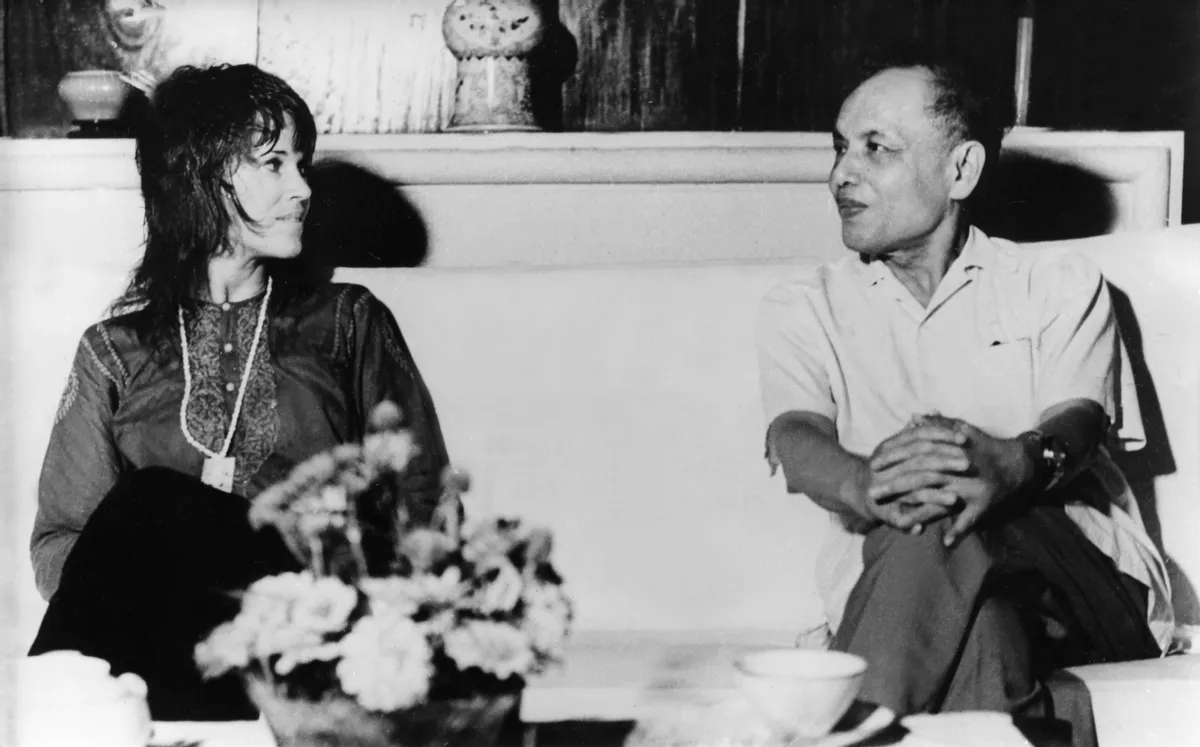
The rumor contains a kernel of truth, as Fonda did travel to North Vietnam in 1972 as an antiwar activist and did meet with a small group of U.S. prisoners of war, a fact she has openly acknowledged.
Her trip was part of a delegation of roughly 300 Americans who traveled to Vietnam to protest the war. A primary goal for Fonda was to inspect and document the Red River Delta’s agricultural dikes and levees, which she—along with other observers—concluded were being intentionally targeted and bombed by the U.S. Air Force. She later shared these findings at a press conference in Paris.
During her time in North Vietnam, Fonda also recorded messages broadcast over Radio Hanoi, an English-language station used for propaganda aimed at demoralizing U.S. troops.
The Anti-Aircraft Gun Photograph
The longevity of the rumor is largely fueled by an infamous photograph of Fonda posing on a North Vietnamese anti-aircraft gun, which earned her the enduring and derogatory nickname “Hanoi Jane.”
Fonda has repeatedly expressed deep regret over the photo. She explained that it was taken on her final day in Hanoi when she was exhausted and taken to meet North Vietnamese soldiers. After singing songs together in a lighthearted exchange, someone guided her onto the anti-aircraft gun and snapped the photo before she fully realized what was happening.
“It is possible that it was a set up, that the Vietnamese had it all planned,” Fonda later wrote. “I will never know. But if they did I can’t blame them. The buck stops here. If I was used, I allowed it to happen.”
This photograph cemented her reputation among critics as treasonous, making it easier for some to believe she was capable of betraying POWs.
Debunking the ‘Secret Messages’ Myth
The viral text typically features a dramatic account attributed to a supposed former prisoner named Col. Larry Carrigan, detailing how prisoners coordinated to pass their Social Security numbers to Fonda.
However, historical records and interviews disprove the account entirely. Larry Carrigan was indeed a real POW, but he was not among the seven prisoners Fonda met during her visit. In interviews, Carrigan dismissed the story as a “figment of somebody’s imagination,” noting he had never even met Fonda.
Other POWs who actually met Fonda during the visit have similarly debunked the claims. Edison Miller, a former prisoner who met with Fonda, told reporters that the viral story was “malarkey.” He stated that no one passed Fonda slips of paper, and that she only asked for their names.
Furthermore, veterans and historical timelines contradict the narrative’s details regarding violent retaliation. Former Navy pilot Mike McGrath, who led a veterans group, noted that there were no recorded instances of U.S. prisoners being beaten to death in Vietnam after 1969—three years prior to Fonda’s visit.
Even if conditions had been hostile, North Vietnamese authorities carefully orchestrated such delegations to project an image of humane treatment, meaning they would have monitored who Fonda spoke with. Additionally, the viral text falsely accuses another former POW, Jerry Driscoll, of spitting at Fonda during the visit—an account Driscoll himself has explicitly denied, stating he never even met her.